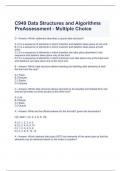
C949 Data Structures and Algorithms PreAssessment - Multiple Choice
D - Answer- Which statement describes a queue data structure? A.) It is a sequence of elements in which insertion and deletion takes place at one end. B.) It is a sequence of elements in which insertion and deletion takes place at both ends. C.) It is a sequence of elements in which insertion can take place anywhere in the sequence and deletion takes place only at the front. D.) It is a sequence of elements in which insertions can take place only at the back end and deletions can take place only at the front end. B - Answer- Which data structure allows inserting and deleting data elements at both the front and the rear? A.) Trees B.) Deques C.) Stacks D.) Queues C - Answer- Which data structure allows elements to be inserted and deleted from one end and provides no direct access to the other end? A.) List B.) Deque C.) Stack D.) Queue A - Answer- What are the official indexes for the list list01 given this declaration? int[ ] list01 = {0, 2, 4, 6, 8, 10}; A.) 0, 1, 2, 3, 4, 5 B.) 0, 2, 4, 6, 8, 10 C.) 1, 2, 3, 4, 5, 6 D.) 2, 4, 6, 8, 10, 12 A - Answer- Which abstract data type (ADT) has elements of the same type so that the elements can be retrieved based on the index or position? A.) List B.) Bag C.) Stack D.) Queue C - Answer- Which data structure allows insertion and removal from only one end of the data structure? A.) List B.) Queue C.) Stack D.) Deque C - Answer- Which data type does the mystery function return?return_type mystery (int R) { int NumUnits = R; return NumUnits * 3.14; } A.) Byte B.) String C.) Double D.) Boolean C - Answer- Which category of data does ("FB", 75.00, 75.03, 74.90) represent in the pseudocode? import datetime def middle(stock, date): symbol, current, high, low = stock return (((high + low) / 2), date) mid_value, date = middle(("FB", 75.00, 75.03, 74.90), (2014, 10, 31)) A.) List B.) Float C.) Tuple D.) Operator A - Answer- Which value is appropriate for Test1 given the expression? char Test1; A.) 'L' B.) 77 C.) 6.5 D.) "value" A - Answer- Which value is appropriate for the variable middle given the pseudocode? function mystery() { string last; string first; char middle; int phone; float rate; } A.) 'D' B.) 'Da' C.) "david" D.) "David" B - Answer- Which type of operation is represented in the pseudocode? int x,y,z; x=y=z=100; A.) Ternary B.) Assignment C.) Comparison D. Equality C - Answer- What is the most efficient data type to use for this data set of a fixed size in Java? a = [0, 0, 1, 4, 7, 16, 31, 64, 127] A.) List B.) Tuple C.) Array D.) Dictionary D - Answer- Which data type is appropriate for this array to store the given data? a = ["AF", "71", "BC", "157", "BA", "253"] A.) Byte B.) Char C.) Short D.) String A - Answer- Which data type is appropriate for the given data set? a = [1, 717, 23, 12, 314, 6] A.) Int B.) Byte C.) Char D.) Boolean B - Answer- Which data type should be used for this object? days = { "Sunday", "Monday", "Tuesday", "Wednesday", "Thursday", "Friday", "Saturday"} A.) Float B.) String C.) Integer D.) Boolean C - Answer- Which data type should be used for this variable? phoneNum = "" A.) Long B.) Short C.) String D.) Integer D - Answer- What is true about garbage collection? A.) It is often portrayed as the same as manual memory management. B.) It is no longer a primary concern since memory is very inexpensive. C.) It is scheduled to take place at regular time intervals to reclaim memory. D.) It reclaims memory from data structures implemented using linked allocations. B - Answer- What is true about a data structure implemented using linked allocation? A) Elements may not be added once the data structure is filled. B.) Storage is allocated using pointers to new locations as needed. C.) The amount of memory used is no greater than a sequential allocation version. D.) An empty structure uses more memory compared to a version using sequential allocation. B - Answer- What are the array elements corresponding to the mid-values in the first and second iterations of a binary search in an array arr = {45, 77, 89, 90, 94, 99, 100} and key = 100? A.) 89 and 94 B.) 90 and 99 C.) 94 and 99 D.) 90 and 100 B - Answer- What is the effect on the object Computing regarding garbage collection? Computing obj = new Computing(); obj = null; A.) It is partially available for garbage collection. B.) It is automatically available for garbage collection. C.) It is a Computing object that is already null, which does not require garbage collection. D.) It is a Computing constructor that has no parameters, and is not available for garbage collection. D - Answer- What are the mid-values in the first and second levels of recursion in this binary search? int arr = {46, 76, 89, 90, 94, 99, 100} and key = 99 A.) 89 and 94 B.) 89 and 99 C.) 90 and 94 D.) 90 and 99 D - Answer- Which data set is represented using the dictionary data type? A.) A set of book titles B.) A set of Celsius temperatures C.) A set of soda cans in a refrigerator D.) A set of students and their test scores B - Answer- What is a characteristic of keys in an associative dictionary data type? A.) They are unique and mutable. B.) They are unique and immutable. C.) They are non-unique and mutable. D.) They are non-unique and immutable. D - Answer- Which method can be used to take a value out of a dictionary? A.) D1[key].pop(value) B.) D1[key].pull(value) C.) D1[key].delete(value) D.) D1[key].remove(value) C - Answer- Given this data dictionary in Python: dict = {'white':0x0000, 'black':0x1111} Which command/function generates the output ['white','black']? A.) dict_keys() B.) keys_values() C.) () D.) s() C - Answer- The reference of the head of the doubly linked list is passed to the reverse() method: 1--2--3--4--5--6 What is the modified linked list when complete? A.) 2--1--4--3--6--5 B.) 5--4--3--2--1--6 C.) 6--5--4--3--2--1 D.) 6--5--4--3--1--2 B - Answer- Which data structure is indexed? A.) Heap B.) Array C.) Linked list D.) Directed graph
Escuela, estudio y materia
- Institución
- C949
- Grado
- C949
Información del documento
- Subido en
- 3 de junio de 2023
- Número de páginas
- 18
- Escrito en
- 2022/2023
- Tipo
- Examen
- Contiene
- Preguntas y respuestas
Temas
-
c949 data structures and algorithms preassessment
-
which statement describes a queue data structure
-
which data structure allows inserting and deleting
-
which data structure allows elements to be insert

Documento también disponible en un lote