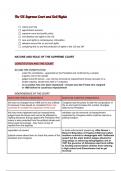
The US Supreme Court and Civil Rights
nature and role
appointment process
supreme court and public policy
civil liberties and rights in the US
race and rights in contemporary US politics
debates around the sc and civil rights
comparing the sc and the protection of rights in the US and UK
NATURE AND ROLE OF THE SUPREME COURT
CONSTITUTION AND THE COURT
SC AND THE CONSTITUTION
- under the constitution - appointed by the President and confirmed by a simple
majority vote in the senate
- judges have life tenure - can only be removed by impeachment (house accuses on a
simple majority, senate tries with a ⅔ majority)
- no sc justice has ever been impeached - closest was Abe Fortas who resigned
in 1968 before he could face impeachment
INDEPENDENCE OF THE COURT
factors that reinforce independence factors that undermine independence
this has not changed since 1869 and is now unlikely Congress has the power to alter the composition of
to because it has stayed so consistent Biden has the sc and could increase the number of judges
promised to consider the expansion of the court allied to the President
this has never happened and bar impeachment, members can be removed via impeachment
judges have life tenure and cannot be affected by conducted by Congress which could be used as a
making decisions that go against the President; their political weapon
salary is also protected from the political climate and
being used as leverage - they have no fear of
reprisal from the leg/exec
separation of powers sc lacks enforcement powers eg. After Brown v
Board of Education of Topeka (1954) that called
judicial review allows them to check the power of the southern schools to desegregate with 'deliberate
president and Congress speed' but the state district judges allowed for
long delays in enforcing desegregation and in
1957 the governor of Arkansas used local militia
to forcibly prevent black children from entering
a high school and Einsenhower had to get
involved
,The ABA is made up of professional lawyers as it is the independence and neutrality of the American
an interest group , not political actors - when judges Bar Association has come into question and
are nominated they rate their suitability and suggests that female and minority judicial nominees
understanding of the law/constitution- their ratings are more likely to receive lower ratings than white
are 'well qualified', 'qualified' and 'not qualified', males
nothing political
since they are there for life, they often change their nominated by the president, confirmed by the
mindset once into the role senate - elected politicians are at the heart of
choosing the composition of the court
JUDICIAL REVIEW
- Marbury v Madison (1803) - founded the power of judicial review for itself
- Fletcher v Peck (1810) - first time the sc declared a state law unconstitutional
- the sc can update the meaning of the words of the constitution through this power eg.
whether or not 'freedom of speech' applies to the internet
- the court does involve itself in politics - it declared in Trump v Hawaii (2018) that
Trump's executive order was constitutional
THE APPOINTMENT PROCESS
a vacancy is created
- voluntary retirement, impeachment, death
- many wait until a favourable president comes in so they are replaced with someone
similar to them
getting it right
- often literally and politically outlive the president that appointed them
- rehnquist served for nearly 33 years (19 as chief justice)
- In a four year term, Trump appointed 3 justices
recruitment
- US courts of appeal, state courts, the exec/congress, state governors, academia
- factors affecting this choice:
- judicial ability
- ideology
- social characteristics (for diversity - in 2017 there were 3 women and there
have only ever been 4)
- political motivations (may prioritise this over ideology if they have a hostile
senate)
nomination
- shortlist
- presidential interview and senate interview
- public announcement
- rating by the ABA Standing Committee on the Federal Judiciary
, confirmation
- candidate appears before the Senate Judiciary Committee
- hearings held
- committee votes but senate does not have to follow that
- simple majority required in the senate
- Clarence Thomas was confirmed on a 52-48 vote despite his 1991 confirmation
hearings being dominated by accusations of sexual harassment made by Anita
Hill (one of his former aides)
strengths of the confirmation process weaknesses of the confirmation process
each nominee receives detailed background process is over-politicised - judges are appointed by
scrutiny by the White House, the FBI, the partisan people who consider the judges political leanings
Senate Judiciary Committee and the media - over their legal expertise - this also makes it hard for the sc
any controversial actions or transgressions to be impartial when there is a stark liberal/conservative
of the past will be revealed eg. the full divide
Senate vote on Brett Kavanaugh was - reps tend to pick originalists acting on judicial
delayed until an FBI investigation had restraint and dems tend to pick liberal justices who
reported on sexual allegations against act on judicial activism
him in additional to his initial FBI - with Brett Kavanaugh the vote was 50-48 where
background check - he was clear only one dep and one rep broke party line
Senate confirmation provides an important senate judiciary committee is equally as politicised -
check on the power of the president - the ineffective scrutiny - the opposition tends to ask aggressive
president has to choose someone who will and personal questions whilst the president's party barely
get sufficient support in the Senate eg. the scrutinises at all
rejection of Robert Bork - Clarence Thomas was questioned more on his
conservative philosophy and sexual assault
many nominees 'disappoint' their nominating allegations than he was on his lacklustre
president and do not end up holding the qualifications
same political outlook showing that they are
independent of their political patrons - now professional interest groups are still affected by politics and
there is an extensive 'paper trail' of past although the ABA has issued 'well qualified' ratings to
writings, speeches and legal judgements to liberals and conservatives, other legal groups are more
minimise this overtly partisan like the Federalist Society
ABA, specialist and professionals, provide can become a media circus - highly partisan media, interest
legislators with additional, expertise groups pouring millions of dollars into ads and lobbying the
information to help with their judgement senate → deepens the political divide eg. Demand justice
spent over 1.1 million on tv ads opposing Kavanaugh
KEY APPOINTMENTS SINCE 2005
1. SAMUEL ALITO - 2006
- VERY conservative
- appointed by GW Bush
- replaced Sandra Day O'Connor appointed by Reagan
- frequently sided with the cons block but later on became the swing vote in
many cases
- moved the swing more to the conservative side → court moving right
nature and role
appointment process
supreme court and public policy
civil liberties and rights in the US
race and rights in contemporary US politics
debates around the sc and civil rights
comparing the sc and the protection of rights in the US and UK
NATURE AND ROLE OF THE SUPREME COURT
CONSTITUTION AND THE COURT
SC AND THE CONSTITUTION
- under the constitution - appointed by the President and confirmed by a simple
majority vote in the senate
- judges have life tenure - can only be removed by impeachment (house accuses on a
simple majority, senate tries with a ⅔ majority)
- no sc justice has ever been impeached - closest was Abe Fortas who resigned
in 1968 before he could face impeachment
INDEPENDENCE OF THE COURT
factors that reinforce independence factors that undermine independence
this has not changed since 1869 and is now unlikely Congress has the power to alter the composition of
to because it has stayed so consistent Biden has the sc and could increase the number of judges
promised to consider the expansion of the court allied to the President
this has never happened and bar impeachment, members can be removed via impeachment
judges have life tenure and cannot be affected by conducted by Congress which could be used as a
making decisions that go against the President; their political weapon
salary is also protected from the political climate and
being used as leverage - they have no fear of
reprisal from the leg/exec
separation of powers sc lacks enforcement powers eg. After Brown v
Board of Education of Topeka (1954) that called
judicial review allows them to check the power of the southern schools to desegregate with 'deliberate
president and Congress speed' but the state district judges allowed for
long delays in enforcing desegregation and in
1957 the governor of Arkansas used local militia
to forcibly prevent black children from entering
a high school and Einsenhower had to get
involved
,The ABA is made up of professional lawyers as it is the independence and neutrality of the American
an interest group , not political actors - when judges Bar Association has come into question and
are nominated they rate their suitability and suggests that female and minority judicial nominees
understanding of the law/constitution- their ratings are more likely to receive lower ratings than white
are 'well qualified', 'qualified' and 'not qualified', males
nothing political
since they are there for life, they often change their nominated by the president, confirmed by the
mindset once into the role senate - elected politicians are at the heart of
choosing the composition of the court
JUDICIAL REVIEW
- Marbury v Madison (1803) - founded the power of judicial review for itself
- Fletcher v Peck (1810) - first time the sc declared a state law unconstitutional
- the sc can update the meaning of the words of the constitution through this power eg.
whether or not 'freedom of speech' applies to the internet
- the court does involve itself in politics - it declared in Trump v Hawaii (2018) that
Trump's executive order was constitutional
THE APPOINTMENT PROCESS
a vacancy is created
- voluntary retirement, impeachment, death
- many wait until a favourable president comes in so they are replaced with someone
similar to them
getting it right
- often literally and politically outlive the president that appointed them
- rehnquist served for nearly 33 years (19 as chief justice)
- In a four year term, Trump appointed 3 justices
recruitment
- US courts of appeal, state courts, the exec/congress, state governors, academia
- factors affecting this choice:
- judicial ability
- ideology
- social characteristics (for diversity - in 2017 there were 3 women and there
have only ever been 4)
- political motivations (may prioritise this over ideology if they have a hostile
senate)
nomination
- shortlist
- presidential interview and senate interview
- public announcement
- rating by the ABA Standing Committee on the Federal Judiciary
, confirmation
- candidate appears before the Senate Judiciary Committee
- hearings held
- committee votes but senate does not have to follow that
- simple majority required in the senate
- Clarence Thomas was confirmed on a 52-48 vote despite his 1991 confirmation
hearings being dominated by accusations of sexual harassment made by Anita
Hill (one of his former aides)
strengths of the confirmation process weaknesses of the confirmation process
each nominee receives detailed background process is over-politicised - judges are appointed by
scrutiny by the White House, the FBI, the partisan people who consider the judges political leanings
Senate Judiciary Committee and the media - over their legal expertise - this also makes it hard for the sc
any controversial actions or transgressions to be impartial when there is a stark liberal/conservative
of the past will be revealed eg. the full divide
Senate vote on Brett Kavanaugh was - reps tend to pick originalists acting on judicial
delayed until an FBI investigation had restraint and dems tend to pick liberal justices who
reported on sexual allegations against act on judicial activism
him in additional to his initial FBI - with Brett Kavanaugh the vote was 50-48 where
background check - he was clear only one dep and one rep broke party line
Senate confirmation provides an important senate judiciary committee is equally as politicised -
check on the power of the president - the ineffective scrutiny - the opposition tends to ask aggressive
president has to choose someone who will and personal questions whilst the president's party barely
get sufficient support in the Senate eg. the scrutinises at all
rejection of Robert Bork - Clarence Thomas was questioned more on his
conservative philosophy and sexual assault
many nominees 'disappoint' their nominating allegations than he was on his lacklustre
president and do not end up holding the qualifications
same political outlook showing that they are
independent of their political patrons - now professional interest groups are still affected by politics and
there is an extensive 'paper trail' of past although the ABA has issued 'well qualified' ratings to
writings, speeches and legal judgements to liberals and conservatives, other legal groups are more
minimise this overtly partisan like the Federalist Society
ABA, specialist and professionals, provide can become a media circus - highly partisan media, interest
legislators with additional, expertise groups pouring millions of dollars into ads and lobbying the
information to help with their judgement senate → deepens the political divide eg. Demand justice
spent over 1.1 million on tv ads opposing Kavanaugh
KEY APPOINTMENTS SINCE 2005
1. SAMUEL ALITO - 2006
- VERY conservative
- appointed by GW Bush
- replaced Sandra Day O'Connor appointed by Reagan
- frequently sided with the cons block but later on became the swing vote in
many cases
- moved the swing more to the conservative side → court moving right