Respiratory (84D
·
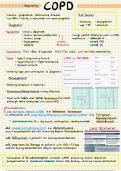
Chronic, progressive, obstructive disease. Risk Factors:
is associated with
Low BM1/ frailty prognosis.
·
worse
-smoking occupation
-
Diagnosis: age>35-pollution
-
Symptoms: chronic dyspnoea
·
-
sputum production -↑ lungs cannot
empty well in COPD,
·
-
chronic as
to: reduced
cough
chronic
leading IC
- -
-
Emphysema chronic -raised FRC
-
wheeze Bronchitis -
raised RC
Spirometry:FEV1-80% expected, FEV1/FVC -0.7, with / little reversibility.
·
of no
Tests: Type respiratory failure
2 CO9D ASTHMA
·
vs
-
Hyperinflation/ Hyperresonance
-
sputum culture
-
smoking/age to
also contributes
diagnosis.
·
Management:
smoking cessation is essential.
·
Rehabilitation is
Pulmonary very effective.
·
·
Start with SABAS and SAMAs (Ipratopium) for relief,
although these rarely help with worse COPD.
Bronchodilators
↑
↑ Long-Acting B2-Agonist (LABA): e.g. Salmeterol, Formeterol.
in combination with
long-Acting Muscarinic Antagonist (LAMA): e.g. Tiotropium,
Glycopyrrogium,
antimuscarinic SES:dry mouth, constipation, renally excreted. Umeclidinium.
add Inhaled Corticosteroid (ICS):e.g. Becomethasone CORD TREATMENT
only if exacerbations are still
occurring despite Bronchodilators.
add Roflumilast in patients still having exacerbations.
add long-term 02 Therapy on patients with 90027.3 kpa
and still having exacerbations despite optimal treatment.
stimulation of BC-adrenoceptors increases came, promoting muscle relaxation.
-
ofmuscarinic blocks Ach binding, muscle contraction.
antagonisation receptors inhibiting
-
·
Chronic, progressive, obstructive disease. Risk Factors:
is associated with
Low BM1/ frailty prognosis.
·
worse
-smoking occupation
-
Diagnosis: age>35-pollution
-
Symptoms: chronic dyspnoea
·
-
sputum production -↑ lungs cannot
empty well in COPD,
·
-
chronic as
to: reduced
cough
chronic
leading IC
- -
-
Emphysema chronic -raised FRC
-
wheeze Bronchitis -
raised RC
Spirometry:FEV1-80% expected, FEV1/FVC -0.7, with / little reversibility.
·
of no
Tests: Type respiratory failure
2 CO9D ASTHMA
·
vs
-
Hyperinflation/ Hyperresonance
-
sputum culture
-
smoking/age to
also contributes
diagnosis.
·
Management:
smoking cessation is essential.
·
Rehabilitation is
Pulmonary very effective.
·
·
Start with SABAS and SAMAs (Ipratopium) for relief,
although these rarely help with worse COPD.
Bronchodilators
↑
↑ Long-Acting B2-Agonist (LABA): e.g. Salmeterol, Formeterol.
in combination with
long-Acting Muscarinic Antagonist (LAMA): e.g. Tiotropium,
Glycopyrrogium,
antimuscarinic SES:dry mouth, constipation, renally excreted. Umeclidinium.
add Inhaled Corticosteroid (ICS):e.g. Becomethasone CORD TREATMENT
only if exacerbations are still
occurring despite Bronchodilators.
add Roflumilast in patients still having exacerbations.
add long-term 02 Therapy on patients with 90027.3 kpa
and still having exacerbations despite optimal treatment.
stimulation of BC-adrenoceptors increases came, promoting muscle relaxation.
-
ofmuscarinic blocks Ach binding, muscle contraction.
antagonisation receptors inhibiting
-