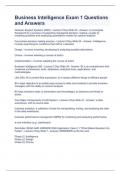
Business Intelligence Exam 1 Questions and Answers
Decision Support Systems (DSS) - Lecture 2 Day Slide 20 - Answer- A conceptual framework for a process of supporting managerial decision- making, usually by modeling problems and employing quantitative models for solution analysis Four-phase decision making process - Lecture 2 Day Slide 24 - Answer- Intelligence - involves searching for conditions that call for a decision Design - involves inventing, developing & analyzing possible alternatives Choice - involves selecting a course of action Implementation - involves adapting the course of action Business Intelligence (BI) - Lecture 2 Day Slide 38 - Answer- BI is an umbrella term that combines architectures, tools, databases, analytical tools, applications, and methodologies Like DSS, BI a content-free expression, so it means different things to different people BI's major objective is to enable easy access to data (and models) to provide business managers with the ability to conduct analysis BI helps transform data, to information (and knowledge), to decisions and finally to action Four Major Components of a BI System - Lecture 2 Day Slide 41 - Answer- a data warehouse, with its source data business analytics, a collection of tools for manipulating, mining, and analyzing the data in the data warehouse; business performance management (BPM) for monitoring and analyzing performance a user interface (e.g., dashboard) Reminder: READ AND UNDERSTAND Application Case 2.1 "What Makes Elevators Go Faster" - Lecture 3 Day Slide 7 - Answer- REMINDER so flip the card Phase (1) Intelligence Phase (2) Design Phase (3) Choice Phase (4) Implementation Lecture 3 Day Slide 13 - Answer- Think of the four phases of the decision making process. However, this time, rank the phases according to the phases they belong. Iconic models (scale models) Analog models Mental Models Mathematical (quantitative) models - Answer- Think of the types of models, and list them from "Less" to "More" or lowest to highest degree of abstraction DSS Characteristics and Capabilities - Answer- Business analytics implies the use of models and data to improve an organization's performance and/or competitive posture Web analytics implies using business analytics on real-time Web information to assist in decision making; often related to e-Commerce Predictive analytics describes the business analytics method of forecasting problems and opportunities rather than simply reporting them as they occur Reminder to go to "Lecture 9 Day" and study Slide 13. - Answer- Study Reminder. General Process of Intelligence Creation and Use - Answer- For each BI project, it is important to use return on investment (ROI) & total cost of ownership (TCO) measures to estimate the cost-benefit ratio. Analysis isn't possible, accurate or reliable unless other steps are taken including the 5 W's: who, what, where, when & why. Successful Business Intelligence Implementation - Answer- The fundamental reasons for investing in BI must be aligned with the company's business strategy & cannot be a technical exercise for the I/T dept BI must serve as a way to change the manner the company conducts business by improving its business processes and transforming decision-making processes to be more data driven Why Data Mining? - Answer- -More intense competition at the global scale -Recognition of the value in data sources -Availability of quality data on customers, vendors, transactions, Web, etc. -Consolidation and integration of data repositories into data warehouses -The exponential increase in data processing and storage capabilities; and decrease in cost -Movement toward conversion of information resources into nonphysical form
Escuela, estudio y materia
- Institución
- Business Intelligence
- Grado
- Business Intelligence
Información del documento
- Subido en
- 30 de mayo de 2023
- Número de páginas
- 3
- Escrito en
- 2022/2023
- Tipo
- Examen
- Contiene
- Preguntas y respuestas
Temas
-
business intelligence exam 1 questions and answers
-
decision support systems dss lecture 2 day slide 20
-
four phase decision making process lecture 2 day slide 24
-
business intelligence bi lect

Documento también disponible en un lote