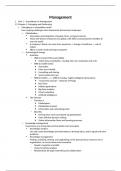
Management
1. Part 1 – Foundations of Management
1.1. Chapter 1: Managing and Performing
I. Managing in a competitive world
Four ongoing challenges that characterize the business landscape:
o Globalization
Interaction and integration of people, firms, and governments
Many well-known enterprises are global, with offices and production facilities all
over the world
A company's talent can come from anywhere -> change of workforce -> role of
expats
Effect on both small and large companies
o Technological change
Evolution
▫ WEB 1.0 (mid-1990s-early 2000s)
♦ Online data consultation, 'reading' dot.com companies and crisis
▫ WEB 2.0 (2005-2015)
♦ Interactive
♦ More user friendly
♦ Consulting and sharing
♦ Social media start-ups
▫ WEB 3.0 (2015-…) -> WEB 4.0 (today, highly intelligent interactions)
♦ "read-write-execute" ->Internet of Things
♦ Real Time
♦ Mobile applications
♦ Big Data analytics
♦ Cloud computing
♦ Artificial intelligence
The internet
▫ Provides a:
♦ Marketplace
♦ Distribution channel
♦ Information and networking point
▫ Benefits:
♦ Driving down costs and speeds up globalization
♦ More efficient decision making
♦ Online information flows and learning processes
o Knowledge management
Importance of a strong idea and translation into innovation
Knowledge workers:
Use and create knowledge and information to develop ideas, and to signal and solve
problems
Knowledge management:
Finding, unlocking, sharing, and capitalizing on the post precious resources of an
organization, to convert ideas into innovation
▫ People's expertise and skills
▫ Vision/creativity/wisdom
▫ Relationships through networking and collaboration
, o Collaboration across boundaries
Effective collaboration requires good communication between departments,
divisions, and other units of the organization
▫ Example: T-shaped manager
Shares knowledge (horizontal) and remains committed as a specialist to
business unit (vertical) -> broad and deep perspective -> knowledge across and
within domains
Companies may capitalize on the ideas of people outside the organization
(consultants, freelancers, advertising agencies, suppliers, and client)
II. Managing for competitive advantage
o Staying ahead of the competition by doing better than your competitors at doing
valuable things
= delivering long-term performance
o Success drivers of performance
Performance indicators: energy usage, employee turnover
The best managers and companies deliver on multiple performance dimensions
▫ Innovation
♦ The introduction of new technologies, processes, goods or services
♦ A firm must:
◊ Adapt to changes in consumer demands and to new competitors
◊ Be ready with new ways to communicate with customers and deliver
the products to them
◊ Innovate or die, products don't sell forever
▫ Quality
Is a function of characteristics of goods or services that aims for excellence
♦ From
◊ Emphasis on attractiveness
◊ Minimal defects
◊ Long-term reliability
♦ To
◊ Preventing defects before they occur = long-term quality
◊ Goal: zero defects in manufacturing
◊ Emphasis on quality already in design-phase = Total Quality
Management
◊ Continuous improvement
▫ Service
♦ Giving customers what they want or need, when they want it
♦ Continually meeting the needs of customers to establish mutually
beneficial long-term relationships
♦ Making it easy and enjoyable for customers to experience or to buy and
use products
▫ Speed
♦ Fast and timely execution, response, and delivery of results
▫ Cost competitiveness
♦ Keeping costs low
♦ Relevance?
To achieve profit maximization and offer attractive prices to consumers
♦ But not without sustainability
▫ Sustainability
, ♦ Minimize the use of polluting, non-renewable and nonrecyclable
resources
♦ Improve social conditions
♦ Focus on the long term
III. The four functions of management
o Management entails:
Working with people and other resources to achieve organizational goals efficiently and
effectively
Effectiveness
Realizing the goals
Efficiency
Realizing goals with minimal use or waste of resources = make the best use of
money, time, materials, and people
o The four functions:
Planning: delivering strategic value
▫ Formulating goals
▫ Developing strategies to achieve the goals
▫ Delivering strategic value
▫ The better you meet your goals, the higher the value will be
Organizing: building a dynamic organization
▫ Assembling and coordinating human, financial, physical, informational, and
other resources, needed to achieve the goals
▫ Hiring of people, job descriptions, specifying responsibilities, allocation
resources
Leading: mobilizing people
▫ Stimulating/motivating people te be good/high performers
▫ Communicating and connecting with people
▫ In and across teams, departments, divisions
▫ Solving problems
Controlling: learning and changing
▫ Monitoring performance
▫ Everything according to plan?
▫ Making necessary changes
▫ Feedback: continually learning and changing, so goals can be achieved
o Performing all four management functions
A typical day for a manager is not neatly divided into the four functions
Days are fractionated and spent dealing with interruptions, meetings, and
troubleshooting
Good managers devote adequate attention and resources to all four management
functions
IV. Management levels and skills
o Management levels
Top-level Managers (strategic)
▫ Senior level, Top Management team (TMT)
▫ General management (CEO, CF0, C00, CIO)
Middle-level Managers (tactical)
▫ Translating corporate goals into business unit targets
▫ Daily operations entrepreneurial and innovative ideas
Frontline Managers (operational)
▫ Supervising production
, ▫ Liaising managers and non-management employees
o Managerial roles
Decision roles
▫ Entrepreneur
▫ Disturbance handler
▫ Resource allocator
▫ Negotiator
Informational roles
▫ Monitor
▫ Disseminator
▫ Spokesperson
Interpersonal roles
▫ Leader
▫ Liaison
▫ Figurehead
o Must-have management skills
Technical
▫ Ability to perform a specialized task involving a particular method or process
Interpersonal and communication
▫ People skills
▫ Ability to lead, motivate, and communicate
▫ Building social capital
▫ Emotional intelligence
Conceptual and decision
▫ Ability to identify and resolve problems
o Top 10 skills of 2025
Analytical thinking and innovation
Active learning and learning strategies
Complex problem-solving
Critical thinking and analysis
Creativity, originality, and initiative
Leadership and social influence
Technology use, monitoring, and control
Technology design and programming
Resilience, stress tolerance, and flexibility
Reasoning, problem-solving, and ideation
V. You and your career: two relationships
o You as a passive employee
Employer
You
o You as an active contributor in a productive relationship
You Your organization
Actively managing your relationship with your organization
Understanding and managing yourself
Empathizing with others
1.2. Chapter 2: The external and internal environment
I. Open systems
o Organizations affect the business environment
o Organizations get affected by the business environment
1. Part 1 – Foundations of Management
1.1. Chapter 1: Managing and Performing
I. Managing in a competitive world
Four ongoing challenges that characterize the business landscape:
o Globalization
Interaction and integration of people, firms, and governments
Many well-known enterprises are global, with offices and production facilities all
over the world
A company's talent can come from anywhere -> change of workforce -> role of
expats
Effect on both small and large companies
o Technological change
Evolution
▫ WEB 1.0 (mid-1990s-early 2000s)
♦ Online data consultation, 'reading' dot.com companies and crisis
▫ WEB 2.0 (2005-2015)
♦ Interactive
♦ More user friendly
♦ Consulting and sharing
♦ Social media start-ups
▫ WEB 3.0 (2015-…) -> WEB 4.0 (today, highly intelligent interactions)
♦ "read-write-execute" ->Internet of Things
♦ Real Time
♦ Mobile applications
♦ Big Data analytics
♦ Cloud computing
♦ Artificial intelligence
The internet
▫ Provides a:
♦ Marketplace
♦ Distribution channel
♦ Information and networking point
▫ Benefits:
♦ Driving down costs and speeds up globalization
♦ More efficient decision making
♦ Online information flows and learning processes
o Knowledge management
Importance of a strong idea and translation into innovation
Knowledge workers:
Use and create knowledge and information to develop ideas, and to signal and solve
problems
Knowledge management:
Finding, unlocking, sharing, and capitalizing on the post precious resources of an
organization, to convert ideas into innovation
▫ People's expertise and skills
▫ Vision/creativity/wisdom
▫ Relationships through networking and collaboration
, o Collaboration across boundaries
Effective collaboration requires good communication between departments,
divisions, and other units of the organization
▫ Example: T-shaped manager
Shares knowledge (horizontal) and remains committed as a specialist to
business unit (vertical) -> broad and deep perspective -> knowledge across and
within domains
Companies may capitalize on the ideas of people outside the organization
(consultants, freelancers, advertising agencies, suppliers, and client)
II. Managing for competitive advantage
o Staying ahead of the competition by doing better than your competitors at doing
valuable things
= delivering long-term performance
o Success drivers of performance
Performance indicators: energy usage, employee turnover
The best managers and companies deliver on multiple performance dimensions
▫ Innovation
♦ The introduction of new technologies, processes, goods or services
♦ A firm must:
◊ Adapt to changes in consumer demands and to new competitors
◊ Be ready with new ways to communicate with customers and deliver
the products to them
◊ Innovate or die, products don't sell forever
▫ Quality
Is a function of characteristics of goods or services that aims for excellence
♦ From
◊ Emphasis on attractiveness
◊ Minimal defects
◊ Long-term reliability
♦ To
◊ Preventing defects before they occur = long-term quality
◊ Goal: zero defects in manufacturing
◊ Emphasis on quality already in design-phase = Total Quality
Management
◊ Continuous improvement
▫ Service
♦ Giving customers what they want or need, when they want it
♦ Continually meeting the needs of customers to establish mutually
beneficial long-term relationships
♦ Making it easy and enjoyable for customers to experience or to buy and
use products
▫ Speed
♦ Fast and timely execution, response, and delivery of results
▫ Cost competitiveness
♦ Keeping costs low
♦ Relevance?
To achieve profit maximization and offer attractive prices to consumers
♦ But not without sustainability
▫ Sustainability
, ♦ Minimize the use of polluting, non-renewable and nonrecyclable
resources
♦ Improve social conditions
♦ Focus on the long term
III. The four functions of management
o Management entails:
Working with people and other resources to achieve organizational goals efficiently and
effectively
Effectiveness
Realizing the goals
Efficiency
Realizing goals with minimal use or waste of resources = make the best use of
money, time, materials, and people
o The four functions:
Planning: delivering strategic value
▫ Formulating goals
▫ Developing strategies to achieve the goals
▫ Delivering strategic value
▫ The better you meet your goals, the higher the value will be
Organizing: building a dynamic organization
▫ Assembling and coordinating human, financial, physical, informational, and
other resources, needed to achieve the goals
▫ Hiring of people, job descriptions, specifying responsibilities, allocation
resources
Leading: mobilizing people
▫ Stimulating/motivating people te be good/high performers
▫ Communicating and connecting with people
▫ In and across teams, departments, divisions
▫ Solving problems
Controlling: learning and changing
▫ Monitoring performance
▫ Everything according to plan?
▫ Making necessary changes
▫ Feedback: continually learning and changing, so goals can be achieved
o Performing all four management functions
A typical day for a manager is not neatly divided into the four functions
Days are fractionated and spent dealing with interruptions, meetings, and
troubleshooting
Good managers devote adequate attention and resources to all four management
functions
IV. Management levels and skills
o Management levels
Top-level Managers (strategic)
▫ Senior level, Top Management team (TMT)
▫ General management (CEO, CF0, C00, CIO)
Middle-level Managers (tactical)
▫ Translating corporate goals into business unit targets
▫ Daily operations entrepreneurial and innovative ideas
Frontline Managers (operational)
▫ Supervising production
, ▫ Liaising managers and non-management employees
o Managerial roles
Decision roles
▫ Entrepreneur
▫ Disturbance handler
▫ Resource allocator
▫ Negotiator
Informational roles
▫ Monitor
▫ Disseminator
▫ Spokesperson
Interpersonal roles
▫ Leader
▫ Liaison
▫ Figurehead
o Must-have management skills
Technical
▫ Ability to perform a specialized task involving a particular method or process
Interpersonal and communication
▫ People skills
▫ Ability to lead, motivate, and communicate
▫ Building social capital
▫ Emotional intelligence
Conceptual and decision
▫ Ability to identify and resolve problems
o Top 10 skills of 2025
Analytical thinking and innovation
Active learning and learning strategies
Complex problem-solving
Critical thinking and analysis
Creativity, originality, and initiative
Leadership and social influence
Technology use, monitoring, and control
Technology design and programming
Resilience, stress tolerance, and flexibility
Reasoning, problem-solving, and ideation
V. You and your career: two relationships
o You as a passive employee
Employer
You
o You as an active contributor in a productive relationship
You Your organization
Actively managing your relationship with your organization
Understanding and managing yourself
Empathizing with others
1.2. Chapter 2: The external and internal environment
I. Open systems
o Organizations affect the business environment
o Organizations get affected by the business environment