(E-Commerce 2023 Business, Technology, and Society, 17e Kenneth Laudon, Carolc Traver)
(Solution Manual all Chapters) 2
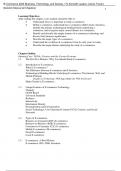
Learning Objectives
After reading this chapter, your students should be able to:
• Understand why it is important to study e-commerce.
• Define e-commerce, understand how e-commerce differs from e-business,
identify the primary technological building blocks underlying e-
commerce, and recognize major current themes in e-commerce.
• Identify and describe the unique features of e-commerce technology and
discuss their business significance.
• Describe the major types of e-commerce.
• Understand the evolution of e-commerce from its early years to today.
• Describe the major themes underlying the study of e-commerce.
Chapter Outline
Opening Case: TikTok: Creators and the Creator Economy
1.1 The First Five Minutes: Why You Should Study E-commerce
1.2 Introduction to E-commerce
What Is E-commerce?
The Difference between E-commerce and E-business
Technological Building Blocks Underlying E-commerce: The Internet, Web, and
Mobile Platform
Insight on Technology: Will Apps Make the Web Irrelevant?
Major Trends in E-commerce
1.3 Unique Features of E-commerce Technology
Ubiquity
Global Reach
Universal Standards
Richness
Interactivity
Information Density
Personalization and Customization
Social Technology: User-Generated Content (UCG), Creators, and Social
Networks
1.4 Types of E-commerce
Business-to-Consumer (B2C) E-commerce
Business-to-Business (B2B) E-commerce
Consumer-to-Consumer (C2C) E-commerce
Mobile E-commerce (M-commerce)
Social E-commerce
Local E-commerce
1.5 E-commerce: A Brief History
E-commerce 1995–2000: Invention
Copyright © 2024 Pearson Education, Inc.
, 3
E-commerce 2001–2006: Consolidation
E-commerce 2007–Present: Reinvention
Insight on Business: Y Combinator’s Startup Boot Camp
Assessing E-commerce: Successes, Surprises, and Failures
1.6 Understanding E-commerce: Organizing Themes
Technology: Infrastructure
Business: Basic Concepts
Society: Taming the Juggernaut
Insight on Society: Facebook and the Age of Privacy
1.7 Careers in E-commerce
The Company
Position: Category Specialist in the E-commerce Retail Program
Qualifications/Skills
Preparing for the Interview
Possible First Interview Questions
1.8 Case Study: Uber: Everything on Demand
1.9 Review
Key Concepts
Questions
Projects
References
List of Key Terms
business-to-business (B2B) e-commerce, p. 22
business-to-consumer (B2C) e-commerce, p. 21
consumer-to-consumer (C2C) e-commerce, p. 24
customization, p. 19
disintermediation, p. 29
e-business, p. 8
e-commerce, p. 8
first mover, p. 29
friction-free commerce, p. 29
information asymmetry, p. 16
information density, p. 19
interactivity, p. 18
Internet, p. 9
local e-commerce, p. 25
marketplace, p. 17
marketspace, p. 17
mobile e-commerce (m-commerce), p. 24
mobile platform, p. 11
network effect, p. 29
Copyright © 2024 Pearson Education, Inc.
, 4
personalization, p. 19
reach, p. 17
richness, p. 18
social e-commerce, p. 24
ubiquity, p. 17
universal standards, p. 18
Web 2.0, p. 31
World Wide Web (the Web), p.10
List of Figures
Figure 1.1 The Difference between E-commerce and E-business, p. 9
Figure 1.2 The Deep Web, p. 10
Figure 1.3 Internet Access in the United States, 2022, p. 11
Figure 1.4 Eight Unique Features of E-commerce Technology, p. 16
Figure 1.5 The Growth of B2C E-commerce in the United States, p. 22
Figure 1.6 Room to Grow, p. 23
Figure 1.7 The Growth of B2B E-commerce in the United States, p. 23
Figure 1.8 The Growth of M-commerce in the United States, p. 25
Figure 1.9 The Relative Size of Different Types of E-commerce in 2022, p. 26
Figure 1.10 Periods in the Development of E-commerce, p. 28 (Figure video in eText)
List of Tables
Table 1.1 Major Trends in E-commerce 2022–2023, p. 15
Table 1.2 Business Significance of the Eight Unique Features of E-commerce
Technology, p. 21
Table 1.3 Major Types of E-commerce, p. 26
Table 1.4 Evolution of E-commerce, p. 34
List of Video Cases in eText
Video Case 1.1: Shopify and the Future of E-commerce
Video Case 1.2: YouTube and the Creator Economy
Overview
One of the biggest challenges that instructors face in teaching a course on e-commerce is
helping students make sense of a very complex phenomenon that involves considerations
of markets, firms, consumer behavior, technology, and social and legal impacts, among
others. As the text’s subtitle (“business. technology. society) suggests, we believe it is
useful to think about e-commerce as involving these three broad, interrelated themes, and
that doing so provides students with a strong and coherent conceptual framework for
understanding e-commerce. Within each chapter, there are three “Insight on” cases
(Insight on Business, Insight on Technology, and Insight on Society), designed to
highlight the connection between the chapter’s content and these themes. Each chapter
begins with an opening case, focusing on a company or issue that students will hopefully
find relevant and interesting, that introduces the topic of the chapter. Each chapter
concludes with a more extensive end-of-chapter cases that ties together the themes and
topics included in the chapter. Class discussion questions for each "Insight on” case and
Copyright © 2024 Pearson Education, Inc.
, 5
the opening case are included in the Teaching Suggestions: Key Points section of this
Instructor’s Manual as well as in the PowerPoint files for the chapter.
E-commerce is continually evolving and has become a thriving
marketplace not only for products but also for services and content, such
as social networks, user-generated content (video, photos, and blogs), and,
of course, entertainment such as movies, TV, video, music, and games.
Today’s e-commerce is predominantly social, mobile, and increasingly,
local. We weave these topics throughout the text into all chapters, because
they are increasingly impacting all aspects of e-commerce. We also
discuss the impact of the Covid-19 pandemic on e-commerce throughout
the text.
Teaching Suggestions: Key Points
The opening case, TikTok: Creators and the Creator Economy (new for this edition)
highlights user-generated content, creators, and the creator economy, with a specific
focus on TikTok, which has become one of the fastest-growing and most popular social
networks. As you discuss the case with your students, you can also pose the following
questions:
• Why is TikTok so popular?
• Do you use TikTok? If so, in what manner—do you just view content or also post
content?
• Do you consider yourself a creator? Have you ever received payments for content
you have created?
• What are some of the negative consequences associated with being a creator?
Section 1.1 addresses an important student concern: why they should study e-commerce.
E-commerce remains the fastest growing retail, service, and entertainment channel. E-
commerce revenues have been growing at double-digit rates since 2010, outpacing
traditional retail by a factor of two or three, and are expected to continue growing at more
than 10% per year through 2026. Even with recent economic conditions that have led to a
slowing of hiring in the tech sector, there continue to be thousands of job opportunities
that require skills in e-commerce. As noted in the text, eventually all commerce will be
“e-commerce”. You should let students know that while e-commerce has now been
around for about 25 years, the e-commerce revolution is still, relatively speaking, in the
beginning phase. The very early tumultuous years are over, but there are many powerful,
commercial, and technological forces that will push e-commerce along in the next
decades. To emphasize this, you can highlight the bullet points noted in Table 1.1. Video
Case 1.1, Shopify and the Future of E-commerce, appears at the top of page 14 of the
eText, in the “Major Trends in E-commerce” section. See pages 18 to 20 of this
Instructor’s Manual for more information about this Video Case, as well as questions that
you can use for class discussion or as a student assignment.
Much of the first chapter is aimed at getting some basic definitions straight. The e-
commerce field is filled with language that some students might find confusing. In
Section 1.2, we distinguish between e-commerce and e-business to set the focus clearly
Copyright © 2024 Pearson Education, Inc.
(Solution Manual all Chapters) 2
Learning Objectives
After reading this chapter, your students should be able to:
• Understand why it is important to study e-commerce.
• Define e-commerce, understand how e-commerce differs from e-business,
identify the primary technological building blocks underlying e-
commerce, and recognize major current themes in e-commerce.
• Identify and describe the unique features of e-commerce technology and
discuss their business significance.
• Describe the major types of e-commerce.
• Understand the evolution of e-commerce from its early years to today.
• Describe the major themes underlying the study of e-commerce.
Chapter Outline
Opening Case: TikTok: Creators and the Creator Economy
1.1 The First Five Minutes: Why You Should Study E-commerce
1.2 Introduction to E-commerce
What Is E-commerce?
The Difference between E-commerce and E-business
Technological Building Blocks Underlying E-commerce: The Internet, Web, and
Mobile Platform
Insight on Technology: Will Apps Make the Web Irrelevant?
Major Trends in E-commerce
1.3 Unique Features of E-commerce Technology
Ubiquity
Global Reach
Universal Standards
Richness
Interactivity
Information Density
Personalization and Customization
Social Technology: User-Generated Content (UCG), Creators, and Social
Networks
1.4 Types of E-commerce
Business-to-Consumer (B2C) E-commerce
Business-to-Business (B2B) E-commerce
Consumer-to-Consumer (C2C) E-commerce
Mobile E-commerce (M-commerce)
Social E-commerce
Local E-commerce
1.5 E-commerce: A Brief History
E-commerce 1995–2000: Invention
Copyright © 2024 Pearson Education, Inc.
, 3
E-commerce 2001–2006: Consolidation
E-commerce 2007–Present: Reinvention
Insight on Business: Y Combinator’s Startup Boot Camp
Assessing E-commerce: Successes, Surprises, and Failures
1.6 Understanding E-commerce: Organizing Themes
Technology: Infrastructure
Business: Basic Concepts
Society: Taming the Juggernaut
Insight on Society: Facebook and the Age of Privacy
1.7 Careers in E-commerce
The Company
Position: Category Specialist in the E-commerce Retail Program
Qualifications/Skills
Preparing for the Interview
Possible First Interview Questions
1.8 Case Study: Uber: Everything on Demand
1.9 Review
Key Concepts
Questions
Projects
References
List of Key Terms
business-to-business (B2B) e-commerce, p. 22
business-to-consumer (B2C) e-commerce, p. 21
consumer-to-consumer (C2C) e-commerce, p. 24
customization, p. 19
disintermediation, p. 29
e-business, p. 8
e-commerce, p. 8
first mover, p. 29
friction-free commerce, p. 29
information asymmetry, p. 16
information density, p. 19
interactivity, p. 18
Internet, p. 9
local e-commerce, p. 25
marketplace, p. 17
marketspace, p. 17
mobile e-commerce (m-commerce), p. 24
mobile platform, p. 11
network effect, p. 29
Copyright © 2024 Pearson Education, Inc.
, 4
personalization, p. 19
reach, p. 17
richness, p. 18
social e-commerce, p. 24
ubiquity, p. 17
universal standards, p. 18
Web 2.0, p. 31
World Wide Web (the Web), p.10
List of Figures
Figure 1.1 The Difference between E-commerce and E-business, p. 9
Figure 1.2 The Deep Web, p. 10
Figure 1.3 Internet Access in the United States, 2022, p. 11
Figure 1.4 Eight Unique Features of E-commerce Technology, p. 16
Figure 1.5 The Growth of B2C E-commerce in the United States, p. 22
Figure 1.6 Room to Grow, p. 23
Figure 1.7 The Growth of B2B E-commerce in the United States, p. 23
Figure 1.8 The Growth of M-commerce in the United States, p. 25
Figure 1.9 The Relative Size of Different Types of E-commerce in 2022, p. 26
Figure 1.10 Periods in the Development of E-commerce, p. 28 (Figure video in eText)
List of Tables
Table 1.1 Major Trends in E-commerce 2022–2023, p. 15
Table 1.2 Business Significance of the Eight Unique Features of E-commerce
Technology, p. 21
Table 1.3 Major Types of E-commerce, p. 26
Table 1.4 Evolution of E-commerce, p. 34
List of Video Cases in eText
Video Case 1.1: Shopify and the Future of E-commerce
Video Case 1.2: YouTube and the Creator Economy
Overview
One of the biggest challenges that instructors face in teaching a course on e-commerce is
helping students make sense of a very complex phenomenon that involves considerations
of markets, firms, consumer behavior, technology, and social and legal impacts, among
others. As the text’s subtitle (“business. technology. society) suggests, we believe it is
useful to think about e-commerce as involving these three broad, interrelated themes, and
that doing so provides students with a strong and coherent conceptual framework for
understanding e-commerce. Within each chapter, there are three “Insight on” cases
(Insight on Business, Insight on Technology, and Insight on Society), designed to
highlight the connection between the chapter’s content and these themes. Each chapter
begins with an opening case, focusing on a company or issue that students will hopefully
find relevant and interesting, that introduces the topic of the chapter. Each chapter
concludes with a more extensive end-of-chapter cases that ties together the themes and
topics included in the chapter. Class discussion questions for each "Insight on” case and
Copyright © 2024 Pearson Education, Inc.
, 5
the opening case are included in the Teaching Suggestions: Key Points section of this
Instructor’s Manual as well as in the PowerPoint files for the chapter.
E-commerce is continually evolving and has become a thriving
marketplace not only for products but also for services and content, such
as social networks, user-generated content (video, photos, and blogs), and,
of course, entertainment such as movies, TV, video, music, and games.
Today’s e-commerce is predominantly social, mobile, and increasingly,
local. We weave these topics throughout the text into all chapters, because
they are increasingly impacting all aspects of e-commerce. We also
discuss the impact of the Covid-19 pandemic on e-commerce throughout
the text.
Teaching Suggestions: Key Points
The opening case, TikTok: Creators and the Creator Economy (new for this edition)
highlights user-generated content, creators, and the creator economy, with a specific
focus on TikTok, which has become one of the fastest-growing and most popular social
networks. As you discuss the case with your students, you can also pose the following
questions:
• Why is TikTok so popular?
• Do you use TikTok? If so, in what manner—do you just view content or also post
content?
• Do you consider yourself a creator? Have you ever received payments for content
you have created?
• What are some of the negative consequences associated with being a creator?
Section 1.1 addresses an important student concern: why they should study e-commerce.
E-commerce remains the fastest growing retail, service, and entertainment channel. E-
commerce revenues have been growing at double-digit rates since 2010, outpacing
traditional retail by a factor of two or three, and are expected to continue growing at more
than 10% per year through 2026. Even with recent economic conditions that have led to a
slowing of hiring in the tech sector, there continue to be thousands of job opportunities
that require skills in e-commerce. As noted in the text, eventually all commerce will be
“e-commerce”. You should let students know that while e-commerce has now been
around for about 25 years, the e-commerce revolution is still, relatively speaking, in the
beginning phase. The very early tumultuous years are over, but there are many powerful,
commercial, and technological forces that will push e-commerce along in the next
decades. To emphasize this, you can highlight the bullet points noted in Table 1.1. Video
Case 1.1, Shopify and the Future of E-commerce, appears at the top of page 14 of the
eText, in the “Major Trends in E-commerce” section. See pages 18 to 20 of this
Instructor’s Manual for more information about this Video Case, as well as questions that
you can use for class discussion or as a student assignment.
Much of the first chapter is aimed at getting some basic definitions straight. The e-
commerce field is filled with language that some students might find confusing. In
Section 1.2, we distinguish between e-commerce and e-business to set the focus clearly
Copyright © 2024 Pearson Education, Inc.