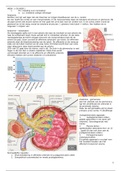
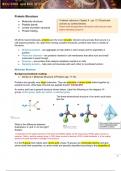
Membranes and Cellular
Organization
Textbook reference: Selected sections of Chapter 5 and
Chapter 2 as outlined below.
● Cell membrane structure Please work through these interactive online lecture notes
before attending Lecture 6.
● Movement in and out of cells
● Eukaryotic vs. Prokaryotic cells
● The Endomembrane System
Cell Membrane Structure
Background textbook reading:
● Chapter 2, Subsection: Lipids are Hydrophobic Molecules (pp. 43-45)
● Chapter 5, Section 5.1 Structure of Cell Membranes (pp. 94-98)
Cells are bounded by membranes. These membranes:
● Physically separate cells from their external environment
● Compartmentalize areas within cells so they can carry out diverse functions
Membranes are made of lipids which are hydrophobic molecules with hydrocarbon (CH2) tails.
Answer the question below and then complete the following crossword so you are familiar with the
different types of lipids.
What is the term given to a hydrocarbon chain with a carboxyl group on one end? Fatty acid
PAGE
\*
, 1) Unsaturated 3) Steroid 2) Phospholipid 4) Triacylglycerol 5) saturated
The major type of lipid found in the cell
membrane is phospholipids. Phospholipids
have both hydrophobic and hydrophilic
regions, making them amphipathic. Note the
hydrophobic and hydrophilic regions on the
diagram to the right.
Phospholipids are able to arrange themselves
spontaneously when in an aqueous
environment. The precise arrangement
depends on the size of the head groups. Lipids
that contain smaller heads but two hydrophobic
tails, form a bilayer.
This bilayer structure makes a very effective membrane able to
separate the external environment from the internal environment. In
addition, this structure explains why membranes are “self-healing”.
Small tears are sealed up by the spontaneous rearrangement of
lipids around the damaged region because water tends to exclude
non-polar molecules.
PAGE
\*
Organization
Textbook reference: Selected sections of Chapter 5 and
Chapter 2 as outlined below.
● Cell membrane structure Please work through these interactive online lecture notes
before attending Lecture 6.
● Movement in and out of cells
● Eukaryotic vs. Prokaryotic cells
● The Endomembrane System
Cell Membrane Structure
Background textbook reading:
● Chapter 2, Subsection: Lipids are Hydrophobic Molecules (pp. 43-45)
● Chapter 5, Section 5.1 Structure of Cell Membranes (pp. 94-98)
Cells are bounded by membranes. These membranes:
● Physically separate cells from their external environment
● Compartmentalize areas within cells so they can carry out diverse functions
Membranes are made of lipids which are hydrophobic molecules with hydrocarbon (CH2) tails.
Answer the question below and then complete the following crossword so you are familiar with the
different types of lipids.
What is the term given to a hydrocarbon chain with a carboxyl group on one end? Fatty acid
PAGE
\*
, 1) Unsaturated 3) Steroid 2) Phospholipid 4) Triacylglycerol 5) saturated
The major type of lipid found in the cell
membrane is phospholipids. Phospholipids
have both hydrophobic and hydrophilic
regions, making them amphipathic. Note the
hydrophobic and hydrophilic regions on the
diagram to the right.
Phospholipids are able to arrange themselves
spontaneously when in an aqueous
environment. The precise arrangement
depends on the size of the head groups. Lipids
that contain smaller heads but two hydrophobic
tails, form a bilayer.
This bilayer structure makes a very effective membrane able to
separate the external environment from the internal environment. In
addition, this structure explains why membranes are “self-healing”.
Small tears are sealed up by the spontaneous rearrangement of
lipids around the damaged region because water tends to exclude
non-polar molecules.
PAGE
\*