ATI Practice B Leadership and Management – Latest Update 100% Pass
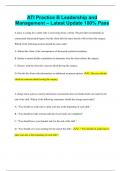
TI Practice B Leadership and Management – Latest Update 100% Pass A nurse is caring for a client who is recovering from a stroke. The provider recommends an extracranial-intracranial bypass, but the client tells the nurse that he will not have the surgery. Which of the following actions should the nurse take? A. Inform the client of the consequences of decreased cerebral circulation. B. Initiate a mental health consultation to determine why the client refuses the surgery. C. Discuss with the client his concerns about having the surgery. D. Provide the client with information on additional treatment options. C. Discuss with the client his concerns about having the surgery. A charge nurse notices a newly hired nurse consistently does not finish client care tasks by the end of the shift. Which of the following statements should the charge nurse make? A. "You should set aside time to plan your day at the beginning of each shift." B. "You should not take a break until all of your tasks are completed." C. "You should leave your hardest task for the end of the shift." D. "You should save your charting for the end of the shift." A. " You should set aside time to plan your day at the beginning of each shift." Two nurses on a unit each contend that the other is not doing a fair share of work. The conflict is affecting the functioning of the unit. A charge nurse should recognize that which of the following is an appropriate approach to this conflict? A. Schedule the nurses to work on alternating shifts. B. Organize a task force to evaluate the situation. C. Tell the nurses that it is their responsibility to cooperate with coworkers. D. Explore alternative solutions to address unit workflow with the nurses. D. Explore alternative solutions to address unit workflow with the nurses. A charge nurse is conducting an in-service with staff members about infection control precautions. The nurse should instruct the staff that which of the following clients requires droplet precautions? A. A client who has shigella. B. A client who has measles. C. A client who has toxic shock syndrome D. A client who has pertussis. D. A client who has pertussis. A nurse in the emergency department is admitting clients following an eartquake. The emergency disaster plan has been implemented due to the anticipated arrival of a large number of casualities. Which of the following clients should the nurse recommend the provider evaluate first? A. A client who has a penetrating head injury and respirations of 4/min. B. A client who has a comminuted fracture of the femur. C. A client who has a 6-inch laceration to the scalp with clotted blood visible. D. A client who has a sucking chest wound. D. A client who has a sucking chest wound. A nurse is caring for a group of clients on a unit. Which of the following assessment findings should the nurse recognize as the priority to report to the charge nurse? A. A client who has heart failure and 2+ edema of her lower extremities. B. A client who is 2 days postoperative and has a urine output of 20 mL/hr C. A client who started taking verapamil and has a heart rate of 75/min. D. A client who is receiving morphine and reports nausea. B. A client who is 2 days post operative and has a urine output of 20 mL/hr A nursing unit is undergoing changes to accomodate new bariatric services that will be available to the unit. Some staff members have verbalized displeasure with the changes. Which of the following actions should the charge nurse take? (Select all that apply) A. Role model a positive approach to the changes. B.
Escuela, estudio y materia
- Institución
- ATI Practice B Leadership and Management
- Grado
- ATI Practice B Leadership and Management
Información del documento
- Subido en
- 15 de mayo de 2023
- Número de páginas
- 52
- Escrito en
- 2022/2023
- Tipo
- Examen
- Contiene
- Preguntas y respuestas
Temas
-
but the
-
ati practice b leadership and management – latest update 100 pass
-
a nurse is caring for a client who is recovering from a stroke the provider recommends an extracranial intracranial bypass

Documento también disponible en un lote