LEADERSHIP ATI: MUST KNOWS
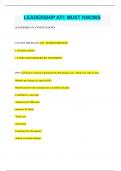
LEADERSHIP ATI: MUST KNOWS LEADERSHIP ATI MUST KNOWS CAN NOT DELEGATE 1. NURSING PROCESS 2. PT EDUCATION 3. TASKS THAT REQUIRE RN JUDGEMENT LPNS -Scope of practice determined by RN practice acts, which vary state to state -Monitor pt findings (as input by RN) -Reinforcement of pt teaching from a standard care plan -Contributes to care plan -Adminsteres IVPB meds -Monitors IV fluids -Trach care -Suctioning -Checking NG tube patency -Admin of enteral feedings -Insertion of urinary catheter -Med admin (excluding IV meds in many states) AP -ADLS: Grooming, bathing, dressing, toileting, ambulating, feeding (without swallowing precautions!!!), positioning, bed making -Specimen collection -I&O -VS on STABLE pts -Assemble pt med records -Maintain safe env -Recognize situations to report to immediate superior -CAN NOT DO DRESSING CHANGES NURSE STAGES 1. NOVICE=Student or new grad 2. ADVANCED BEGINNER=Most New RNs 3. COMPETENT=2-3 yrs experience 4. PROFICIENT=Signif amt of experience; holistic care 5. EXPERT=Do not need to rely on rules TB -Neg pressure -particulate (HEPA) masks -Airborne precautions CANNOT CONSENT -Schitzophrenia -15 yr old -Dementia OK: BAL .05 QUANTITATIVE -Phenomenology QUANTITATIVE -Meta analysis -Experimental study -Secondary analysis MED TIMES -Ok to give 30 min early FROM COMPREHENSIVE FROM COMPREHENSIVE PHASES OF MANAGEMENT PROCESS -Planning -Organzing -Staffing -Directing -Controlling PRIORITIZATION PRINCIPLES 1. LIFE BEFORE LIMB EX: Shock over pt w limb inj 2. ACUTE BEFORE CHRONIC 3. ACTUAL BEFORE POTENTIAL 4. MASLOWS: SELSP 5. EMERGENCIES VS. EXPECTED FINDINGS BUDGETS PERSONAL=Worked time and benefit time OPERATING=Electricity, maintenance, and supplies CAPITAL BUDGET=Buildings or major equipt ETHICAL PRINCIPLES VIDELITY=Be faithful; keep promises NONMALEFICIENCE=Not to do hard VERACITY=Tell the truth ANA CODE OF ETHICS -Sets guidelines to use when providing pt care -Outlines RN resp to pt and profession of nursing -Assists the RN in making ethical decisions ORGAN DONATION -Regualted by state and fed laws -RN must present option of organ donation to all fams ADVANCE DIRECTIVE =Doc in which pt who is competent is able to express wished re: future acceptable health care (including the desire for extraordinary lifesaving measures: CPR, intubation, and artificial hydration or nut) -Able to designate another person to make dec when the pt becomes physically or mentally unable to do so LIVING WILL =Legal doc that instructs health care providers and fam members about what, if any, life-sustaining tx an individual wants if at some time the ind is unable to make dec DURABLE POA =Legal doc that desgnates another person to make health care dec for pt when pt becomes unable to make dec independently INFORMED CONSENT -RN must witness signature -CAN provide clarification to info already given by MD -CANNOT provide NEW info TYPES OF LAWS AND COURTS 1. CRIMINAL LAW -Felony-Major -Misdemenaor-Minor 2. CIVIL LAWS TORT LAW: 1. UNINTENTIONAL TORTL=Negligence, malplactice 2. QUASI-INTENTAIONAL=Breach of confidentiality, defamation of char 3. INTENTIONAL TORT=Assault (threat), battery (touch), false imprisonment CONT'D 3. STATE LAWS=Nursing pracitce reg by state law. Each board of RN ahs rules reg and stand that vary FEDERAL REGS=Hippa, ADA, etc. MALPRACTICE =Failure to act in reasonable and prudent manner NEGLIGENCE =Omission to do something that a reasonable person would do OR =Doing something that a resonable person would NOT do -Standard of pro practice is developed by prof. organizations ASSIGNING =Process of transferring auth, accountability, and resp of pt care to another member of the health care tea DELEGATING =Process of tranferring auth and resp to another team member to complete a task while retaining accountability SUPERVISING =Process of directing, monitoring, and evaluating the performance of tasks by another team member of the health care team -RNs resp for supervision of pt care tasks delegated to AP adn LPNS also knowsn as UAP and LVN 5 RIGHTS OF DELEGATION 1. TASK=What task should be delegated 2. CIRCUMSTANCE=Under what circumstances 3. PERSON=To whom 4. DIRECTION/COMMUNICATOIN=What info should be communicated 5. RIGHT SUPERVISOIN/EVAL=How to supervise/evaluate` AVODIING/WITHDRAWGIN -Both parties knowthres conflict but refuse to face it or fix -May be approp for minor confl when 1 part holds more power than other of is issue may worl itself out over time -BC conflict remains, it may surface again at later data and escalate over time -Usually LOSE LOSE sit SMOOTHING -1 party attempts to smooth another party by trying to satisfy the other party -Often used to preserve or maintain a peaceful work env -This focus may be on what is agreed upon, leaving conflict largely unresvoled -LOSE LOSE sit COMPETING/COERCING -1 party pursues a desired solution at the expense of others -Managers may use this when a quick or unpopular dec must be made -Party who loses something may experince anger, aggrevation, and desire for retibution -WIN-LOSE sit COOPERATING/ACCOMADATING -1 party sacrifices something, allowing the other party to get what it wants -Opposite of competing -Original prob may not actually be resolved -Solution may contribute to future conflict -LOSE-WIN sit COMPROMISING/NEGOTIATING -Each party gives something up -To consider this a WIN/LOSE WIN/LOSe sit, both parties must give up something equally imp -If 1 party give up more than the other, it can become a WIN-LOSE sit ORDER OF GENERATIONS 1. VETERAN 2. BABY BOOMER 3. GENERATION X 4. GENERATION Y DEC MAKING DECISIVE=Min, one option FLEXIBLE=Limited, several option HIERARCHIAL=Large, one option INTEGRATIVE=Large, several option TEAM 1. FORMING=Get to know; ledaer defines tasks for team and offers directoin 2. STORMING=Conflict arises, and team mem begin to express polarized viewe -Team est rules, and members begin to take on various roles 3. NORMING=Team est rule; members show respect for on eanother and begin to accomplish some of tasks 4. PERFORMING=Team focuses on accomplishmen tof task INTENTIONAL TORTS 1. ASSAULT=Makes another person fearful and aprpehensive; threatening to place NG tube in pt refusing to eat 2. BATTERY=Intentional and wrongful physical contact w person that involves injury or offensive contact (restraining pt and giving injection against his wishes) 3. FALSE IMPRISON=Use restraints in pt to prevent him from leaving TRIAGE 1. EMERGENCY=CLASS 1=Highest priority!!!! Who have life threat inj but high poss of survival once stable 2. URGEN=CLASS II=Second hightest-to pt who have minor inj that are not yet life threatening and usually can wait 45-60 min for tx 3. NONURGENT=CLASS III=To pt who have minor inj and not life threat and do NOT need immed attn 4. EXPECTANT=CLASS IV=LOWEST priority-given to those NOT EXPECTED TO LIVE and allowed to DIE NATURALLy-Comfort measures will be given but restorative measures will not
Escuela, estudio y materia
- Institución
- LEADERSHIP ATI: MUST KNOWS
- Grado
- LEADERSHIP ATI: MUST KNOWS
Información del documento
- Subido en
- 15 de mayo de 2023
- Número de páginas
- 11
- Escrito en
- 2022/2023
- Tipo
- Examen
- Contiene
- Preguntas y respuestas
Temas
-
leadership ati must knows

Documento también disponible en un lote