Business Research Methods chapter 13
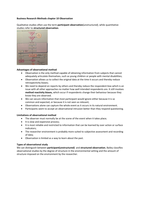
In everyday usage, measurement, occurs when an established yardstick verifies the height, weight or
another feature of a physical object. Measurement in research consists of assigning numbers to
empirical events in compliance with a set of rules. This definition implies that measurement is a
three-part process:
1. Selecting observable empirical events;
2. Developing a set of mapping rules – a scheme for assigning numbers or symbols to represent
aspects of the event being measured;
3. Applying the mapping rule(s) to each observation of that event.
The goal of measurement is to provide the highest-quality, lowest error data for testing hypotheses.
Variables being studied in research may be classified as objects or as properties. Objects include the
things of ordinary experience, such as tables, people, books and cars. Object can also include things
that are not as concrete as these, such as attitudes, opinions and peer-group pressures. Properties
are the characteristics of the objects. A person’s physical properties may be stated in terms of
weight, height and posture.
Researchers measure indicants of the properties or indicants of the properties of objects.
Mapping rules have four characteristics as follows:
1. Classification: numbers are used to group or sort responses. No order exists.
2. Order: numbers are ordered and transitivity applies. A is greater than, less than, or equal to B.
3. Distance: differences between numbers are ordered. The difference between any pair of numbers
is greater than, less than or equal to the difference between any other pair of numbers.
4. Origin: the number of series has a unique origin indicated by the number zero.
Combinations of these characteristics of classification, order, distance and origin provide four widely
used classification of measurement scale
1. Nominal 2. Ordinal 3. Interval 4. Ratio
In everyday usage, measurement, occurs when an established yardstick verifies the height, weight or
another feature of a physical object. Measurement in research consists of assigning numbers to
empirical events in compliance with a set of rules. This definition implies that measurement is a
three-part process:
1. Selecting observable empirical events;
2. Developing a set of mapping rules – a scheme for assigning numbers or symbols to represent
aspects of the event being measured;
3. Applying the mapping rule(s) to each observation of that event.
The goal of measurement is to provide the highest-quality, lowest error data for testing hypotheses.
Variables being studied in research may be classified as objects or as properties. Objects include the
things of ordinary experience, such as tables, people, books and cars. Object can also include things
that are not as concrete as these, such as attitudes, opinions and peer-group pressures. Properties
are the characteristics of the objects. A person’s physical properties may be stated in terms of
weight, height and posture.
Researchers measure indicants of the properties or indicants of the properties of objects.
Mapping rules have four characteristics as follows:
1. Classification: numbers are used to group or sort responses. No order exists.
2. Order: numbers are ordered and transitivity applies. A is greater than, less than, or equal to B.
3. Distance: differences between numbers are ordered. The difference between any pair of numbers
is greater than, less than or equal to the difference between any other pair of numbers.
4. Origin: the number of series has a unique origin indicated by the number zero.
Combinations of these characteristics of classification, order, distance and origin provide four widely
used classification of measurement scale
1. Nominal 2. Ordinal 3. Interval 4. Ratio