Option F: Food and health
1.1: Global Hunger Index (0-100, 0 being the best and 100 the worst); its components are
undernourishment, child stunting, child wasting, and child mortality.
Global Food Security Index (based on indices from 113 countries); its components are affordability,
availability, quality, and safety. There is a strong negative correlation between food consumption as a
share of household income and food security.
Stunting: Low height for the age of an individual. Cause of long-term malnutrition. Wasting: Low
weight for the age of an individual. Cause of short-term malnutrition. Undernourished: Insufficient
calorie intake of one or more individuals. Cause of short and long-term malnutrition.
1.2: LICs get most of their diets from carbs, while HICs from protein and dairy. There is a positive
correlation between wealth and calorie intake. A higher wealth also causes a population to produce
more energy. As calorie intake in LICs may increase, HICs already have a high calorie intake, hence
theirs will only increase at a reduced rate.
1.3: HALE: Health Adjusted Life Expectancy, showing the life expectancy of men and women at full
health in a certain country.
Infant mortality: The probability that a child will die before reaching the age of 1 (deaths per 1000 live
births).
Child mortality: The probability that a child will die before reaching the age of 5 (deaths per 1000 live
births).
Maternal mortality rates: The probability that a women will die giving birth (deaths per 100000 live
births).
Access to sanitation: The amount of people who have access to sanitation worldwide.
Access to health: The amount of people per doctor or hospital.
Case study: HALE in Canada.
Infant mortality is globally on the decrease.
1.4: Epidemic disease: infectious or contagious communicable diseases (Most often in LICs; diseases
such as diarrhoea, gastroenteritis, etc).
Degenerative disease: non-communicable diseases that cause a gradual worsening in the health of an
individual (Most often in HICs; diseases such as cancer, Parkinson’s disease, etc). These often develop
past the age of 60.
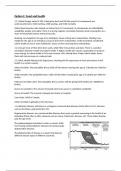
The epidemiological transition is when a country shifts
from having mostly epidemic diseases to having mostly
degenerative diseases.
The global burden of disease is a report that looks at
different disease types in different countries.
, 2.1: Using a system approach when looking at farming allows us to compare different aspects of
farming types, showing us the inputs (ex: temperature), outputs (ex: capital), and processes. The
more inputs there are, the more transfers, stores, and outputs there will be.
Subsistence farming is when a farmer produces to sustain himself, while commercial farming is when
a farmer produces to generate income; it is likely to be less sustainable as it prioritizes profit.
2.2: The photosynthetic efficiency is the fraction of light energy converted into chemical energy
during photosynthesis in plants and algae.
The energy efficiency ratio is a measure of the amount of energy inputs into a system compared with
the outputs. Beef has a low EER, and because its consumption is increasing, global EER is likely to
decrease.
A water footprint is a measure of how much water is used in human activities, such as for producing
food. Products with high water footprints, such as meat, will tend to be more expensive. Rising water
requirements will hence cause the price to increase.
2.3: The traditional view of food deficiency implies that food deficiencies were caused by local
shortages because of physical factors.
FAD (Food availability deficit), the cause of food insecurity, is historically seen as being due to a lack of
available food in a local area, usually due to problems such as climate, weather, transport, and
storage.
FED (Food entitlement deficit) is the inability of people to purchase food, even if it is available in their
local area.
Case study: Bahrain
Despite the problems of climate, soil and land availability, Bahrain was self-sufficient in fruit and
vegetable before the development of the oil industry in the 1930s. With the increase in the wealth of
the area that came with the development of the oil industry, agricultural production decreased,
energy needs increased, and people’s diets shifted to more animal-based foods. This fits with the
nutritional transition as people changed their diets towards more animal-based products instead of
carbohydrates.
Food choices are affected by:
- Income/status, generally, the higher the disposable income, the higher the quality of food
bought and the higher the “status” of a brand or product the more likely it is bought by higher
income households.
- Level of education, a person that is well educated about healthy eating habits tends to buy
different things than a person that is less educated.
- Taste, different people have different preferences when it comes to food, therefore affecting
their food choices.
Case study: Khayelitsha, Cape Town, South Africa.
In urban environments a higher variety of food is available also in rural areas the foods are more
“local”, meaning people’s consumption patterns in urban environments are going to be different to
people’s consumption patterns in rural areas.
1.1: Global Hunger Index (0-100, 0 being the best and 100 the worst); its components are
undernourishment, child stunting, child wasting, and child mortality.
Global Food Security Index (based on indices from 113 countries); its components are affordability,
availability, quality, and safety. There is a strong negative correlation between food consumption as a
share of household income and food security.
Stunting: Low height for the age of an individual. Cause of long-term malnutrition. Wasting: Low
weight for the age of an individual. Cause of short-term malnutrition. Undernourished: Insufficient
calorie intake of one or more individuals. Cause of short and long-term malnutrition.
1.2: LICs get most of their diets from carbs, while HICs from protein and dairy. There is a positive
correlation between wealth and calorie intake. A higher wealth also causes a population to produce
more energy. As calorie intake in LICs may increase, HICs already have a high calorie intake, hence
theirs will only increase at a reduced rate.
1.3: HALE: Health Adjusted Life Expectancy, showing the life expectancy of men and women at full
health in a certain country.
Infant mortality: The probability that a child will die before reaching the age of 1 (deaths per 1000 live
births).
Child mortality: The probability that a child will die before reaching the age of 5 (deaths per 1000 live
births).
Maternal mortality rates: The probability that a women will die giving birth (deaths per 100000 live
births).
Access to sanitation: The amount of people who have access to sanitation worldwide.
Access to health: The amount of people per doctor or hospital.
Case study: HALE in Canada.
Infant mortality is globally on the decrease.
1.4: Epidemic disease: infectious or contagious communicable diseases (Most often in LICs; diseases
such as diarrhoea, gastroenteritis, etc).
Degenerative disease: non-communicable diseases that cause a gradual worsening in the health of an
individual (Most often in HICs; diseases such as cancer, Parkinson’s disease, etc). These often develop
past the age of 60.
The epidemiological transition is when a country shifts
from having mostly epidemic diseases to having mostly
degenerative diseases.
The global burden of disease is a report that looks at
different disease types in different countries.
, 2.1: Using a system approach when looking at farming allows us to compare different aspects of
farming types, showing us the inputs (ex: temperature), outputs (ex: capital), and processes. The
more inputs there are, the more transfers, stores, and outputs there will be.
Subsistence farming is when a farmer produces to sustain himself, while commercial farming is when
a farmer produces to generate income; it is likely to be less sustainable as it prioritizes profit.
2.2: The photosynthetic efficiency is the fraction of light energy converted into chemical energy
during photosynthesis in plants and algae.
The energy efficiency ratio is a measure of the amount of energy inputs into a system compared with
the outputs. Beef has a low EER, and because its consumption is increasing, global EER is likely to
decrease.
A water footprint is a measure of how much water is used in human activities, such as for producing
food. Products with high water footprints, such as meat, will tend to be more expensive. Rising water
requirements will hence cause the price to increase.
2.3: The traditional view of food deficiency implies that food deficiencies were caused by local
shortages because of physical factors.
FAD (Food availability deficit), the cause of food insecurity, is historically seen as being due to a lack of
available food in a local area, usually due to problems such as climate, weather, transport, and
storage.
FED (Food entitlement deficit) is the inability of people to purchase food, even if it is available in their
local area.
Case study: Bahrain
Despite the problems of climate, soil and land availability, Bahrain was self-sufficient in fruit and
vegetable before the development of the oil industry in the 1930s. With the increase in the wealth of
the area that came with the development of the oil industry, agricultural production decreased,
energy needs increased, and people’s diets shifted to more animal-based foods. This fits with the
nutritional transition as people changed their diets towards more animal-based products instead of
carbohydrates.
Food choices are affected by:
- Income/status, generally, the higher the disposable income, the higher the quality of food
bought and the higher the “status” of a brand or product the more likely it is bought by higher
income households.
- Level of education, a person that is well educated about healthy eating habits tends to buy
different things than a person that is less educated.
- Taste, different people have different preferences when it comes to food, therefore affecting
their food choices.
Case study: Khayelitsha, Cape Town, South Africa.
In urban environments a higher variety of food is available also in rural areas the foods are more
“local”, meaning people’s consumption patterns in urban environments are going to be different to
people’s consumption patterns in rural areas.