ARDMS Exam Prep Correct 100%
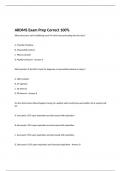
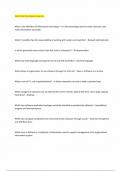
What structures aid in stabilizing each AV valve from protruding into the atria? A. Chordae Tendinae B. Myocardial tendons C. Fibrous strands D. Papillary Muscles - Answer A What portion of the ECG is best for diagnosis of myocardial ischemia or injury? A. QRS complex B. ST segment C. QT interval D. PR interval - Answer B On the mitral valve inflow Doppler tracing of a patient with constrictive pericarditis, the E velocity will be: A. increased 25% upon inspiration and decreased with expiration B. decreased 25% upon expiration and increased with inspiration C. Increased 25% upon inspiration and decreased with expiration D. Decreased 25% upon inspiration and increased expiration - Answer D An ausculatory finding in constrictive pericarditis may be: A. pericardial knock B. honking sound C. pericardial rub D. Carvallo's sign - Answer A Right ventricular early diastolic collapse seen on M-mode echocardiography suggests: A. cardiac tamponade B. constrictive pericarditis C. pleural effusion D. pericarditis - Answer A The most common cardiac valve tumor is: A. myxoma B. Lipoma C. Rhabdomyoma D. Fibroelastoma - Answer D A high density, well defined spectral Doppler tracing of mitral regurgitation may indicate: A. LAE B. Late closure of MV C. Mild regurgitation D. severe regurgitation - Answer D Patients with constrictive pericarditis typically go into heart failure due to: A. increased pulmonary pressures B. Diastolic dysfunction C. systolic dysfunction D. increased pericardial pressure - Answer B What is the finding with Chagas disease, which helps to identify it as the cause of dilated cardiomyopathy? A. left ventricular apical aneurysm B. Mitral regurgitation C. Dilated left ventricle D. dilated right ventricle - Answer A Maneuvers that mat decrease left ventricular volume and provoke mitral prolapse include: A. supine to standing position B. Valsalva maneuver C. Amyl Nitrate D. all the above - Answer D Aortic stenosis has narrow pulse pressure. A. true B. false - Answer A DeBakey Type I aortic dissection involves the: A. descending only B. ascending aorta C. Ascending and descending D. sinus of valsalva - Answer C Endocardial cushion defects have a high incidence with: A. Down's Syndrome B. Fitz-hugh Curtis syndrome C. Marfan's Syndrome D. acromegaly - Answer A This abnormality is a common prosthetic valve dysfunction in patients diagnosed with infective endocarditis: A. stenosis B. Ring Abscess C. pericardial effusion D. infarction - Answer B A pericardial effusion is rarely seen behind this chamber: A. LA B. LV C. RV D. RA - Answer A A tricuspid valve area of 1.5 cm² is suggestive of: A. severe tricuspid stenosis B. moderate TS C.moderate to severe TS D. Mild TS - Answer A Severe aortic regurgitation is suggested when: A. the pressure half time of the AI is 600 msec B. Holodiastolic flow reversal is seen in the descending aorta C. the regurgitation spectral tracing has a box-like appearance D. Holodiastolic flow reversal is seen in the pulmonary artery - Answer B
Escuela, estudio y materia
- Institución
- ARDMS
- Grado
- ARDMS
Información del documento
- Subido en
- 8 de mayo de 2023
- Número de páginas
- 17
- Escrito en
- 2022/2023
- Tipo
- Examen
- Contiene
- Preguntas y respuestas
Temas
-
ardms
-
ardms exam prep correct 100
-
what structures aid in stabilizing each av valve from protruding into the atria a chordae tendinae b myocardial tendons c fibrous strands d papillary muscles a

Documento también disponible en un lote