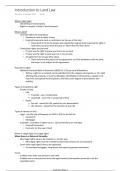
Introduction to Land Law
Saturday, 9 October 2021 10:42
What is Land Law?
- Ownership of land (estates)
- Rights in respect of other's land (interest)
What is land?
- Land law rights are proprietary
○ Easements such as rights of way
○ Freehold covenants such as restrictions on the use of the land
▪ These bind not only the people who signed the original deed imposing the right or
restriction, but also those that buy or inherit the land from them
- Contractual rights are personal
○ If I give you the right to graze your horse on my land
○ If I give you the right to park your car in my car park
○ An agreement to occupy office space
▪ These only bind the parties to the agreement, so if the landowner sells the land,
the buyer is not subject to this agreement
Proprietary rights
- National Provincial Bank v Ainsworth [1965] AC 1175 per Lord Wilberforce:
○ 'Before a right or an interest can be admitted into the category of property, or of a right
affecting the property, it must be definable, identifiable by third parties, capable in its
nature of assumption by third parties, and have some degree of permanence and
stability.'
Types of proprietary right
- Estates in land
○ Law
▪ Freehold - own it indefinitely
▪ Leasehold - own it for a set period of time
○ Equity
▪ Fee tail - owned for life, passed to your descendants
▪ Life interest - owned for the duration of your life
Types of interest in land
- Legal - see the Law of Property Act 1925 s.1(2) for the full list
○ Easements
○ Mortgages
- Equitable - examples of rights not in s.1(2) so therefore are not legal
○ Freehold covenants
○ Contracts for the sale of land
When is a legal right not a legal right?
When there is a failure of formality.
- Most legal rights have to be created in a certain way
○ Most legal rights must be created by deed (short leases are an exception)
- Some other legal rights have to be registered
○ For example mortgages, long leases and expressly granted easements
Trusts
- Enables more than one person to own land
- Enables one or more person) to be the legal owner(s) and another person(s) to be the
equitable owner
- Trusts can be created
Land Law Page 1
Saturday, 9 October 2021 10:42
What is Land Law?
- Ownership of land (estates)
- Rights in respect of other's land (interest)
What is land?
- Land law rights are proprietary
○ Easements such as rights of way
○ Freehold covenants such as restrictions on the use of the land
▪ These bind not only the people who signed the original deed imposing the right or
restriction, but also those that buy or inherit the land from them
- Contractual rights are personal
○ If I give you the right to graze your horse on my land
○ If I give you the right to park your car in my car park
○ An agreement to occupy office space
▪ These only bind the parties to the agreement, so if the landowner sells the land,
the buyer is not subject to this agreement
Proprietary rights
- National Provincial Bank v Ainsworth [1965] AC 1175 per Lord Wilberforce:
○ 'Before a right or an interest can be admitted into the category of property, or of a right
affecting the property, it must be definable, identifiable by third parties, capable in its
nature of assumption by third parties, and have some degree of permanence and
stability.'
Types of proprietary right
- Estates in land
○ Law
▪ Freehold - own it indefinitely
▪ Leasehold - own it for a set period of time
○ Equity
▪ Fee tail - owned for life, passed to your descendants
▪ Life interest - owned for the duration of your life
Types of interest in land
- Legal - see the Law of Property Act 1925 s.1(2) for the full list
○ Easements
○ Mortgages
- Equitable - examples of rights not in s.1(2) so therefore are not legal
○ Freehold covenants
○ Contracts for the sale of land
When is a legal right not a legal right?
When there is a failure of formality.
- Most legal rights have to be created in a certain way
○ Most legal rights must be created by deed (short leases are an exception)
- Some other legal rights have to be registered
○ For example mortgages, long leases and expressly granted easements
Trusts
- Enables more than one person to own land
- Enables one or more person) to be the legal owner(s) and another person(s) to be the
equitable owner
- Trusts can be created
Land Law Page 1