Python Language Notes Part-3
Factoril using Recursion
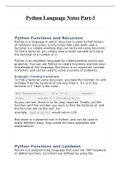
Python Functions and Recursion
Python is a language in which recursion is used to find factors
of numbers. Recursion is a function that calls itself, and a
factorial is a simple example that can be found using recursion.
To find a factorial, you simply take a result variable and store
the factorial of a number in it.
Python is an excellent language for understanding syntax and
grammar. You can use Python to create functions and test your
knowledge of the language. Recursion is an important concept
in Python, and can be used to solve a variety of problems.
Example: Finding Factorials
To find a factorial using recursion, you take the number (n) and
multiply it by the factorial of one less than n. If n is 0, the
factorial is 1. Here is the code:
def factorial(n): if n == 0: return 1
else: return n * factorial(n-1)
As you can see, there is no for loop required. Simply call the
function with the number you want to find the factorial of, and
the function will do the rest. For
example, factorial(5) would return 120.
Recursion is a powerful tool in Python, and can be used in
many different ways. Stay tuned for more examples and
explanations!
Anoymus Functios | Lambd
Python Functions and Lambdas
Python is a programming language that uses the "def" keyword
to define functions. Functions are defined by using the
, function's name and code in the programming language.
Python allows you to define a function when you want to use it
directly.
Python's function code is written using the "def" keyword and
is based on the concept of functions. It uses the function's
name to define functions. Python allows you to use a function
only once, and it is called an anonymous function or a lambda
function. These functions can be written within another
function or on their own.
Python has been developed for the language by programming
and is designed to use a function to find the square of a value.
An anonymous function in Python, also known as a lambda
expression or function, accepts a value and returns its square.
To assign an anonymous function, simply use lambda with a
variable name. This variable represents your function. You can
pass it to any other function, and it will work. Let's talk about
how you can use these lambda functions in other functions
later on.
I hope you enjoyed this explanation of Python functions and
lambdas. Let me know in the comments section if you have any
questions.
Filter Map Reduc
Python Functions
Python is a language that allows for the creation of anonymous
functions, which are functions without a name. The language
also has built-in functions such as filter, map, and reduce that
can assist in writing code quickly and easily.
Filter and Map Functions
The filter function takes two arguments: a function and
a sequence. It returns a sequence, but you can use a
list to return desired results. The function filters the
sequence based on a condition provided. For example,
you can filter out all values that are not equal to
"android."
Factoril using Recursion
Python Functions and Recursion
Python is a language in which recursion is used to find factors
of numbers. Recursion is a function that calls itself, and a
factorial is a simple example that can be found using recursion.
To find a factorial, you simply take a result variable and store
the factorial of a number in it.
Python is an excellent language for understanding syntax and
grammar. You can use Python to create functions and test your
knowledge of the language. Recursion is an important concept
in Python, and can be used to solve a variety of problems.
Example: Finding Factorials
To find a factorial using recursion, you take the number (n) and
multiply it by the factorial of one less than n. If n is 0, the
factorial is 1. Here is the code:
def factorial(n): if n == 0: return 1
else: return n * factorial(n-1)
As you can see, there is no for loop required. Simply call the
function with the number you want to find the factorial of, and
the function will do the rest. For
example, factorial(5) would return 120.
Recursion is a powerful tool in Python, and can be used in
many different ways. Stay tuned for more examples and
explanations!
Anoymus Functios | Lambd
Python Functions and Lambdas
Python is a programming language that uses the "def" keyword
to define functions. Functions are defined by using the
, function's name and code in the programming language.
Python allows you to define a function when you want to use it
directly.
Python's function code is written using the "def" keyword and
is based on the concept of functions. It uses the function's
name to define functions. Python allows you to use a function
only once, and it is called an anonymous function or a lambda
function. These functions can be written within another
function or on their own.
Python has been developed for the language by programming
and is designed to use a function to find the square of a value.
An anonymous function in Python, also known as a lambda
expression or function, accepts a value and returns its square.
To assign an anonymous function, simply use lambda with a
variable name. This variable represents your function. You can
pass it to any other function, and it will work. Let's talk about
how you can use these lambda functions in other functions
later on.
I hope you enjoyed this explanation of Python functions and
lambdas. Let me know in the comments section if you have any
questions.
Filter Map Reduc
Python Functions
Python is a language that allows for the creation of anonymous
functions, which are functions without a name. The language
also has built-in functions such as filter, map, and reduce that
can assist in writing code quickly and easily.
Filter and Map Functions
The filter function takes two arguments: a function and
a sequence. It returns a sequence, but you can use a
list to return desired results. The function filters the
sequence based on a condition provided. For example,
you can filter out all values that are not equal to
"android."