CHAPTER 13
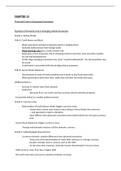
Financial Crises in Emerging Economies
Dynamics of Financial Crisis in Emerging Market Economies
STAGE 1: INITIAL PHASE
Path A: Credit Booms and Busts
- Weak supervision and lack of expertise lead to a lending boom
- Domestic banks borrow from foreign banks
- Fixed exchange rate give a sense of lower risk.
- Banks play a more important role in emerging market economies, since securities markets
are not well developed yet.
- At this stage emerging economies may resort “sound fundementals”. EG, fiscal positions may
be sound.
- Credit boom is associated with deterirating balance payments.
Path B: Severe Piscal Imbalances
- Governments in need of funds sometimes force banks to buy fovernment debt
- When government debt loses value, banks lose and their net worth decreases.
Additional factors:
- Increase in interest rates (from aboard)
- Asset price
-Decrease firm’s net worth and thus increase adverse selection problems
- Uncertainty linked to unstable political systems
STAGE 2: Currency Crisis
- Deterioration of bank balance sheets triggers currency crises:
-Government cannot raise interest rates (doing so forced banks into solvency)
-...and speculatory expect a deviation
-Note diffence with advanced economies (were banks failures do not cause currency
crisis
- Severe fiscal imbalances triggers currency crises:
-Foreign and domestic investors sell the domestic currency
STAGE 3: Fulled-Fledged Financial Crisis
- Currency mismatch: another difference from advanced economies
-Arises out of the denomination of many debt contracts in a foreign currency
(usually a foreign reserve currency such as the US$)
-At the same time, however, domestic income denominated in local currency
- With currency crisis, firms face a higher debt
- Net worth decreases and averse selection problems increases
, - Debt burden in terms of domestic currency increases (net worth decreases)
- Increase in expected and actual inflation reduces firms’ cash flow
-“Twin crisis”
- Banks are more likely to fail:
- Indiciduals are less likely to pyaoff debts (value of assets fall)
-Debt denominated in foreign currency increaes (value of liability increase)
Application: Crisis in South Korea, 1997-98
- Financial liberalization and globalization mismanged
- Pervension of the financial liberalization and globalization process: chaebols and the South
Korea crisis
- Starting point: sound macroeconomics fundamentals
-Rapid growth, low unemployment, and fiscal surpluses
- “Asian miracle”
- What happend? Financial liberalization in the 1990s
- Financial de-regulation
-Opening up of capital markets
-Outcome: lending boom fueled by massive foreign borrowing-especially short term
-Pervension of the financial liberalization and globalization process: chaebols and the South Korea
crisis
-Chaebols: large family-owned conglomerates
- Political ties: too big to fail
-Leading role in borrowing frenzy: very high leverage (but low profits)
- Facilitating role played by South Korean merchant banks
- Stock market decline and failure of firms increase uncertainty
- In early 1997, series of negative shocks to the external position of (already weakened)
chaebols
- First high-profile bankruptcy of one of the largest chaebols in January, folowed by 5 more
- Uncertainty caused by such bankruptcies, and decrease in chaebols’ net worth, cause a
sharp decline in stock market values
- Adverse selection and moral hazard problem worsen, and the economy contracts
- Currency crisis ensues
- Speculative attack against the South Korean currency (won)
- Fueled by
-deterioration financial health of chaebols (associated with high leverage)
Financial Crises in Emerging Economies
Dynamics of Financial Crisis in Emerging Market Economies
STAGE 1: INITIAL PHASE
Path A: Credit Booms and Busts
- Weak supervision and lack of expertise lead to a lending boom
- Domestic banks borrow from foreign banks
- Fixed exchange rate give a sense of lower risk.
- Banks play a more important role in emerging market economies, since securities markets
are not well developed yet.
- At this stage emerging economies may resort “sound fundementals”. EG, fiscal positions may
be sound.
- Credit boom is associated with deterirating balance payments.
Path B: Severe Piscal Imbalances
- Governments in need of funds sometimes force banks to buy fovernment debt
- When government debt loses value, banks lose and their net worth decreases.
Additional factors:
- Increase in interest rates (from aboard)
- Asset price
-Decrease firm’s net worth and thus increase adverse selection problems
- Uncertainty linked to unstable political systems
STAGE 2: Currency Crisis
- Deterioration of bank balance sheets triggers currency crises:
-Government cannot raise interest rates (doing so forced banks into solvency)
-...and speculatory expect a deviation
-Note diffence with advanced economies (were banks failures do not cause currency
crisis
- Severe fiscal imbalances triggers currency crises:
-Foreign and domestic investors sell the domestic currency
STAGE 3: Fulled-Fledged Financial Crisis
- Currency mismatch: another difference from advanced economies
-Arises out of the denomination of many debt contracts in a foreign currency
(usually a foreign reserve currency such as the US$)
-At the same time, however, domestic income denominated in local currency
- With currency crisis, firms face a higher debt
- Net worth decreases and averse selection problems increases
, - Debt burden in terms of domestic currency increases (net worth decreases)
- Increase in expected and actual inflation reduces firms’ cash flow
-“Twin crisis”
- Banks are more likely to fail:
- Indiciduals are less likely to pyaoff debts (value of assets fall)
-Debt denominated in foreign currency increaes (value of liability increase)
Application: Crisis in South Korea, 1997-98
- Financial liberalization and globalization mismanged
- Pervension of the financial liberalization and globalization process: chaebols and the South
Korea crisis
- Starting point: sound macroeconomics fundamentals
-Rapid growth, low unemployment, and fiscal surpluses
- “Asian miracle”
- What happend? Financial liberalization in the 1990s
- Financial de-regulation
-Opening up of capital markets
-Outcome: lending boom fueled by massive foreign borrowing-especially short term
-Pervension of the financial liberalization and globalization process: chaebols and the South Korea
crisis
-Chaebols: large family-owned conglomerates
- Political ties: too big to fail
-Leading role in borrowing frenzy: very high leverage (but low profits)
- Facilitating role played by South Korean merchant banks
- Stock market decline and failure of firms increase uncertainty
- In early 1997, series of negative shocks to the external position of (already weakened)
chaebols
- First high-profile bankruptcy of one of the largest chaebols in January, folowed by 5 more
- Uncertainty caused by such bankruptcies, and decrease in chaebols’ net worth, cause a
sharp decline in stock market values
- Adverse selection and moral hazard problem worsen, and the economy contracts
- Currency crisis ensues
- Speculative attack against the South Korean currency (won)
- Fueled by
-deterioration financial health of chaebols (associated with high leverage)