

The body in motion notes - Core 2
How do the musculoskeletal and cardiorespiratory systems of the body influence and respond to
movement?
Skeletal system
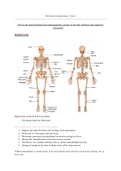
Major bones involved in the movement
- The human body has 206 bones.
Bone arrangements allow for five main functions
1. Support: provides the body with its shape, form and posture
2. Protection: of vital organs and soft tissue
3. Movement: proving as an attachment for muscles acting as a lever.
4. Blood cells: manufactured in the bone marrow cavities
5. Storehouse: for essential nutrients such as calcium and phosphorous and
6. Storage of energy in the form of lipids in the yellow bone marrow.
Yellow bone marrow: is made mostly of fat and contains stem cells that can become cartilage, fat, or
bone cells.
,Types of bones
Main types of bones include:
1. Long bones: have greater length than width, they consist of compac bone encasing spongy
bone. (e.g femur, tibia, fibula, phalanges, humerus etc).
2. Short bone: Have similar width and length, they are spongy bone except for the surface. (e.g
carpals and tarsals).
3. Flat bones: provide protection to vital organs. E,g scapula, sternum, ribs. Thye are composed
of 2 thin plates of compact bone encasing spongy bone.
4. Irregular bones: complex shapes, varying in the amount of sponge and compact bone. (e.g
vertebrae, ilium, pubis).
5. Sesamoid bones: very small round bones, e.g patella.
Typical structure of a long bone
Epiphysis: end of the bone
Diaphysis: long portion of the bone
Articular cartilage - a thin layer of cartilage covering the epiphysis
Periosteum: membrane around the surface of the bone.
Cancellous bone is strong and light, spongy bone tissue able to withstand stress.
Bone marrow: contains blood vessels, fat and blood-forming tissues.
Major bones for movement - upper limb
Clavicle:
- Long bone
- Provides attachment between the shoulder girdle and the vertebral
column.
- Gives greater mobility to the shoulder joint
Scapula:
- A flat bone
- Allows for attachment of arm to body
Humerus:
- Joins shoulder to elbow
- Hinge joint
Tarsals, metcarpals and phalanges:
- Allow for fine motor skills
, Pelvic girdle
The pelvis comprises several bones and provides the base
of support necessary for the weight of the upper body.
The pelvic girdle allows less movement than the shoulder
girdle because the supporting ligaments are short and
strong.
The hip joint, where the femur (thigh bone) attaches, adds
to the stability of the structure.
Major bones for movement - lower body
Femur: s the longest and strongest bone in the body. The bone is covered by
large muscles that extend from the pelvic girdle to the shin, enabling many
movements, such as running and kicking.
Patella: small, seasmoid bone that provides protection the the knee.
Tibia: bears most of the body weight and is involved in all lower body
movements.
Fibula: slender long bone e that lies parallel with and on the lateral side of the
tibia. It works with the tibia in providing support and stability to the lower leg
Tarsals, metatarsals and phalanges: They work as a unit providing a structure
that enables leg movements, including walking and running
, Anatomical terms
1. Superior: towards the head; for example, the chest is superior to the hips
2. Inferior: towards the feet; for example, the foot is inferior to the leg
3. Anterior: towards the front; for example, the breast is on the anterior chest wall.
4. Posterior: towards the back; for example, the backbone is posterior to the heart.
5. Medial: towards the body's midline; for example, the big toe is on the medial side of the foot
6. Lateral: towards the side of the body; for example, the little toe is on the lateral side of the foot
7. Proximal: towards the body’s mass; for example, the shoulder is proximal to the elbow
8. Distal: away from the body’s mass; for example, the elbow is distal to the shoulder.
How do the musculoskeletal and cardiorespiratory systems of the body influence and respond to
movement?
Skeletal system
Major bones involved in the movement
- The human body has 206 bones.
Bone arrangements allow for five main functions
1. Support: provides the body with its shape, form and posture
2. Protection: of vital organs and soft tissue
3. Movement: proving as an attachment for muscles acting as a lever.
4. Blood cells: manufactured in the bone marrow cavities
5. Storehouse: for essential nutrients such as calcium and phosphorous and
6. Storage of energy in the form of lipids in the yellow bone marrow.
Yellow bone marrow: is made mostly of fat and contains stem cells that can become cartilage, fat, or
bone cells.
,Types of bones
Main types of bones include:
1. Long bones: have greater length than width, they consist of compac bone encasing spongy
bone. (e.g femur, tibia, fibula, phalanges, humerus etc).
2. Short bone: Have similar width and length, they are spongy bone except for the surface. (e.g
carpals and tarsals).
3. Flat bones: provide protection to vital organs. E,g scapula, sternum, ribs. Thye are composed
of 2 thin plates of compact bone encasing spongy bone.
4. Irregular bones: complex shapes, varying in the amount of sponge and compact bone. (e.g
vertebrae, ilium, pubis).
5. Sesamoid bones: very small round bones, e.g patella.
Typical structure of a long bone
Epiphysis: end of the bone
Diaphysis: long portion of the bone
Articular cartilage - a thin layer of cartilage covering the epiphysis
Periosteum: membrane around the surface of the bone.
Cancellous bone is strong and light, spongy bone tissue able to withstand stress.
Bone marrow: contains blood vessels, fat and blood-forming tissues.
Major bones for movement - upper limb
Clavicle:
- Long bone
- Provides attachment between the shoulder girdle and the vertebral
column.
- Gives greater mobility to the shoulder joint
Scapula:
- A flat bone
- Allows for attachment of arm to body
Humerus:
- Joins shoulder to elbow
- Hinge joint
Tarsals, metcarpals and phalanges:
- Allow for fine motor skills
, Pelvic girdle
The pelvis comprises several bones and provides the base
of support necessary for the weight of the upper body.
The pelvic girdle allows less movement than the shoulder
girdle because the supporting ligaments are short and
strong.
The hip joint, where the femur (thigh bone) attaches, adds
to the stability of the structure.
Major bones for movement - lower body
Femur: s the longest and strongest bone in the body. The bone is covered by
large muscles that extend from the pelvic girdle to the shin, enabling many
movements, such as running and kicking.
Patella: small, seasmoid bone that provides protection the the knee.
Tibia: bears most of the body weight and is involved in all lower body
movements.
Fibula: slender long bone e that lies parallel with and on the lateral side of the
tibia. It works with the tibia in providing support and stability to the lower leg
Tarsals, metatarsals and phalanges: They work as a unit providing a structure
that enables leg movements, including walking and running
, Anatomical terms
1. Superior: towards the head; for example, the chest is superior to the hips
2. Inferior: towards the feet; for example, the foot is inferior to the leg
3. Anterior: towards the front; for example, the breast is on the anterior chest wall.
4. Posterior: towards the back; for example, the backbone is posterior to the heart.
5. Medial: towards the body's midline; for example, the big toe is on the medial side of the foot
6. Lateral: towards the side of the body; for example, the little toe is on the lateral side of the foot
7. Proximal: towards the body’s mass; for example, the shoulder is proximal to the elbow
8. Distal: away from the body’s mass; for example, the elbow is distal to the shoulder.

