NUR 2633: Maternal Child Health Official Study Guide – Test 4 (Final Exam) – 100% proven pass rate. Graded A+
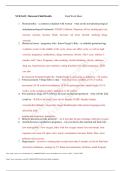
NUR 2633: Maternal Child Health Official Study Guide – Test 4 (Final Exam) – 100% proven pass rate. Graded A+ Document Content and Description Below NUR 2633: Maternal Child Health Official Study Guide – Test 4 (Final Exam) – 1. Dysmenorrhea – a common complaint with women – what are the non-pharmacological and pharmacological treatments . Dysmenorrhea- painful menses Non pharmacological-heat, exercise, increase calcium Pharmacological- NSAIDs 2. Obstetrical issues – pregnancy risks - Know Naegle’s Rule – to establish gestational age Naegle’s Rule is first day of last missed period subtract 3 months add 7 days and add one year Fundal height(14 weeks just above the symphysis), 12 weeks embryonic stage organ development, 10-12 weeks heart tones, movement starts at 16 weeks multigravida, 18 weeks primigravida 3. Poor nutrition, drugs, HTN, DM are all issues of perfusion – what will the fetal result be. IUGR are large head skinny not much brown fat had poor perfusion Small for gestational are proportional have brown fat Macrosomic- body as big as head, worried about birth injuries they usually come from uncontrolled diabetic, Poor lung maturity, hypoglycemic(jittery, lethargy) Meconium staining- post dates because of stress 4. Anemia becomes a problem in pregnancy – can you discuss the maternal and fetal risks Most pregnant women have anemia, normal phenomenon, plasma volume goes up not RBC volume so women become anemic, iron supplements Constipation- they are already constipated and then the iron supplements make them even more, exercise water calcium orange juice no laxatives fiber stool softener 5. Hypertension – preeclampsia has specific symptoms – please know these as well as treatment modalities and nursing interventions – keep In mind Magnesium Sulfate, nursing interventions HTN, edema, proteinuria. Subjective signs are headache, gastric pain, swelling, blurred vision. Organs effected are brain, hear, liver and kidneys. Nursing interventions- DTRs, vitals every hour, respiratory rate, lung sounds, urine output, put Foley in, bedrest Magnesium sulfate is used to relax muscles, vessels. The blood vessels are tight and the blood pressure goes up. If we don’t treat this seizures will happen. Hypoxia, IUGR, small baby. 6. Pre- term labor – define it; signs and symptoms, treatment modalities and nursing interventions. Labor that begins before 37 weeks, regular contractions that cause cervical change Nursing interventions- bedrest, hydration(500ml LR bolus), fetal monitor, left side, UA(UTI can cause uterine irritability) 2cm 80% effaced what should the doctor order? Terbutaline, a tocolytic that stops contractions and delays the labor process, side effects- maternal tachycardia, baby’s HR goes up too. If this is not working, we then use Magnesium sulfate. Mag is given to relax the uterus, smooth muscle relaxant, give her 4g bolus over a 15-20 min timeframe, then 2g maintenance dose. If we send her home-pelvic rest nothing in the vagina, this can stimulate contractions. Semen is prostaglandin, which can start labor. Betamethasone is for lung maturity, we need 24 hours for it to work. 7. Diabetes Mellitus – Type 1, Type 2 and Gestational DM all have issues that are common to all and specific to each. Note the concerns specific to each, management and fetal surveillance Type 1- no insulin production, fetal anomalies, risk to baby developing, insulin levels go down in the first trimester, the need rapidly increases Type 2- usually diet controlled, if not she needs insulin, macrosomic baby because sugar crosses the placenta insulin does not GDM- diabetes only in pregnancy 8. Define Macrosomia – and what are the risks Risks of Macrosomia are birth injury, lung immaturity, hyperglycemia. 9. During fetal development a nurse can recognize well- being of the fetus through 3 things? Fetal heart tones, fetal movement, fundal height Fundal height at 32 weeks should be 28-34cm, 1 cm per gestational week give or take 2 weeks 10. How do you determine EDD? Naegele’s Rule is first day of last missed period subtract 3 months add 7 days and add one year 11. What is an NST, and a BPP for whom would you recommend these tests? NST- Non-stress test, to look for fetal activity BPP- Bio physical profile, ultrasound that looks at 4 different markers. Scored 0-2, 8 being the best. A 6 they are probably keeping mom to watch her and baby, 4 and under delivering baby. 1. Full body fetal movement 2. Fetal tone 3. Amniotic fluid amount- need to see 500ml fluid or its oligohydramnios 4. Breathing movement- intercostals moving, chest expansions 12. Amniocentesis: when and for what reason? We do amniocentesis to check for chromosomal anomalies including Down Syndrome and Trisomy 18. Only other time is at end of pregnancy when we are checking lung maturity(L/S ratio). 13. Amniotic fluid surrounds the baby and has 5 functions – oligohydramnios means? Polyhydramnios- what are you thinking? Functions 1. Fetal movement 2. Protect the cord 3. Cushioning the baby 4. Temperature control 5. Making sure the GI and renal systems are working Oligohydramnios- Not enough amniotic fluid Polyhydramnios- Too much amniotic fluid14. It is all about the placenta and perfusion – how do promote perfusion to the placenta, and what can interfere? (any disease or substance that interferes with vascular perfusion: HTN, DM, smoking, drugs, poor nutrition, etc.) HTN, DM, smoking, drugs, malnutrition all affect perfusion, will use intrauterine resuscitation to regain perfusion to the placenta. 15. Know fetal heart rate monitoring – 5 parts and what does each tell you.(ie: accelerations are always positive, healthy babies) a. Baseline (110-160bpm) normal fetal heart rate during a 10 minute segment rounded to the nearest 5bpm, b. Variability; most important, at least a moderate variability we know baby has enough oxygen supply and neurological response and will be able to manage whatever is thrown at it, why would a baby have minimal variability? Mom on drugs, baby is sleeping, mom is dehydrated, hasn’t eaten, we gave mom drugs to help with labor Absent or undetectable-considered non-reassuring Minimal- less than 5/min Moderate- 6 to 25/min Marked- greater than 25/min c. Accelerations; an abrupt increased fetal heart rate above baseline with onset to peak of the acceleration less than 30 seconds and less than 2 minutes in duration, caused by vaginal exam and fundal pressure d. Decelerations; decrease or loss of fetal heart rate Early; mirrors moms contraction, compression of the fetal head from a contraction, vaginal exam, fundal pressure(benign deceleration, NORMAL), no intervention Late; decrease in FHR after mom’s contraction looks like a U, uterine placenta insufficiency causing inadequate fetal oxygenation, maternal hypotension, abruption placenta, uterine hyper stimulation with oxytocin(BAD, need intrauterine resuscitation) Variable; decrease in FHR looks like a V, cord compression, short or prolapsed cord, nuchal (cord around the neck), oligohydramnios, need intrauterine resuscitation Prolonged; greater then 2 minutes but less than 10 minutes a. Maternal Uterine Activity – what are the expectations. 16. Know Normal Fetal heart rate, when movement occurs, and when you can palpate fundal height and begin measuring with a tape measure. Fetal well-being is fetal movement, fetal heart tones and fundal height. All moms can feel the baby movement first between 16-20 weeks, primigravida feel it first at 18-20 weeks, it is a butterfly feeling low in the abdomen. Multigravida is 16-18 weeks. When can we hear fetal heart tones with a Doppler? By 10-12 weeks because the uterus is coming outside of the pelvis at this time. 110-160bpm Fundal height starts at 14 weeks, it grows with the weeks gestation, we don’t use cm till after 20 weeks, if a mommy is 16 weeks where would we see fundal height? Halfwaybetween the symphysis pubis and the umbilicus, 20 weeks is the umbilicus and 12-14 weeks is the symphysis pubis. We start at the symphysis pubis and measure cm to the top of the uterus. Give or take 2 cm. So if its 28 weeks it could be 26 or 30. If the measure is wrong by more than 2cm the date could be wrong or twins or something else is growing in the uterus. If it is less than 2 cm the date could be wrong, the baby isn’t growing. 17. If there is a non reassuring Fetal Heart rate – what are the nursing interventions? Intrauterine resuscitation 1. Turn on left side 2. LR 500 ml bolus 3. Oxygen via mask 8-10 liters 4. Stop Pitocin 5. Call Dr. 18. Epidural anesthesia is common place, what needs to be completed before an epidural can be placed? What are the risks to mother and then to baby with epidural. Bolus a liter of fluids, consent, order, vital signs, CBC to look at platelets. Risks of regional anesthesia is hypotension, we prevent this by fluids and p
Escuela, estudio y materia
- Institución
- NUR 2633: Maternal Child Health
- Grado
- NUR 2633: Maternal Child Health
Información del documento
- Subido en
- 26 de abril de 2023
- Número de páginas
- 12
- Escrito en
- 2022/2023
- Tipo
- Examen
- Contiene
- Preguntas y respuestas
Temas
-
nur 2633 maternal child health official study guide – test 4 final exam – 100 proven pass rate graded a document content and description below nur 2633 maternal child health official study guid