

NRNP 6540 Quiz - Week 1 Knowledge Check 2022/2023
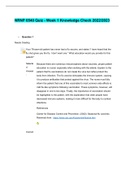
Review Test Submission: Quiz - Week 1 Knowledge Check • Question 1 Needs Grading Your 78-year-old patient has never had a flu vaccine, and states “I have heard that the flu shot gives you the flu. I don’t want one.” What education would you provide for this patient? Selected Answer: Correct Because there are numerous misconceptions about vaccines, proper patient education is crucial, especially when working with the elderly. Explain to the patient that flu vaccinations do not create the virus but rather protect the body from infection. The flu vaccine stimulates the immune system, causing it to produce antibodies that protect against the virus. The nurse must fully inform the patient that one of this vaccination's most common side effects is mild flu-like symptoms following vaccination. These symptoms, however, will disappear in one to two days. Finally, the importance of vaccination should be highlighted to the patient, with the explanation that older people have decreased immune systems, making it more difficult for the body to combat infections. References Center for Disease Control and Prevention. (2022). Seasonal flu vaccines. Retrieved from: Answer: Explain the mechanism of the immunization in providing an immune response, the risks of morbidity and mortality of the influenza virus each year, the risks of the flu in the older populations, especially those 75 or older. You might also explain the risks of transmitting the flu virus to older friends and spouse. Older adults are especially vulnerable to both the short- and long-term complications of this infection. For example, when exposed to influenza, older individuals are more likely to experience a severe infection, develop pneumonia, require hospitalization, or die. Mortality rates in patients 75 years and older are four to eight times higher than those seen for patients aged 65 to 74 years and over 50 times higher than those seen before the age of 65 years. A total of 90% of deaths attributable to influenza occur in individuals aged 60 years and older. Response Feedback: [None Given] • Question 2 Needs Grading In older patients about to receive a solid organ transplant, which immunization would you withhold and for what reason? Selected Answer: Some live vaccinations are entirely unsuitable for solid-organ transplant recipients. The oral polio vaccine, yellow fever, vaccinia, bacillus Calmette-Guerin, and live oral typhoid vaccine are among them. Immunosuppression is one of the contraindications of vaccination with live vaccines. Reference Duchini, A., Goss, J. A., Karpen, S., & Pockros, P. J. (2003). Vaccinations for adult solid-organ transplant recipients: current recommendations and protocols. Clinical microbiology reviews, 16(3), 357–364. 364.2003 Correct Answer: Older patients who are being considered for a solid organ transplant should receive the same immunizations recommended for all older adults. ZVL is contraindicated for recipients of a solid organ transplantation because it is a live virus vaccine. RZV is not contraindicated in immunocompromised individuals, including solid organ transplant recipients.
Información del documento
- Subido en
- 19 de abril de 2023
- Número de páginas
- 14
- Escrito en
- 2022/2023
- Tipo
- Examen
- Contiene
- Preguntas y respuestas

