Seminars Public International Law
Week 1
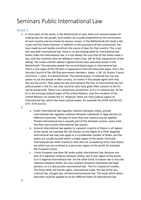
1. In most parts of the world, in the Netherlands as well, there are national bodies for
making laws for the people. Such bodies are usually established by the constitution
of each country and are known by various names. In the Netherlands this body is the
crown and the States-General. In addition to the provisions of the constitution, the
laws made by such bodies constitute the source of laws for that country. This is not
the case with international law, there is no law-making body for international law.
States make the international law. It is not always the case that all the states make a
law, only the countries who are willing to make a law, will do that, equalisation of the
willing. The crown and the cabinet (=government) have executive power in the
Netherlands. The executive power has no centralized organ in international law.
There is one organ of the UN who is supposed to have the executive organ, this is the
Security Council of the UN (five permanent members, states -> UK, US, Russia, France
and China -> veto). It is decentralized. The judicial power, in national law, has the
power to sue the people in their country, no matter if this people agree with that,
this are the courts. They apply the law and interpret the law. In international law the
judicial power is the ICJ, but only countries who have given their consent to the ICJ
can be prosecuted. There is no compulsory jurisdiction, as it is in national law. As the
ICJ is the principal judicial organ of the United Nations, only the members of the
United Nations can invoke the ICJ. However, there are more judicial organs of
international law, which also have judicial power, for example the ECHR and the ICC,
ICTY, ICTR and ECJ.
2.
a. Public international law regulates relations between states, private
international law regulates relations between individuals or legal persons (in
different countries). The laws of more than one country may be applied.
Private international law is actually part of the domestic system, every state
has their own private international law system.
b. General international law applies to a greater majority of States in all regions
of the world, for example the UN Charter on the Rights of a Child. Regional
international law may also apply to a considerable number of States, but the
States are usually located within a single region of the world. Particular
international law refers mainly to rules that are accepted by only a few States,
but which are not confined to a particular region of the world, for example
the European Union.
c. I think European law does fall under public international law, because one
part of it regulates relations between States, but in one region of the world,
so it is regional international law. On the other hand, European law is not only
relations between States, but also relations between individuals and legal
persons, so it is also private international law. The EU is based on treaties.
The three fields are human rights, international trade, the law of the sea,
criminal law, refugee law, climate/environmental law. The levels which Abass
describes could be applied to all the different fields of international law.
3.
Week 1
1. In most parts of the world, in the Netherlands as well, there are national bodies for
making laws for the people. Such bodies are usually established by the constitution
of each country and are known by various names. In the Netherlands this body is the
crown and the States-General. In addition to the provisions of the constitution, the
laws made by such bodies constitute the source of laws for that country. This is not
the case with international law, there is no law-making body for international law.
States make the international law. It is not always the case that all the states make a
law, only the countries who are willing to make a law, will do that, equalisation of the
willing. The crown and the cabinet (=government) have executive power in the
Netherlands. The executive power has no centralized organ in international law.
There is one organ of the UN who is supposed to have the executive organ, this is the
Security Council of the UN (five permanent members, states -> UK, US, Russia, France
and China -> veto). It is decentralized. The judicial power, in national law, has the
power to sue the people in their country, no matter if this people agree with that,
this are the courts. They apply the law and interpret the law. In international law the
judicial power is the ICJ, but only countries who have given their consent to the ICJ
can be prosecuted. There is no compulsory jurisdiction, as it is in national law. As the
ICJ is the principal judicial organ of the United Nations, only the members of the
United Nations can invoke the ICJ. However, there are more judicial organs of
international law, which also have judicial power, for example the ECHR and the ICC,
ICTY, ICTR and ECJ.
2.
a. Public international law regulates relations between states, private
international law regulates relations between individuals or legal persons (in
different countries). The laws of more than one country may be applied.
Private international law is actually part of the domestic system, every state
has their own private international law system.
b. General international law applies to a greater majority of States in all regions
of the world, for example the UN Charter on the Rights of a Child. Regional
international law may also apply to a considerable number of States, but the
States are usually located within a single region of the world. Particular
international law refers mainly to rules that are accepted by only a few States,
but which are not confined to a particular region of the world, for example
the European Union.
c. I think European law does fall under public international law, because one
part of it regulates relations between States, but in one region of the world,
so it is regional international law. On the other hand, European law is not only
relations between States, but also relations between individuals and legal
persons, so it is also private international law. The EU is based on treaties.
The three fields are human rights, international trade, the law of the sea,
criminal law, refugee law, climate/environmental law. The levels which Abass
describes could be applied to all the different fields of international law.
3.