Lecture 18 – Synthesis of lipids
Lipid definition:
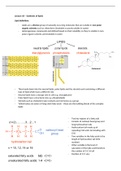
- Lipids are a diverse group of naturally occurring molecules that are soluble in non-polar
organic solvents such as chloroform (insoluble or poorly soluble in water)
- Heterogeneous compounds and defined based on their solubility so they’re soluble in non-
polar organic solvents and insoluble in water
- They break down into the neutral lipids, polar lipids and the steroids each containing a different
type of lipid which have a different role
- Neutral lipids have a storage role in cells e.g. triacylglycerol
- Polar lipids have a structural role e.g. phospholipids
- Steroids such as cholesterol also contains sex hormones as a group
- Yellow boxes are esters of long chain fatty acids – these are the building blocks of the complex
lipids
- Two key regions of a fatty acid
- Consists of carboxyl head group and
long hydrocarbon tails
- Hydrocarbon tail made up of
repeating CH2 units terminating with
CH3
- Two variables in the fatty acids is the
length of hydrocarbon tail (CH2
number)
- Other variable is the level of
saturation of the fatty acid therefore
the number of C=C in tail
- Position of C=C vary
,- Fatty acids produced
by a cycle of reactions
- Fatty acid synthesis
takes place in the
cytosol and involves
many enzymes which
are composed of a
multi enzyme complex
- This complex is called
fatty acid synthase
and it contains many
different active sites of
enzymes
- Many intermediates
involved and mostly
linked to ACP (acetyl carrier protein) which is part of the fatty acid synthase complex
- We grow fatty acids from fatty acid precursor which is acetyl CoA which becomes acetyl ACP
(linked to carrier) and we elongate the fatty acid 2 carbons at a time pushing it through a cycle of
reactions
- Each carbon is joined via the carboxyl end
- The two carbons come from malonyl CoA which becomes malonyl ACP these are referred to as
the carbon donor and 2 carbons are added to the elongating fatty acid from malonly ACP which
is a 3C compound, since we only add 2 carbons we lose the last one as CO2
- Fatty acids go through 4 reactions in this cycle: condensation (adding carbons), reduction,
dehydration and reduction – goes from fatty acid which is x carbons to fatty acid which is x
carbons +2
Acetyl group shuttle
- Starting point for FA synthesis is
acetyl CoA
- Majority of fatty acid coA
produced in mitochondria and
the membrane is not freely
permeable to acetyl coA
- There’s a shuttle process which
can move acetyl coA out of
mitochondria into the cytoplasm
- Acetyl group shuttle:
mitochondrial Acetyl coA reacts
with oxaloacetate to form citrate using
citrate synthase
- Citrate is freely permeable to leave and move across to the cytoplasm and through the action of
a second enzyme called citrate lyase citrate is broken down to form acetyl coA and oxaloacetate
(cycled back through malate and pyruvate back into mitochondria)
,- Once acetyl CoA is in the cytosol the first reaction that occurs is to convert the 2 carbon acetyl
CoA carbon into the 3 carbon malonyl coA (carbon donor in elongation process) using enzyme
acetyl coA carboxylase.
- This is an irreversible step and it’s at this point carbon gets committed to fatty acid synthesis
- Major point of control and regulation in this pathway
Acyl carrier protein
- Next step is to link acetyl CoA and malonyl CoA to the ACP, this is done by 2 different transferase
enzymes
- ACP replaces CoA so the CoA is a product as a result
- The acetyl ACP are our 2 carbon precursor compounds for elongation and we have malonyl ACP
which is our carbon donor, the 3 carbon compound – this donates 2 carbons to our elongating
fatty acid
Condensation
- Condensation reaction where
acetyl ACP is condensed with
malonyl ACP catalysed by enzyme
β-ketoacyl synthase
- This adds 2 carbons to the
carboxyl end of the acetyl ACP
producing a 4 carbon compound
called acetoacetyl ACP
- Acetoacetyl ACP is a 4 carbon beta
ketoacyl ACP
- Products of carbon dioxide and
ACP as well
, Reduction
- Acetoaceyl ACP molecule is then reduced
for the first time to form D-3-hydroxbutryl
ACP and NADPH is oxidised to form
NADP+
- Using enzyme β-ketoacyl reductase
Dehydration
- Next is the dehydration reaction where
D-3Hydroxbutyryl ACP is dehydrated to
form water and crotonyl acp (4 carbon
compound)
- This uses enzyme dehydratase
Reduction
- The second reduction in the cycle
- Crotonyl ACP reduced to butyryl ACP
- NADPH (reductant) against oxidised to
NADP+
- Enzyme: enoyl redutase
Lipid definition:
- Lipids are a diverse group of naturally occurring molecules that are soluble in non-polar
organic solvents such as chloroform (insoluble or poorly soluble in water)
- Heterogeneous compounds and defined based on their solubility so they’re soluble in non-
polar organic solvents and insoluble in water
- They break down into the neutral lipids, polar lipids and the steroids each containing a different
type of lipid which have a different role
- Neutral lipids have a storage role in cells e.g. triacylglycerol
- Polar lipids have a structural role e.g. phospholipids
- Steroids such as cholesterol also contains sex hormones as a group
- Yellow boxes are esters of long chain fatty acids – these are the building blocks of the complex
lipids
- Two key regions of a fatty acid
- Consists of carboxyl head group and
long hydrocarbon tails
- Hydrocarbon tail made up of
repeating CH2 units terminating with
CH3
- Two variables in the fatty acids is the
length of hydrocarbon tail (CH2
number)
- Other variable is the level of
saturation of the fatty acid therefore
the number of C=C in tail
- Position of C=C vary
,- Fatty acids produced
by a cycle of reactions
- Fatty acid synthesis
takes place in the
cytosol and involves
many enzymes which
are composed of a
multi enzyme complex
- This complex is called
fatty acid synthase
and it contains many
different active sites of
enzymes
- Many intermediates
involved and mostly
linked to ACP (acetyl carrier protein) which is part of the fatty acid synthase complex
- We grow fatty acids from fatty acid precursor which is acetyl CoA which becomes acetyl ACP
(linked to carrier) and we elongate the fatty acid 2 carbons at a time pushing it through a cycle of
reactions
- Each carbon is joined via the carboxyl end
- The two carbons come from malonyl CoA which becomes malonyl ACP these are referred to as
the carbon donor and 2 carbons are added to the elongating fatty acid from malonly ACP which
is a 3C compound, since we only add 2 carbons we lose the last one as CO2
- Fatty acids go through 4 reactions in this cycle: condensation (adding carbons), reduction,
dehydration and reduction – goes from fatty acid which is x carbons to fatty acid which is x
carbons +2
Acetyl group shuttle
- Starting point for FA synthesis is
acetyl CoA
- Majority of fatty acid coA
produced in mitochondria and
the membrane is not freely
permeable to acetyl coA
- There’s a shuttle process which
can move acetyl coA out of
mitochondria into the cytoplasm
- Acetyl group shuttle:
mitochondrial Acetyl coA reacts
with oxaloacetate to form citrate using
citrate synthase
- Citrate is freely permeable to leave and move across to the cytoplasm and through the action of
a second enzyme called citrate lyase citrate is broken down to form acetyl coA and oxaloacetate
(cycled back through malate and pyruvate back into mitochondria)
,- Once acetyl CoA is in the cytosol the first reaction that occurs is to convert the 2 carbon acetyl
CoA carbon into the 3 carbon malonyl coA (carbon donor in elongation process) using enzyme
acetyl coA carboxylase.
- This is an irreversible step and it’s at this point carbon gets committed to fatty acid synthesis
- Major point of control and regulation in this pathway
Acyl carrier protein
- Next step is to link acetyl CoA and malonyl CoA to the ACP, this is done by 2 different transferase
enzymes
- ACP replaces CoA so the CoA is a product as a result
- The acetyl ACP are our 2 carbon precursor compounds for elongation and we have malonyl ACP
which is our carbon donor, the 3 carbon compound – this donates 2 carbons to our elongating
fatty acid
Condensation
- Condensation reaction where
acetyl ACP is condensed with
malonyl ACP catalysed by enzyme
β-ketoacyl synthase
- This adds 2 carbons to the
carboxyl end of the acetyl ACP
producing a 4 carbon compound
called acetoacetyl ACP
- Acetoacetyl ACP is a 4 carbon beta
ketoacyl ACP
- Products of carbon dioxide and
ACP as well
, Reduction
- Acetoaceyl ACP molecule is then reduced
for the first time to form D-3-hydroxbutryl
ACP and NADPH is oxidised to form
NADP+
- Using enzyme β-ketoacyl reductase
Dehydration
- Next is the dehydration reaction where
D-3Hydroxbutyryl ACP is dehydrated to
form water and crotonyl acp (4 carbon
compound)
- This uses enzyme dehydratase
Reduction
- The second reduction in the cycle
- Crotonyl ACP reduced to butyryl ACP
- NADPH (reductant) against oxidised to
NADP+
- Enzyme: enoyl redutase