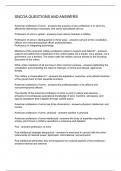
BCEN QUESTIONS & ANSWERS TESTBANK Complete Solution
BCEN QUESTIONS & ANSWERS TESTBANK Complete Solution Shock - ANSWER impaired tissue perfusion secondary to circulatory failure 4. The nurse is preparing a client who had a below-the-knee (BKA) amputation for discharge to home. Which recommendations should the nurse provide this client? (Select all that apply) a. Wash the stump with soap and water. b. Avoid range of motion exercise. c. Apply alcohol to the stump after bathing. d. Inspect skin for redness. e. Use a residual limb shrinker. conduction abnormalities) and SNS (stress, pain) Chonotropes Drug Class - ANSWER drugs that affect HR at SA node Inotropes Drug Class - ANSWER drugs that affect contractility of the heart Given IV Nitroglycerin - ANSWER Coronary artery dilator (improves collateral bloodflow to MI tissue) Peripheral vasodilator: strong pre-load reduction, mild afterload reduction Must be mixed in glass- may require special tubing Do NOT give within 24h of phosphodiesterase inhibitors Nitroprusside - ANSWER Potentiates depolarizing neuromuscular blocking agents Decreases SVR Moderate preload reduction, strong afterload reduction Caution with hyponatremia, hypothyroidism and renal impariment Epinepherine - ANSWER Increases CO, HR, SVR and relaxes bronchial smooth muscle Titrate to desired response, may cause hyperglycemia Dobutamine - ANSWER decreases preload and afterload + increases contractility, SV, and CO Does NOT increase O2 demand Correct hypovolemia before administering Dopamine - ANSWER Lower doses: increases contractility Higher doses: additionally increases vasoconstriction Correct hypervolemia before administering Milrinone - ANSWER Increases CO, vasodilation Decreases SVR Monitor for dysrhythmias, hypotension, hypokalemia Norepinepherine - ANSWER Increases CO, HR, SVR Increases BP and coronary artery blood flow Tissue necrosis if infiltration Phenylepherine - ANSWER Decreases HR Increases SVR, SBP Tissue necrosis if infiltration Admin with IVF for hypotension Vasopressin - ANSWER Increases SVR Causes vasoconstriction, water retention, urine concentration May be used to augment vasopressors Adenosine - ANSWER Indicated for SVT and Wolff-Parkinson-White Slows SA and AV node conduction Rapid IVP May cause transient heartblock or asystole Amiodarone - ANSWER Indicated for unstable VT/VF, SVT Decreases AV conduction, prolongs action potential and refractory period Digoxin - ANSWER Indicated for Afib/Aflutter and SVT Decreases SA and AV node conduction + increases force of contraction Monitor serum drug levels for toxicity Diltiazem - ANSWER Indicated for Angina, htn, uncontrolled afib/aflutter Slows AV conduction CA channel blocker Cont EKG monitoring during infusion IV solution stable only for 24 hours Esmolol - ANSWER Indicated for SVT, HTN, and sinus tach slows HR, dec CO, reduces BP given slowly, not IVP Ibutilide - ANSWER Indicated for rapid conversion of afib/aflutter on new onset slows sinus node rate and AV conduction Dose related prolongation of QT interval can cause torsades within 4-6 hours of administration Lidocaine - ANSWER Indicated for PVCs, vtach and vfib Decreases depolarization, automaticity and excitability of ventricle during diastole Monitor for CNS toxicity Procainamide - ANSWER Indicated for Afib, SVT, PVCs and Vtach increases threshold of ventricles and His-Purkinje fibers Decreases myocardial excitability and conduction velocity Depresses contractility May result in RVR, QRS widening, and AV blocks Propranolol - ANSWER Indicated for SVT Slows sinus HR + decreases CO, BP, and MI severity give slowly or dilute and infuse Verapamil - ANSWER Indicated for SVT and Afib/aflutter slows SA, AV conduction + vasodilation and decreased PVR Caution with LV dysfunction, hypertrophic cardiomyopathy, and long term betablocker use Home meds + presentation of CP - ANSWER pts who used phosphodiesterase inhibitors (-afil) may have decreased CO risk w/ inferior wall infarct and nitroglycerin administration Ticagrelor may have decreased effectiveness when given with ASA Cardioversion - ANSWER synchronized defibrillation with spontaneous circulation/hemodynamically stable SVT, afib/aflutter, Vtach with pulse Defibrillation - ANSWER no spontaneous circulation Monophasic (200-300j) or Biphasic (120-200j) (most biphasic) Peds pts 2j/kg then 4j/kg; max 10j/kg Wolff-Parkinson-White Syndrome - ANSWER First Degree Heart Block - ANSWER prolonged PR-interval usually benign Second Degree Type 1 Heart Block - ANSWER gradually increasing PR interval that results in a block that results in a P wave with no QRS after blocked beat the PR is usually shorter Second Degree Type 2 Heart Block - ANSWER consistent PR interval that eventually results in a blocked impulse that results in P wave with no QRS after blocked beat the PR is usually normal Third Degree Heart Block - ANSWER P-P intervals are consistent and QRS-QRS are consistent but some P-waves are hidden in QRS complexes Acute Coronary Syndrome - ANSWER Stable angina--unstable angina-- NSTEMI-- STEMI Check EKG, Trop and/or CK-MB MONA Percutaneous Coronary Intervention or thrombolytics Heart Failure: L vs R sided - ANSWER R: JVD, acites, peripheral edema, hepatomegaly, inc CVP L: SOB, dyspnea, crackles, S3 heart sound, pulm edema HF confirmed with BNP > 100 Pericardial Tamponade - ANSWER pericardial sac which usually contains 20-50 cc of fluids starts to rapidly fill with fluids Usually results in pericardial or cardiac effusion Compression of heart makes it an ineffective pump Becks Triad: Distant muffled heartsound, Distended JVD, Decreased BP Peripheral Arterial Occlusion - ANSWER pain is constant but worsens with movement and improves with rest burning in nature cold extremity with dec distal pulses Elevate HOB but not extremity Encourage activity embolectomy, thrombolytics, surgery Peripheral Venous Occlusion - ANSWER Pain is more common with standing and diminishes with rest/elevation deep and aching/throbbing in nature swelling in extremity with darkened color and possible fever elevate affected extremity absolute bed rest compression socks, anticoagulants, vena cava filter Respiratory Acidosis - ANSWER low pH, high PaCO2, normal or high with compensation HCO3 causes: CNS depression from drugs/injury/disease, asphyxia, hypoventilation, COPD or lung disease Respiratory Alkalosis - ANSWER high pH, low PaCO2, normal or low with compensation HCO3 causes: hyperventilation, respiratory stimulation from drugs/disease/infection/fever, gram-neg bacteria, anxiety or pain Metabolic Acidosis - ANSWER low pH, normal or low w/ compensation PaCO2, low HCO3 Causes: diarrhea, renal disease, hepatic disease, endocrine disorders, shock Metabolic Alkalosis - ANSWER high pH, normal or high w/compensation PaCO2, high HCO3 causes: prolonged vomiting or gastric suction; K+ loss from renal disease or steroids, excessive alkali ingestion Pulmonary Embolism Types - ANSWER -Blood clot: usually migrates from DVT, pelvis, or R heart -Fat: usually 24-48 hours after long bone fracture- presents with petechiae over chest and axilla -Amniotic fluid: shortly after delivery -Air: from dive injuries or inadvertent air through IV Pulmonary Embolism Clinical Presentation - ANSWER SOB, tachypnea, tachycardia, diaphoresis, syncope, fever, cough with hemoptysis, S2 heart sound, JVD, elevated ESR/D-dimer, new onset R-BBB/peaked P waves/depressed T waves Acute Bronchitis - ANSWER viral in nature- OTC cough medication, humidification, bronchodilators, and corticosteroids can be used supportively R/O: influenza (if febrile), pneumonia (if hypoxic or rales) and pertussis (if paroxysmal cough) Bronchiolitis - ANSWER Viral infection, usually RSV- copious nasal secretions self-limiting with distress peaking between 5-7 days R/O: influenza, bacterial infection Suction nares, supplemental O2, bronchodilators May require admission if >70breaths/min Pneumonia - ANSWER Can be viral (slower onset) or bacterial (rapid onset) in nature Infiltrates may be seen on chest Xray in bacterial cases Inhalation Injury - ANSWER Inhalation of smoke or other toxins which causes damage to cilia making it difficult to clear secretions Check carboxyhemoglobin levels + manage airway Asthma - ANSWER Chronic reactive airway disease respiratory alkalosis (early) and acidosis (late) Wheezing on inspiration (early) and expiration (late) Breath sounds decrease in lower lobes first and progress upwards Short-acting Beta Agonists for Asthma Treatment - ANSWER IE: Epi/racemic epi, albuterol, salmeterol, levalbuterol relax smooth muscles of bronchioles-- bronchodilation side effects: tachycardia Anticholinergics for Asthma Treatment - ANSWER IE: Ipratropium inhibits contractions of bronchial smooth muscle and limits mucus secretion side effects: dry mouth, pupil dilation, inc HR, blurred vision Corticosteriods for Asthma Treatment - ANSWER IE: dexamethasone, beclomethasone, prednisone, methylprednisone Anti-inflammatory properties and immunosuppressant effects reduce airway inflammation and inhibit mucus production; decrease swelling and hyperactivity Magnesium Sulfate for Asthma Treatment - ANSWER inhibits smooth muscle contraction, decreases release of histamine, inhibits acetylcholine release COPD - ANSWER Includes chronic bronchitis (cough 3+ months for 2 yrs) and emphysema (destruction of aveoli) Bronchitis: blue bloater, productive cough, normal RR, hypoxemia, cyanosis, cor pulmonale, periph edema Emphysema: pink puffer, no cough, thin +barrel chest, tachypnea, pursed-lip breathing/tripod positioning, xray will show lung overinflation and low diaphragm CPAP & BIPAP - ANSWER CPAP: constant mild airflow on single setting to keep airway open BIPAP: time-cycled airflow that delivers two levels of pressure, a lower pressure on inhalation and higher pressure on exhalation Risks: decrease venous return to heart/may dec CO in pt's who are dehydrated, barotrauma, aspiration if pt vomits Pulmonary Edema (types, causes, presentation, treatment) - ANSWER cardiogenic: secondary to high pulmonary capillary pressure non-cardiogenic: pulmonary capillary permeability Causes: ARDS, kidney failure, submersion injury, head trauma, rapid re-expansion of lungs (commonly rapid ascent while scuba diving), inhalation of toxic gas, drug use presentation: pink frothy sputum, crackles/wheezes/SOB, tachypnea + tachycardia, sensation of suffocation Treat underlying cause, mechanical ventilation w/ low tidal volumes, CPAP or BIPAP ARDS Definition/Mechanism - ANSWER Form of noncardiogenic pulmonary edema inflammatory syndrome characterized by aveolar injury which increases aveolar capillary permeability allowing protein-rich fluid to pass into aveoli resulting in hypoxemia ARDS (causes, treatments, complications) - ANSWER Causes: aspiration, pneumonia, toxic inhalation, pulmonary contusion, submersion injury (indirect causes include sepsis, trauma, massive transfusion, burns, DIC, shock, pancreatitis) Treatments: intubation with PEEP and low tidal volumes, treat underlying cause, caution with fluids Complications: renal failure, BGL abnormalities, MODS, ventilator-associated pna Pleural Effusion (definition, assessment, intervention) - ANSWER Definition: abnormal collection of fluid in pleural space-- not a disease but result of underlying condition (ie: CHF, nephrotic syndrome, pna, infected wound, trauma, lung abscess, tumor) Assessment: CT, Xray, pleural aspiration Intervention: analgesia, O2, tx underlying cause, needle thoracentesis or chest tube if large and compromising respirations Airway Obstruction: Larynx - ANSWER Large obstructions will completely block airway: no airway sounds/movement, no coughing Smaller obstructions will cause hoarseness and aphonia Airway Obstruction: Trachea - ANSWER large obstructions will cause complete airway obstruction with lack of coughing, no airway sounds/movement Airway Obstruction: Bronchi - ANSWER Cough, unilateral wheezing, decrease in breath sounds 80-90% of aspirated objects lodge here In adults more likely to lodge in R bronchus; peds either side is equally likely Spontaneous Pneumothorax (characteristics, causes, presentation, interventions) - ANSWER Characteristics: accumulation of air in pleural space causing partial or complete collapse of lung as air accumulates increasing pressure Causes: young, thin, tall males or smokers with pulmonary disease Presentation: sudden onset pleuritic CP, dyspnea, cough, dec breath sounds on affected side Interventions: high fowler, O2, chest tube (5th or 6th ICS midaxillary) Simple Pneumothorax (characteristics, causes, presentation, interventions) - ANSWER Characteristics: accumulation of air in pleural space causing partial or complete collapse of lung as air accumulates increasing pressure Causes: Blunt trauma Presentation: CP, dyspnea, cough, dec breath sounds on affected side Interventions: high fowlers, O2, Chest tube may be necessary for larger pneumos Open Pneumothorax (characteristics, causes, presentation, interventions) - ANSWER Characteristics: penetrating wound allowing air to enter thorax and loss of normal negative intrathoracic pressure Causes: penetrating trauma Presentation: visible chest wound, resp distress, sucking sound, asymmetrical chest expansion, bubbling of blood around wound, subcutaneous emphysema Intervention: ABCs, cover wound w/ 3 sided occlusive dressing, prep for chest tube insertion Tension Pneumothorax (characteristics, causes, presentation, interventions) - ANSWER Characteristics: air enters pleural space during inspiration and is unable to escape on exhalation, pressure shifts mediastinum and collapses opposite lung, dec CO, life threatening Causes: blunt or penetrating trauma or complication of mechanical ventilation Presentation: severe resp distress, dec CO, distant heart sounds, JVD, deviated trachea (late) Intervention: needle decompression, chest tube insertion, pain control Hemothorax (characteristics, causes, presentation, interventions) - ANSWER Characteristics: accumulation of blood in pleural space, often accompanied by pneumothorax (can accumulate up to 1500ml of blood in chest cavity) Causes: blunt or penetrating trauma Presentation: resp distress, pain on inspiration, dec breath sounds on affected side, asymmetric chest wall movement Interventions: ABCs, fluids, blood products, chest tube placement, emergent surgery (only if 1500ml initial volume, or 1000mL initial with 200ml/hr for 2-4 hours) Flail Chest (definition, presentation, intervention) - ANSWER Definition: 2 + adjacent ribs fractured in 2 + locations or detachment of sternum; free floating segment is drawn inward with insp and outward on exp causing paradoxical chest wall motion-- life threatening if not immediately identified and treated Presentation: paradoxical chest wall movement, resp distress, CP, hemo/pneumothorax, subcutaneous emphysema, pony crepitus, impaired cough, hypoxia Interventions: mechanical ventilation w/ PEEP chest tube placement if hemo/pneumothorax prepare for surgery Pulmonary Contusion (definition, causes, presentation, interventions) - ANSWER Definition: injury of lung resulting in edema and blood collection Causes: blunt chest trauma, missile trauma, barotrauma Presentation: resp distress, CP, dec breath sounds/crackles/wheezes, chest wall bruising, cough w/ hemoptysis Interventions: Chest xray (may not reveal infiltrates until 12+ hours after injury), continuous SPO2 monitoring, O2 or CPAP/BIPAP Ruptured Diaphragm (definition, causes, presentation, interventions) - ANSWER Definition: abd contents herniate into chest and compress lungs/heart/aorta/vena cava Causes: blunt or penetrating chest trauma (most on L-side because R-side is stronger and protected by liver) Presentation: dyspnea, dysphagia, bowel sounds in chest, abd pain radiating to L shoulder, undigested food or fecal matter in chest tube drainage Interventions: chest xray/CT/FAST exam, NG or OG, emergent surgical repair Upper GI Bleed (causes, presentation, assessment, interventions) - ANSWER Causes: duodenal and gastric ulcers, Mallory-Weiss syndrome, esophagitis, NSAID use, esophageal varices Presentation: hematemesis or melena, dizziness, weakness, syncope, postural hypotension (lower GIB will be bright red in color) Assessment: labs, CT, endoscopy, occult blood testing, BUN:creatinine ration not at 10:1 (BUN elevates with GIB but creatinine remains unaffected) Interventions: gastric tube, IV, blood transfusion may be needed for hbg < 7 Occult blood false negatives and false positives - ANSWER False positives: red meat, radishes, turnips, cabbage, cauliflower, horseradish, raw broccoli, cantaloupe False negatives: citrus fruits and vitamin C supplements Acute Gastroenteritis (definition, presentation, interventions) - ANSWER Definition: bacterial, viral, or chemical in origin (including food poisoning) Presentation: N/V/D, lower abd cramping, fever, dehydration Splenomegaly suggests bacterial infection Interventions: fluids, monitor for metabolic acidosis, monitor for K/glucose/Ca abnormalities, NPO, stool sample, meds for sx management/treatment Pyloric Stenosis (definition, presentation, assessment, intervention) - ANSWER Definition: hyperplasia/hypertrophy of the pylorus muscle at the junction of the stomach w/ the duodenum preventing stomach emptying Presentation: usually 2-5wks old, projectile vomiting after feeding, seeming hungry immediately after feeding/vomiting, poor weight gain, few stools, visible peristaltic waves, RUQ mass, dehydration s/s Assessment: labs, abd US, barium swallow, urinalysis Interventions: IV fluid and electrolyte replacement, monitor Is &Os, gastric tube insertion, prep for surgery Esophageal Obstruction (definition, presentation, intervention) - ANSWER Definition: Typically caused by lodging of food bolus or bone Presentation:May state that something is stuck, difficulty swallowing, drooling, subcutaneous emphysema of neck if perforation has occurred Intervention: ensure no airway obstruction, upright position, IV glucagon is a smooth muscle relaxant, esophagoscopy Sengstaken-Blakemore Tube - ANSWER designed for emergency control of bleeding esophageal varices and/or as diagnostic tool to determine source/extent of hemorrhage into stomach introduced orally or nasally Minnesota Tube - ANSWER Four lumen, double balloon designed for the tx of esophageal varices Elongated esophageal balloon helps control bleeding, third and fourth lumens facilitate suctioning above the balloon and in the stomach Linton-Nachlas Tube - ANSWER Triple lumen designed to control bleeding of esophageal varices Large 700-800 ml balloon controls bleeding Suction fluids above balloon and gastric contents below balloon Mallory-Weiss Syndrome (definition, presentation, assessment, interventions) - ANSWER Definition: small tears to the junction of the esophagus and stomach Presentation: vomiting and retching followed by hematemesis, ETOH/ASA use, coughing, bulimia, pregnancy, hematochezia (frank red stool) possible, red or coffee ground emesis Assessment: labs, gastric tube for aspirate, labs Interventions: IV access, antiemetics, prep for endoscopy, avoid balloon tamponade (last resort) Murphy Sign - ANSWER palp the R subcostal area while pt inspires deeply A positive response occurs when pt experiences pain w/palp- may even have inspiratory arrest Pancreatitis Complications - ANSWER -Hypocalcemia: free fatty acids formed by lipase release bind with Ca, may present as tetany -Pleural effusions: pancreatic enzymes can trigger inflammatory cascade causing inc cap permeability -ARDS: inflammatory process creates leaky capillaries resulting in pleural effusions and fluid in alveoli causing ARDS -Retroperitoneal Bleeding: autolysis caused by pancreatic enzymes can cause bleeding from pancreas and other abd structures- watch for Cullen sign (ecchymosis to umbilicus) and Grey-Turner sign (ecchymosis to flanks) Hepatitis Discharge Teaching - ANSWER Fecal-Oral (A, E): use private bathroom, do not handle/prepare food that will be eaten by others Parenteral (B, C, D): do not donate blood or tissue, practice safe sex, do not share personal items All: avoid ETOH, steroids, eat small freq meals that are low fat and high carb Appendicitis (definition, presentation, assessment, interventions) - ANSWER Definition: obstruction of appendiceal lumen causing decreased blood flow, necrosis, and perforation- can lead to peritonitis; most common cause of peds abd pain but is rare under 2 years of age Presentation: early- dull steady periumbilical pain, mild fever, nausea; late (12-48 hrs)- RLQ pain, flexing of knees may dec pain, rebound tenderness; pregnant pt's may have RUQ pain as gravid uterus pushes the appendix upwards Assessment: CBC (leukocytosis), UA/hCG test, CT w/ contrast recommended over US Intervention: IVF, NPO, prep for surgery Ulcerative Colitis (definition, presentation) - ANSWER inflammatory bowel disease affecting only large intestine- typically sigmoid and rectal areas; affects only mucosal and submucosal layer presentation: abd distention, anemia, N/V/D, fever, LLQ pain, diarrhea containing blood/pus/mucus but not containing fat, rectal bleeding Crohns Disease (definition, presentation) - ANSWER defitinition: inflammatory bowel disease affecting any part of GI tract but most commonly at transition from large to small intestine presentation: abd pain cramping/steady, periumbilical or RLQ pain, intermittent low-grade fever, s/s of intestinal obstruction, associated anal fissures, perianal fistulae or abscesses Intestinal Obstruction Causes - ANSWER -Physical: fecal impaction, hernia, intussusception, volvulus -Nervous system disorders: paralytic ileus -Inflammatory conditions: abscess, inflammatory bowel disease Small vs Large Intestinal Obstruction Presenations - ANSWER Small: rapid onset, frequent copious vomiting of bile and feces, colicky/intermittent/wave-like cramping, bowel movements early and late constipation, minimal distention Large: gradual onset, rare vomiting, low-grade cramping/abd pain, absolute constipation, greatly increased distention Both: fever, tachycardia, high pitched peristaltic rush proximal to obstruction followed by absent bowel sounds distally, borborygmi, elevated WBC Intussusception (definition, causes, presentation, assessment, intervention) - ANSWER Definition: telescoping of bowels; most common in kids 3mo-5years; most common in males Causes: may follow viral infection, polyps, hyperactive peristalsis, abnormal bowel lining Presentation: sudden acute crampy pain, flexed knees, bilious emesis, currant jelly stools with bloody mucus, abd distention, sausage shaped palpable mass in RUQ Assessment: abd xray or CT, barium or air enema Interventions: NPO, barium or air enema, prep for surgery Volvulus (definition, presentation, assessment, interventions) - ANSWER Definition: abnormal bowel rotation with mesenteric attachment; congenital abnormality- results in strangulation of superior mesenteric artery and bowel infarction- usually occurs within first month of life Presentation: bilious vomiting, abd pain/distention, bloody stools, hematemesis, peristaltic waves visible, peritoneal signs of bowel perf Assessment: labs, UA, abd CT Interventions: IV access, GI tube insertion, prep for surgery Peritonitis (definition, causes, presentation, interventions) - ANSWER Definition: inflammation of the peritoneum; primary: blood-borne organisms enter cavity, secondary: abd organs perforate and release contents (more common) Causes: ruptured appendix, pancreatitis, penetrating trauma, peritoneal dialysis Presentation: diffuse pain exacerbated with movement and coughing- may be relieved by flexing knees, tenderness/rebound tenderness, diminished bowel sounds, s/s of sepsis, dehydration, resp difficulties Interventions: NPO/gastric tube insertion/bowel rest, abx, prep for surgery Pathophysiology of Burns - ANSWER -coagulation necrosis of soft tissue occurs leading to release of vasoactive substances -Altered capillary wall leads to increased permeability -vasodilation -edema that typically peaks around 24 hours after injury (typically resolves in the next 18-24 hours) -loss of fluids -alteration to tissue perfusion, swelling of airway, hypovolemia (esp if >20% body surface burned) that can lead to shock/ decreased CO/death Airway/Breathing of Burn Victims - ANSWER -monitor closely, early intubation may be necessary if: agitation, dec LOC, hoarseness/stridor/vocal changes, progressive edema, oral/nasal erythema, inability to manage secretions, extensive facial burns, carbonaceous sputum - Singed nose hairs alone are not a sign for early intubation -Consider CO or cyanide poisoning Circumferential Burn Interventions - ANSWER chest wall escharotomy, electrocautery, and/or fasciotomy Acid Ingestion - ANSWER Common sources: batteries, drain cleaners, toilet bowl cleaners, vinegar, sulfuric acid Tissue Damage Type: coagulation-type necrosis GI Damage: greater damage to the stomach Interventions: NPO, consult toxicology Alkali Ingestion - ANSWER Common sources: drain cleaners, alkaline batteries, fertilizers, lye, baking soda, ammonia Tissue Damage Type: liquefaction of tissue GI Damage: greater damage to esophagus Interventions: NPO, consult toxicology Hydrofluoric Acid (characteristics, presentation, assessment, interventions) - ANSWER Characteristics: fluoride seeks out Ca, can lead to systemic toxicity, clear and colorless liquid, used during oil refinement and as a precursor to household chemicals like Teflon and Freon Presentation: tetany; Chvostek sign (spasm/twitch of the face from tapping on the facial nerve); Trousseau sign (latent tetany in which carpal spasm can be elicited by upper arm compression); dysrhythmia Assessment: EKG, serum ca level Interventions: analgesics, calcium gluconate gel Thermal Burn Interventions - ANSWER -stop the burning process -if burns are less than/equal to 10% total body surface treat area with moistened, cool dressings -if burn is >10% total body surface pt is at risk for hypothermia: cover with dry sterile dressing or clean sheet, maintain body temperature, avoid breaking blisters Tar/Asphalt Burns - ANSWER -tar adheres to skin and creates a barrier that is difficult to remove- may continue to burn skin -stop the burning process -apply fat emollients to assist in loosening tar/asphalt -abx ointment -treat underlying burns as thermal burns Estimating Burn Size - ANSWER -Rule of Nines: based on the principle that each section of the body is a multiple of 9; perineum accounts for 1%; the head is 18% in peds pt's but 9% in adults -Palm method: the pt's hand from wrist crease to finger tips is 1% of total body surface area (ideal for scattered burns) First Degree Burn - ANSWER Tissue Affected: Epidermis (superficial) Presentation: redness, hypersensitivity, pain Healing: heals on own in days without scaring Second Degree Burn - ANSWER Tissue Affected: epidermis, partial dermis Presentation: red, blistered, wet, weepy, whiter, edematous Healing: may heal spontaneously in 2-3 weeks; minimal scaring Third Degree Burn - ANSWER Tissue Affected: entire epidermis and dermis destroyed Presentation: whitish or charred appearance, coagulated vessels may be visible Healing: Scar formation; skin grafting Fourth Degree Burn - ANSWER Tissue Affected: underlying fat, fascia, muscle and/or bone Presentation: often unable to distinguish from third degree burns Healing: scar contracture formation, skin grafting, surgical intervention Fluid Resuscitation in Burn Pts - ANSWER -Lactated Ringers is fluid of choice -Parkland Formula: 4ml LR x body SA x body weight (kg) half of volume in first 8 hours; the other half over next 16 hours -ABLS Formula: 2-4mL (or 3mL peds pt) LR x kg x% body SA Pediatric Burn Considerations - ANSWER ··Relatively greater body surface area/kg ··Impaired thermoregulation ··Limited glycogen stores ··Thinner skin → deeper burns ··Small airway → less edema needed for obstruction ··Lower to ground →
Escuela, estudio y materia
- Institución
- BCEN Q
- Grado
- BCEN Q
Información del documento
- Subido en
- 14 de abril de 2023
- Número de páginas
- 79
- Escrito en
- 2022/2023
- Tipo
- Examen
- Contiene
- Preguntas y respuestas
Temas
-
bcen questions amp answers testbank complete solution shock answer impaired tissue perfusion secondary to circulatory failure 4 the nurse is preparing a client who had a below the knee bka