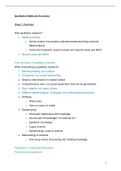
Qualitative Methods Summary
Week 1 Overview
Why qualitative research?
• Meaning making
o Social context: how people understand particular things (beyond
data/numbers)
o Cannot be measured: beyond answer set, beyond cause and effect
• Not just cause and effect
Four principles of qualitative research
What characterizes qualitative research?
1. Meaning making, not numbers
2. Complexity, not causal relationships
• Observe phenomenon in natural context
• Comprehensive view, not causal explanation that can be generalized
3. Micro insights, not macro picture
4. Different epistemological, ontological, and methodological positions
• Ontology
o What exists
o View on nature of reality
• Epistemology
o Perceived relationship with knowledge
o Are we part of knowledge? Or external to it
o Episteme: knowledge
o Logos: science
o Epistemology: study of science
• Methodology & methods
o How we go about discovering and creating knowledge
Paradigms in media/communication
Post positivism/positivism
1
,Positivism
• Positivism believes there’s one truth
• Objective knowledge
• Neutral data collection + analysis
Post-positivism
• Still one truth
• Researchers flawed
Quantitative: predictive; hypothesis
A different way of looking
Constructionism
• Believes there are several truths
• Knowledge filtered through shared meanings
Critical tradition
• Reality and truth shaped by factors such as race, gender, culture
• Aim: achieve transformative social change
Participatory and cooperative tradition
• Co-creation
• Empowering participants
Qualitative: researcher part of process; reflexive
Difference between methodology vs. methods
• Methodology: beliefs related to how to study the social world
• Methods: concrete ways of studying the social world
o Method of data collection
o Method of data analysis
• Methodological section in paper/thesis
o First section: methodological literature
o Second section: justify what you have done to collect and analyse the
data
Shift in perspective/vocabulary
2
, • Quantitative language: hypothesis, variables, correlations, objectivity,
researcher bias
• Qualitative language: research question, concepts, relationships, reflexivity,
situatedness and intersubjectivity
Core features of qualitative research
• Insightful, complex, emancipatory
Week 1 Reading
Chapter 1: Getting Started
Raymond William’s (a cultural materialist) definition of:
• Theory: systematic explanations of real-world everyday practices
• Culture: a way of life
• History: continuous and connected process
Cultural approach to communication
• Communication process: means of production based on the discourse of
individuals and groups produced within a specific cultural, historical, and
political context
o We make meaning and construct our own social realities through our
use of language
• Brennen disagrees that researchers can do qualitative research without using
an explicit theoretical framework/easy to mix qualitative and quantitative
• Brennen agrees with Cliff Christians and James Carey (1989) that the use of
mixed methods should be driven by the RQ and, theoretically and
philosophically grounded
Quantitative vs. Qualitative Research
• Quantitative: systematic, precise, and accurate as it determines validity,
reliability, objectivity, and truth
o Isolate specific elements, and uses numbers to measure causal
relationships between variables
3
, • Qualitative: interdisciplinary, interpretive, political, and theoretical in nature
• According to Steinar Kvale (1996): subject matter of qualitative research is
meaningful relations to be interpreted
o Qualitative consider alternative notions of knowledge and understand
that reality is socially constructed
• When we use symbols to construct our own social realities, those symbols are
using us
• Notion of transparency: researchers being open with their theoretical
foundations and research strategies to be aware of the potential uses and
implications of the research
• Types of textual analysis: discourse analysis, ideological critique, historical
analysis, case studies, open-ended in-depth interviews
o The method (textual analysis) is based on the RQ
• Notion of triangulation: use of multiple methods to develop in-depth
understandings of social experiences
• Qualitative consider the diversity of meanings and values created in media
o Unlike quantitative that measure the effects of different types of
communication (e.g., effects of TV violence on children)
The development of qualitative research
• Hanno Hardt (1992): a critical theorist conceptualized the field of
communication as a behavioral science encouraged an emphasis on
methodological concerns (i.e., sampling, measurement, research design, and
instrumentation)
o overshadow considerations of theoretical issues regarding the role of
media and communication within society
• Neil Postman (1988): suggested that the more insightful media studies stem
from the power of its language, explanations, relevance, and credibility
• By the end of 20th century: qualitative integrated into the realm of
communication and media studies
• In the 21st century: integrated but some researchers see qualitative as an
attack on reason and truth
• Data is envisioned as neutral, objective, authentic (e.g., “data shows…”)
4
Week 1 Overview
Why qualitative research?
• Meaning making
o Social context: how people understand particular things (beyond
data/numbers)
o Cannot be measured: beyond answer set, beyond cause and effect
• Not just cause and effect
Four principles of qualitative research
What characterizes qualitative research?
1. Meaning making, not numbers
2. Complexity, not causal relationships
• Observe phenomenon in natural context
• Comprehensive view, not causal explanation that can be generalized
3. Micro insights, not macro picture
4. Different epistemological, ontological, and methodological positions
• Ontology
o What exists
o View on nature of reality
• Epistemology
o Perceived relationship with knowledge
o Are we part of knowledge? Or external to it
o Episteme: knowledge
o Logos: science
o Epistemology: study of science
• Methodology & methods
o How we go about discovering and creating knowledge
Paradigms in media/communication
Post positivism/positivism
1
,Positivism
• Positivism believes there’s one truth
• Objective knowledge
• Neutral data collection + analysis
Post-positivism
• Still one truth
• Researchers flawed
Quantitative: predictive; hypothesis
A different way of looking
Constructionism
• Believes there are several truths
• Knowledge filtered through shared meanings
Critical tradition
• Reality and truth shaped by factors such as race, gender, culture
• Aim: achieve transformative social change
Participatory and cooperative tradition
• Co-creation
• Empowering participants
Qualitative: researcher part of process; reflexive
Difference between methodology vs. methods
• Methodology: beliefs related to how to study the social world
• Methods: concrete ways of studying the social world
o Method of data collection
o Method of data analysis
• Methodological section in paper/thesis
o First section: methodological literature
o Second section: justify what you have done to collect and analyse the
data
Shift in perspective/vocabulary
2
, • Quantitative language: hypothesis, variables, correlations, objectivity,
researcher bias
• Qualitative language: research question, concepts, relationships, reflexivity,
situatedness and intersubjectivity
Core features of qualitative research
• Insightful, complex, emancipatory
Week 1 Reading
Chapter 1: Getting Started
Raymond William’s (a cultural materialist) definition of:
• Theory: systematic explanations of real-world everyday practices
• Culture: a way of life
• History: continuous and connected process
Cultural approach to communication
• Communication process: means of production based on the discourse of
individuals and groups produced within a specific cultural, historical, and
political context
o We make meaning and construct our own social realities through our
use of language
• Brennen disagrees that researchers can do qualitative research without using
an explicit theoretical framework/easy to mix qualitative and quantitative
• Brennen agrees with Cliff Christians and James Carey (1989) that the use of
mixed methods should be driven by the RQ and, theoretically and
philosophically grounded
Quantitative vs. Qualitative Research
• Quantitative: systematic, precise, and accurate as it determines validity,
reliability, objectivity, and truth
o Isolate specific elements, and uses numbers to measure causal
relationships between variables
3
, • Qualitative: interdisciplinary, interpretive, political, and theoretical in nature
• According to Steinar Kvale (1996): subject matter of qualitative research is
meaningful relations to be interpreted
o Qualitative consider alternative notions of knowledge and understand
that reality is socially constructed
• When we use symbols to construct our own social realities, those symbols are
using us
• Notion of transparency: researchers being open with their theoretical
foundations and research strategies to be aware of the potential uses and
implications of the research
• Types of textual analysis: discourse analysis, ideological critique, historical
analysis, case studies, open-ended in-depth interviews
o The method (textual analysis) is based on the RQ
• Notion of triangulation: use of multiple methods to develop in-depth
understandings of social experiences
• Qualitative consider the diversity of meanings and values created in media
o Unlike quantitative that measure the effects of different types of
communication (e.g., effects of TV violence on children)
The development of qualitative research
• Hanno Hardt (1992): a critical theorist conceptualized the field of
communication as a behavioral science encouraged an emphasis on
methodological concerns (i.e., sampling, measurement, research design, and
instrumentation)
o overshadow considerations of theoretical issues regarding the role of
media and communication within society
• Neil Postman (1988): suggested that the more insightful media studies stem
from the power of its language, explanations, relevance, and credibility
• By the end of 20th century: qualitative integrated into the realm of
communication and media studies
• In the 21st century: integrated but some researchers see qualitative as an
attack on reason and truth
• Data is envisioned as neutral, objective, authentic (e.g., “data shows…”)
4