SED Task 6. Autism as an extreme male brain
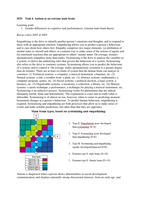
Learning goals
1. Gender differences in cognitive task performances; extreme male brain theory
Baron-cohen 2002 & 2005
Empathising is the drive to identify another person’s emotions and thoughts, and to respond to
these with an appropriate emotion. Empathising allows you to predict a person’s behaviour,
and to care about how others feel. Empathy comprises two major elements: (a) attribution of
mental states to oneself and others, as a natural way to make sense of the actions of agents and
(b) emotional reactions that are appropriate to others’ mental states. On average, females
spontaneously empathise more than males. Systemising is the drive to analyse the variables in
a system, to derive the underlying rules that govern the behaviour of a system. Systemising
also refers to the drive to construct systems. Systemising allows you to predict the behaviour
of a system, and to control it. On average, males spontaneously systemise to a greater degree
than do females. There are at least six kinds of system that the human brain can analyse or
construct: (1) Technical systems: a computer, a musical instrument, a hammer, etc. (2)
Natural systems: a tide, a weather front, a plant, etc. (3) Abstract systems: mathematics, a
computer program, syntax, etc. (4) Social systems: a political election, a legal system, a
business, etc. (5) Organisable systems: a taxonomy, a collection, a library, etc. (6) Motoric
systems: a sports technique, a performance, a technique for playing a musical instrument, etc.
Systemising is an inductive process. Systemising works for phenomena that are indeed
ultimately lawful, finite and deterministic. The explanation is exact and its truth-value is
defeasible. Systemising is of almost no use, however, when it comes to predicting moment-
bymoment changes in a person’s behaviour. To predict human behaviour, empathising is
required. Systemising and empathising are both processes that allow us to make sense of
events and make reliable predictions, but other than that they are opposites.
Autism is diagnosed when a person shows abnormalities in social development,
communication, and displays unusually strong obsessional interests, from an early age and
Learning goals
1. Gender differences in cognitive task performances; extreme male brain theory
Baron-cohen 2002 & 2005
Empathising is the drive to identify another person’s emotions and thoughts, and to respond to
these with an appropriate emotion. Empathising allows you to predict a person’s behaviour,
and to care about how others feel. Empathy comprises two major elements: (a) attribution of
mental states to oneself and others, as a natural way to make sense of the actions of agents and
(b) emotional reactions that are appropriate to others’ mental states. On average, females
spontaneously empathise more than males. Systemising is the drive to analyse the variables in
a system, to derive the underlying rules that govern the behaviour of a system. Systemising
also refers to the drive to construct systems. Systemising allows you to predict the behaviour
of a system, and to control it. On average, males spontaneously systemise to a greater degree
than do females. There are at least six kinds of system that the human brain can analyse or
construct: (1) Technical systems: a computer, a musical instrument, a hammer, etc. (2)
Natural systems: a tide, a weather front, a plant, etc. (3) Abstract systems: mathematics, a
computer program, syntax, etc. (4) Social systems: a political election, a legal system, a
business, etc. (5) Organisable systems: a taxonomy, a collection, a library, etc. (6) Motoric
systems: a sports technique, a performance, a technique for playing a musical instrument, etc.
Systemising is an inductive process. Systemising works for phenomena that are indeed
ultimately lawful, finite and deterministic. The explanation is exact and its truth-value is
defeasible. Systemising is of almost no use, however, when it comes to predicting moment-
bymoment changes in a person’s behaviour. To predict human behaviour, empathising is
required. Systemising and empathising are both processes that allow us to make sense of
events and make reliable predictions, but other than that they are opposites.
Autism is diagnosed when a person shows abnormalities in social development,
communication, and displays unusually strong obsessional interests, from an early age and