NAPSRX PRACTICE QUESTIONS- TEST PREP
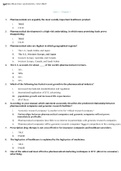
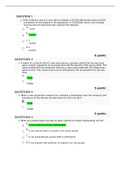
NAPSRX PRACTICE QUESTIONS- TEST PREP 1. Pharmaceuticals are arguably the most socially important healthcare product. i. TRUE ii. FALSE 2. Pharmaceutical development is a high-risk undertaking, in which many promising leads prove disappointing. i. TRUE ii. FALSE 3. Pharmaceutical sales are highest in which geographical regions? i. The U.S., Saudi Arabia, and Japan ii. The U.S., Western Europe, and Japan iii. Western Europe, Australia, and Canada iv. Western Europe, Canada, and Saudi Arabia 4. The U.S. accounts for about ____ of the world’s pharmaceutical revenues. i. 30% ii. 50% iii. 80% iv. 95% 5. Which of the following has fueled recent growth in the pharmaceutical industry? i. increased international standardization and regulation ii. international legalization of DTC advertising iii. population growth and increased life expectancies iv. all of these 6. According to your manual, which statement accurately describes the predicted relationship between pharmaceutical companies and genomic research facilities? i. "Genomic research company" is another term for "ethical research company." ii. Partnerships between pharmaceutical companies and genomic companies will not prove immediately profitable. iii. Pharmaceutical companies have little to no interest in partnerships with genomic research companies. iv. Pharmaceutical companies will be genomic research companies' biggest competitors in the coming years. 7. Prescription drug therapy is not cost-effective for insurance companies and healthcare providers. i. TRUE ii. FALSE 8. The high price of healthcare is explained by the high price of medicines. i. TRUE ii. FALSE 9. One of the oldest and least effective pharmaceutical marketing techniques is DTC (direct-to-consumer) advertising. A+ i. TRUE ii. FALSE 10. What influences the number of districts in a region? i. the number of qualified sales representatives who apply to represent that region ii. the region's population iii. both the district's population and the number of qualified sales representatives who apply to represent that region iv. none of these 11. What is an example of the regionalization of healthcare delivery systems? i. California and Florida have different demographics. ii. California and Florida have different drug companies. iii. California and Florida have different DTC advertisements. iv. California and Florida have different prescription reimbursement policies. 12. The heart of a pharmaceutical sales team is the Regional Manager. i. TRUE ii. FALSE 13. Most DMs did not start as representatives. i. TRUE ii. FALSE 14. How many territories are in a typical district? i. 1 to 2 ii. 8 to 12 iii. 30 to 40 iv. 50 to 100 15. What is the most effective method for grabbing market share? i. comparative selling ii. criticizing the competition iii. power point presentations iv. questioning doctors' choices Quiz 2 , Chapter 2 & 3 1. Pharmaceutical reps mainly visit pharmacies. i. TRUE ii. FALSE 2. It usually only takes 1-2 calls to a physician before he or she commits to prescribing your product. i. TRUE ii. FALSE 3. The pharmacist may dispense a product other than what the physician prescribed A+ i. TRUE ii. FALSE 4. According to Chapter 12 of your manual, which of the following would classify as "payers"? i. employers ii. patients iii. pharmacists iv. physicians 5. According to your manual, what defines "ethical pharmaceutical companies"? i. donating a specified proportion of their revenue to consumer organizations ii. donating a specified proportion of their revenue to the NIH iii. manufacturing generics iv. researching and developing novel drugs 6. One of the most disappointing results of the pharmaceutical industry’s continued investment in R & D is the few new drugs being approved and in development. i. TRUE ii. FALSE 7. Thanks to modern medicines, how long are people newly diagnosed with HIV expected to live? i. another 10 years ii. another 20 years iii. another 5 years iv. another 50 years 8. How much has the average American lifespan increased since 1890? i. almost 10 years ii. almost 15 years iii. almost 30 years iv. almost 5 years 9. What is a treatment group? i. a group of patients assigned to receive a specified treatment ii. a group of patients who have volunteered to receive the active drug, but not the placebo iii. A group of substances being tested iv. A list of study protocols 10. What is the main difference between a blinded and double-blinded study? i. A blinded study is performed to control the placebo effect whereas a double-blinded study is performed to control the observer effect. ii. A double-blinded study has two control groups, but a blinded study only has one. iii. Blinded studies are more scientifically rigorous. iv. In a double blinded study, neither the study staff nor the study participants know which subjects are in the experimental group and which are in the control. 11. What does "asymptomatic" mean? i. exhibiting atypical signs or symptoms that were not indicated in the product packaging ii. not exhibiting signs or symptoms A+ iii. refusing treatment for symptoms iv. toxic or harmful to the human body Quiz 3 , Chapter 4 1. Which term denotes the study of bodily functions (as opposed to structures)? i. anatomy ii. cytology iii. oncology iv. physiology 2. In its broadest definition, a drug is any substance that produces a physical or psychological change in the body. i. TRUE ii. FALSE 3. How does the Federal Food, Drug and Cosmetic Act (FFDCA) define a drug? i. any substance intended for use in the diagnosis, cure, mitigation, treatment or prevention of disease, or a substance other than food intended to affect the structure or function of the body ii. any substance that causes legitimate side effects iii. any substance that outperforms a placebo iv. any substance that produces a physical or psychological change in the body 4. Which statement about vitamins is CORRECT? i. Most of the body's required vitamins are manufactured in the bone marrow. ii. Most of the body's required vitamins are products of the body's metabolic processes. iii. Most of the body's required vitamins must be taken in from outside the body. iv. The body manufactures most of the vitamins it requires. 5. ADME testing measures the rate at which the body absorbs the drug, distributes it to the organs necessary to produce the desired effect, metabolizes it into waste material and then excretes it from the body. i. TRUE ii. FALSE 6. ADME testing is primarily used in what field? i. epidemiology ii. epigenetics iii. pharmacodynamics iv. pharmacokinetics 7. Which statement about placebos is CORRECT? i. By definition, placebos must b designed to affect everyone equally. ii. Placebo effects can be distinguished from drugs because they are always desirable. iii. Placebo effects can lead to withdrawal symptoms. iv. Placebos can be distinguished from drugs because they do not lead to withdrawal symptoms. 8. On average, only about 5 of 4,000 drugs studied in the laboratory are eventually studied in people. A+ i. TRUE ii. FALSE 9. Which statement is TRUE about drugs taken sublingually? i. Sublingual administration is the most common route of administration. ii. Sublingual drugs are absorbed directly and almost immediately into the bloodstream. iii. Sublingual drugs are used primarily to treat the mouth. iv. Sublingual drugs must first pass through the intestinal wall and liver, just like oral drugs, but can be used in patients with swallowing problems. 10. What are 3 of the 7 rights of drug administration? i. the right patient, the right drug, and the right dose ii. the right supervision, the right patient, and the right dose iii. the right technique, the right documentation, and the right supervision iv. the right to information about one's medication, the right to question one's treatment, and the right to a second opinion 11. Pro-drugs are administered in an active form, which is metabolized into an inactive form. i. TRUE ii. FALSE 12. The kidney of an 85-year-old person excretes drugs only _____ as efficiently as that of a 35-year-old person. i. around 15% ii. around 30% iii. around 50% iv. This is impossible to predict because it depends on such a wide range of other factors. 13. The normal age-related decrease in kidney function can help doctors determine an appropriate dosage based solely on a person’s age. i. TRUE ii. FALSE 14. What DIFFERENTIATES a caplet from a tablet? i. Caplets are made of compressed powder. ii. Caplets are shaped like capsules and have film coatings to aid in swallowing. iii. Caplets are used for sustained-release drugs. iv. Caplets contain hard cylindrical granules, liquids, or some combination of these. 15. Where will you find the legend “Caution: Federal Law prohibits dispensing without a prescription”? i. on the label of all prescription drugs ii. on the labels of all generic drugs iii. only on the labels of drugs dispensed at pharmacies (as opposed to, e.g., product samples at doctors' offices) iv. only on the labels of product samples 16. What happens in slow acetylators? i. Drugs that are metabolized by N-acetyl transferase are less likely to reach toxic levels than in fast acetylators. A+ ii. Drugs that are metabolized by N-acetyl transferase tend to reach higher blood levels and remain in the body longer. iii. Drugs that are metabolized by N-acetyl transferase tend to reach lower blood levels, but remain in the body longer. iv. None of these statements apply to slow acetylators. Quiz 4 , Chapter 4 1. About _____ of the people in the U.S. are "slow acetylators." i. 1% ii. 5% iii. 25% iv. 50% 2. Which of the following statements about drug-drug interactions is INCORRECT? i. Drug-drug interactions are always harmful. ii. Duplication can involve two drugs with the same effect causing toxicity when taken together. iii. Duplication can involve two drugs with the same effect intensifying each other's therapeutic effects without any serious side effects. iv. Opposition can involve two drugs with opposing actions interacting to reduce one's effectiveness but not the other's. 3. Smoking decreases the effectiveness of some drugs. i. TRUE ii. FALSE 4. Which of the following statements about dietary supplements is INCORRECT? i. Because dietary supplements are not drugs, interactions with drugs are not a concern. ii. Dietary supplements are regulated as foods. iii. Dietary supplements contain vitamins, minerals, amino acids, and/or herb
Escuela, estudio y materia
- Institución
- NAPSRx
- Grado
- NAPSRx
Información del documento
- Subido en
- 10 de abril de 2023
- Número de páginas
- 35
- Escrito en
- 2022/2023
- Tipo
- Examen
- Contiene
- Preguntas y respuestas
Temas
-
in wh
-
napsrx practice questions test prep1 pharmaceuticals are arguably the most socially important healthcare product i true ii false 2 pharmaceutical development is a high risk undertaking

Documento también disponible en un lote