Lecture 1
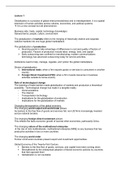
Globalization is a process of global interconnectedness and is interdependent. It is a spatial
extension of human activities across cultures, economies, and political systems.
It is a new concept but old phenomenon.
Business side: trade, capital, technology (knowledge)
General terms: people, culture, environment
The globalization of markets refers to the merging of historically distinct and separate
national markets into one huge global marketplace.
The globalization of production
Sourcing goods to take advantage of differences in cost and quality of factors of
production. Factors of production include labor, energy, land, and capital.
Early outsourcing was confined to manufacturing; modern communications
technology has advanced outsourcing today for service activities.
Institutions need to help, manage, regulate, and ‘police’ the global marketplace.
Drivers of globalization
1. International trade: when a firm exports goods or services to consumers in another
country
2. Foreign Direct Investment (FDI): when a firm invests resources in business
activities outside its home-country
Role of technological change
The lowering of trade barriers made globalization of markets and production a theoretical
possibility. Technological change has made it a tangible reality.
- Communications
- The internet
- Transportation technology
- Implications for the globalization of production
- Implications for the globalization of markets
Changing demographics of the global economy
The changing world output and world trade picture
As barriers to the free flow of goods and services fell, non-US firms increasingly invested
across national borders.
The changing foreign direct investment picture
This reflects the facts economic growth of several other economies, particularly China.
The changing nature of the multinational enterprise
the rise of mini multinationals, multinational enterprise (MNE) is any business that has
productive activities in two or more countries.
The changing world order
Former communist countries present export and investment opportunities.
Global Economy of the Twenty-First Century
Barriers to the free flow of goods, services, and capital have been coming down
Strengthened by the widespread adoption of liberal economic policies by countries
that had opposed them
Globalization is not inevitable:
, o Countries may pull back
o Risks are high
The globalization debate
Globalization, Labor Policies, and the Environment
- Critics argue:
o Labor and environmental regulations increase manufacturing costs
o Lack of regulation can lead to abuse
o Firms move production to nations that do not have regulations
- Supporters argue:
o Tougher environmental regulations and stricter labor standards go hand in
hand with economic progress
o Free trade leads to less labor exploitation and less pollution
Globalization and national sovereignty
- Critics argue:
o Shift of power away from national governments toward supranational
organizations.
o WTO, EU, United Nations
- Supporters argue:
o The power of supranational organizations is limited to what nation-states
collectively agree to grant.
o These organizations exist to serve the collective interests of member states.
Managing international business differs from managing purely domestic business.
Countries are different.
Range of problems is wider and problems more complex.
Must find ways to work within limits imposed by government.
Lecture 2
Strategy and the firm (Michael Porter)
Basic principles of strategy
Strategy refers to actions that managers take to attain the goals of the firm.
Goal is to maximize the value of the firm for owners and shareholders.
Profitability is the rate of return a firm makes on its invested capital (ROI)
Profit growth measures percentage increase in net profits over time
- A firm should be explicit about its choice of strategic emphasis with regard to value
creation (differentiation) and low cost.
- A firm should configure its internal operations to support that strategic emphasis.
, 1. Pick a position on the efficiency frontier that is viable in the sense that there is
enough demand to support that choice.
2. Configure its internal operations, such as manufacturing, marketing, logistics,
information systems, human resources, and so on, so that they support that position.
3. Make sure that the firm has the right organization structure in place to execute its
strategy.
The firm as a ‘value chain’
International firms are able to:
Expand potential size of market for domestic products
o Local competitors may lack comparable competencies to compete
Realize “location economies”
o Dispersing value-creation activities to other locations of (e.g., cheaper labor)
Realize greater ‘cost economies’
o reductions in unit cost from producing large volumes of a product to be sold
globally
Earn a greater return-on-investment
o In mature multinationals, development of valuable skills can occur in foreign
subsidiaries.
o Leveraging the skills created within subsidiaries and applying them to other
operations within the firm’s global network may create value.
International firms face two pressures: cost reduction and local responsiveness
Choosing a strategy for ‘international competitiveness’
The need to customize the product to local conditions may work against the implementation
of a global standardization strategy.
- Concessions may need to be made to local conditions
Globalization is a process of global interconnectedness and is interdependent. It is a spatial
extension of human activities across cultures, economies, and political systems.
It is a new concept but old phenomenon.
Business side: trade, capital, technology (knowledge)
General terms: people, culture, environment
The globalization of markets refers to the merging of historically distinct and separate
national markets into one huge global marketplace.
The globalization of production
Sourcing goods to take advantage of differences in cost and quality of factors of
production. Factors of production include labor, energy, land, and capital.
Early outsourcing was confined to manufacturing; modern communications
technology has advanced outsourcing today for service activities.
Institutions need to help, manage, regulate, and ‘police’ the global marketplace.
Drivers of globalization
1. International trade: when a firm exports goods or services to consumers in another
country
2. Foreign Direct Investment (FDI): when a firm invests resources in business
activities outside its home-country
Role of technological change
The lowering of trade barriers made globalization of markets and production a theoretical
possibility. Technological change has made it a tangible reality.
- Communications
- The internet
- Transportation technology
- Implications for the globalization of production
- Implications for the globalization of markets
Changing demographics of the global economy
The changing world output and world trade picture
As barriers to the free flow of goods and services fell, non-US firms increasingly invested
across national borders.
The changing foreign direct investment picture
This reflects the facts economic growth of several other economies, particularly China.
The changing nature of the multinational enterprise
the rise of mini multinationals, multinational enterprise (MNE) is any business that has
productive activities in two or more countries.
The changing world order
Former communist countries present export and investment opportunities.
Global Economy of the Twenty-First Century
Barriers to the free flow of goods, services, and capital have been coming down
Strengthened by the widespread adoption of liberal economic policies by countries
that had opposed them
Globalization is not inevitable:
, o Countries may pull back
o Risks are high
The globalization debate
Globalization, Labor Policies, and the Environment
- Critics argue:
o Labor and environmental regulations increase manufacturing costs
o Lack of regulation can lead to abuse
o Firms move production to nations that do not have regulations
- Supporters argue:
o Tougher environmental regulations and stricter labor standards go hand in
hand with economic progress
o Free trade leads to less labor exploitation and less pollution
Globalization and national sovereignty
- Critics argue:
o Shift of power away from national governments toward supranational
organizations.
o WTO, EU, United Nations
- Supporters argue:
o The power of supranational organizations is limited to what nation-states
collectively agree to grant.
o These organizations exist to serve the collective interests of member states.
Managing international business differs from managing purely domestic business.
Countries are different.
Range of problems is wider and problems more complex.
Must find ways to work within limits imposed by government.
Lecture 2
Strategy and the firm (Michael Porter)
Basic principles of strategy
Strategy refers to actions that managers take to attain the goals of the firm.
Goal is to maximize the value of the firm for owners and shareholders.
Profitability is the rate of return a firm makes on its invested capital (ROI)
Profit growth measures percentage increase in net profits over time
- A firm should be explicit about its choice of strategic emphasis with regard to value
creation (differentiation) and low cost.
- A firm should configure its internal operations to support that strategic emphasis.
, 1. Pick a position on the efficiency frontier that is viable in the sense that there is
enough demand to support that choice.
2. Configure its internal operations, such as manufacturing, marketing, logistics,
information systems, human resources, and so on, so that they support that position.
3. Make sure that the firm has the right organization structure in place to execute its
strategy.
The firm as a ‘value chain’
International firms are able to:
Expand potential size of market for domestic products
o Local competitors may lack comparable competencies to compete
Realize “location economies”
o Dispersing value-creation activities to other locations of (e.g., cheaper labor)
Realize greater ‘cost economies’
o reductions in unit cost from producing large volumes of a product to be sold
globally
Earn a greater return-on-investment
o In mature multinationals, development of valuable skills can occur in foreign
subsidiaries.
o Leveraging the skills created within subsidiaries and applying them to other
operations within the firm’s global network may create value.
International firms face two pressures: cost reduction and local responsiveness
Choosing a strategy for ‘international competitiveness’
The need to customize the product to local conditions may work against the implementation
of a global standardization strategy.
- Concessions may need to be made to local conditions