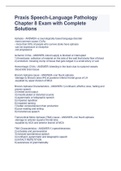
Praxis Speech-Language Pathology Chapter 8 Exam with Complete Solutions
Aphasia - ANSWER--a neurologically based language disorder -most common cause: CVAs - more than 50% of people who survive stoke have aphasia -can be expressive or receptive -not progressive Ischemic CVAs - ANSWER--blood supply is blocked or interrupted 1) thrombosis: collection of material on the side of the wall that blocks flow of blood 2) embolism: traveling clump of tissue that gets lodged in a small artery or vein Hemorrhagic CVAs - ANSWER--bleeding in the brain due to ruptured vessels -blood kills brain tissue Broca's Aphasia cause - ANSWER--non fluent aphasia -damage to Broca's area (44) at posterior inferior frontal gyrus of LH -supplied by upper division of MCA Broca's Aphasia Characteristics - ANSWER-1) nonfluent, effortful, slow, halting and uneven speech 2) limited word output 3) misarticulated or distorted sounds 4) agrammatic or telegraphic speech 5) impaired repetition 6) impaired naming 7) better comprehension than production 8) poor reading and writing 9) monotonous speech Transcortical Motor Aphasia (TMA) cause - ANSWER--non fluent aphasia -damage to anterior superior frontal lobe -supplied by ACA and anterior branch of MCA TMA Characteristics - ANSWER-1) speechlessness 2) echolalia and perseveration 3) reduced spontaneous speech 4) nonfluent, agrammatic and telegraphic speech 5) INTACT REPETITION 6) awareness of grammaticality 7) unfinished sentences 8) generally good comprehension 9) seriously impaired writing -tend to exhibit motor difficulties -may be apathetic or withdraw Mixed Transcortical Aphasia (MTA) cause - ANSWER--rare nonfluent aphasia -damage between areas supplied by ACA and MCA MTA Characteristics - ANSWER-1) limited spontaneous speech 2) automatic unintentional nature of communication 3) severe echolalia 4) severely impaired fluency 5) severely impaired comprehension 6) naming difficulty 7) unimpaired automatic speech 8) severely impaired reading and writing Global Aphasia - ANSWER--most severe form of aphasia -extensive lesions damage all areas -profoundly impaired language skills across all domains -may have strong neurological and neuromotor symptoms as well Wernicke's Aphasia Cause - ANSWER--fluent aphasia -damage to posterior portion of superior temporal gyrus -supplied by posterior branch of MCA Wernicke's Characteristics - ANSWER-1) effortlessly produced flowing speech with normal phrase length 2) rapid rate of speech with maintained prosody and articulation 3) intact grammatical structures 4) Word-finding difficulties 5) paraphasic speech 6) circumlocutions 7) empty speech 8) poor comprehension 9)impaired repetition 10) generally poor communication -paresis and paralysis less common -may appear confused Transcortical Sensory Aphasia (TSA) cause - ANSWER--fluent aphasia -damage to tempo-parietal region TSA Characteristics - ANSWER-1) fluent speech 2) paraphasic and empty speech 3) severe naming problems with many pauses 4) INTACT REPETITION 5) echolalia of anything 6) impaired comprehension 7) good oral reading Conduction Aphasia Cause - ANSWER--rare fluent aphasia -damage to area between Wernicke's and Broca's Conduction Characteristics - ANSWER-1) VERY IMPAIRED REPETITION 2) variable fluency across patients 3) paraphasic and empty speech 4) WFD 5) efforts to correct errors but not always successful 6) severe to mild naming problems 7) near normal comprehension Anomic Aphasia cause - ANSWER--fluent aphasia -controversial as to area of lesion Anomic Characteristics - ANSWER-1) VERY DEBILITATIVE AND PERVASIVE WFD 2) generally fluent speech 3) normal syntax 4) use of vague and nonspecific words 5) circumlocution 6)paraphasias 7) good comprehension 8) intact repetition 9) normal reading and writing Subcortical Aphasias Cause - ANSWER--lesions in subcortical areas around basal ganglia and thalamus Characteristics of Basal Ganglia damage - ANSWER-1) fluent speech 2) intact repetition 3) normal comprehension 4) articulation and prosody problems 5) WFD 6) semantic paraphasias 7) intact writing Characteristics of Thalamus damage - ANSWER-1) hemiglegia, RVF problems 2) initial mutism 3) severe naming problems 4) good comprehension of simple materials 5) good repetition 6) poor reading and writing Boston Diagnostic Aphasia Exam - ANSWER--artic, fluency, word-finding, repetition, serial speech, grammar, paraphasias, auditory comprehension, oral reading, reading comprehension, writing, and musical skills -SPEECH AND LANGUAGE Western Aphasia Battery - ANSWER--speech content, fluency, auditory comprehension, repetition, naming, reading, writing, calculation, drawing, nonverbal thinking, and block design -MOSTLY LANGUAGE Minnesota Test for Differential Diagnosis of Aphasia - ANSWER--auditory disturbances, visual and reading disturbances, speech and language disturbances, visuomotor and writing disturbances, and numerical and arithmetic disturbances -SPEECH AND LANGUAGE ONLY SMALL PART Neurosensory Center Comprehensive Examination - ANSWER--comprehension, production, reading, wriing, word fluency, digit and sentence repetition, visual object naming, sentence construction, and artic as well as tactile functions -MOSTLY SPEECH AND LANGUAGE Multilingual APhasia Examination - ANSWER--naming, repetition, fluencycy, audtitory comprehension, spelling, and writing -comes in French, English, German, Italian, and Spanish Bilingual Aphasia Test - ANSWER--phonologic, morphologic, syntactic, lexical, and semantic skills are addressed in primary and secondary languages -covers 40 different languages Porch Index of Communicative Ability - ANSWER--limited measure of language -requires intensive training to administer and score Aphasia Diagnostic Profiles - ANSWER--overall severity of aphasia -comprehension, word retrieval, repetition, alternative communication Alexia - ANSWER--loss of previously acquired reading skills due to neural damage Agraphia - ANSWER--the loss or impairment of normally acquired writing skills -due to lesions in the foot of the second frontal gyrus of the brain (Exner's writing area) Agnosia - ANSWER--impaired understanding of the meaning of stimuli even though there is no peripheral sensory impairment Auditory Agnosia - ANSWER--often associated with bilateral damage to the auditory association area -impaired understanding of the meaning of auditory stimuli -normal hearing and normal visual recognition of objects Auditory Verbal Agnosia - ANSWER--associated with bilateral temporal lobe lesions -impaired understanding of spoken words -normal hearing, recognition of nonverbal sounds, and recognition of printed words Visual Agnosia - ANSWER--associated with bilateral occipital lobe damage -impaired visual recognition of objects that may be intermittent -normal auditory or tactile recognition Tactile Agnosia - ANSWER--associated with lesions in parietal lobe -impaired tactile recognition of objects when visual feedback is blocked Apraxia - ANSWER--neurogenic speech disorder characterized by sensorimotor problems in positioning and sequentially moving muscles for the volitional productions of speech Cause of Apraxia - ANSWER--injury or damage to speech-motor programming areas in the dominant hemisphere -usually caused by stroke (commonly concurrent with Broca's) but can also be caused by degenerative diseases and head trauma Communication Deficits in Apraxia - ANSWER--most patients have awareness of problems -initiation of speech often slow or delayed -may use compensatory strategy of reduced rate -high variability of errors on volitional speech sounds -attempts at self corrects unsuccessful -prosodic problems Dysarthria - ANSWER--neurologically based speech disorder characterized by impaired muscular control and peripheral or central nervous system pathology -oral communication problems span: respiratory, articulatory, phonatory, resonatory, and prosodic features Causes of Dysarthria - ANSWER--degenerative diseases (i.e. Parkinson's or Wilson's) -stroke, infections, TBI -congenital problems (i.e. CP) Respiratory Problems with Dysarthria - ANSWER--forced inspirations or expirations that interrupt speech -audible or breathy respiration -grunting at the end of respiration
Escuela, estudio y materia
- Institución
- Praxis Speech
- Grado
- Praxis Speech
Información del documento
- Subido en
- 7 de abril de 2023
- Número de páginas
- 10
- Escrito en
- 2022/2023
- Tipo
- Examen
- Contiene
- Preguntas y respuestas
Temas
-
praxis speech
-
aphasia
-
ischemic cvas
-
hemorrhagic cvas
-
praxis speech language pathology chapter 8 exam
-
praxis speech language pathology chapter 8 exam with complete solutions
-
brocas aphasia cause

Documento también disponible en un lote