
Athabasca University PHYS 204 Assignment 2
Assignment 2
The ten questions below cover Units 5–7 and each carries equal weight. You are expected to solve all
questions in detail and submit by uploading to the appropriate drop box. Scanned copy of your
handwritten solutions should be acceptable.
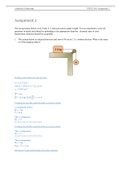
1. The system below is released from rest and moves 90 cm in 1.5 s, without friction. What is the mass
m of the hanging object?
Finding acceleration first and net force:
1
d = v1 t + 2 a xt 2
1
0.90 m = (0)(1.5 s) + 2 a x (1.5)2
a x = 0.80 m/s2
⃑⃑⃑⃑ = ma⃑
ΣF
m
⃑⃑⃑⃑ = (2.0 kg) (0.80 ) = 1.6 N
ΣF
s2
Treating the box like a particle under a net force model:
x-component of box
ΣFx = mg
⃑T = m1 a⃑x
The y-component:
ΣFy = 0
(no movement in the y-direction)
Treating the ball like a particle under a net force model:
The x-component:
ΣFx = 0
(no movement in the x-direction)
The y-component:
ΣFy = mg
⃑ = m2 a⃑
m2 g − T
Solving for T and substituting in the other equation:
, ⃑T = m1 a⃑x
m2 g − ⃑T = m2 a⃑
m2 g − m1 a⃑x = m2 a⃑
m 𝑚 m
m2 (9.80665 2 ) − (2.0 kg)(0.8 2 ) = m2 (0.8 2 )
s 𝑠 s
m m 𝑚
m2 (9.80665 2 ) − m2 (0.8 2 ) = (2.0 kg)(0.8 2 )
s s 𝑠
m2 (9.80665 − 0.8) = 1.6 N
1.6
m2 = = 0.177646 kg
9.00665
The mass of the hanging object is 1.78 × 10⁻¹ kg.
2. When the two boxes shown below are released from rest the system accelerates with
2.80 m/s2. Calculate the coefficient of kinetic friction, assuming that it is the same for both
boxes.
Normal force
tension force Mass 2
F = ma 70
tension force 𝑚𝑔𝑠𝑖𝑛20
70
Normal force 20
Gravitational force
𝑚𝑔 cos 20
Gravitational force
𝑚𝑔 cos 60
90
F = ma
𝑚𝑔 sin 60
For Mass 1 (2.5 kg):
⃑ = m1 g⃑ cos 60
n
m
⃑ = (2.5 kg) (9.80665
n ) cos 60
s2
⃑ = 12.2583 N
n
⃑ = m1 a⃑
F
m1 g⃑ sin 𝜃 − ⃑T − fk = m1 a⃑
m1 g⃑ sin 𝜃 − ⃑T − (n)(μ) = m1 a⃑
m
(2.5 kg)(9.80665)(sin 60) − ⃑T − (12.2583)(μ) = (2.5 kg) (2.80 2 )
s
−T ⃑ = 7.0 − 21.232 + 12.2583μ
⃑T = 14.232 − 12.2583μ
⃑F 7.0 N
μ= = = 0.571042
mg⃑ 12.2583 N
For Mass 2 (4.0 kg):

