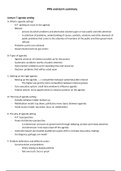
PAM Task 1 Models of brain development
Learning goals:
1. Describe the models with pros and cons, support and constraints
2. How could developmental cognitive neuroscience contribute to ongoing debates in
cognitive neuroscience?
Mareschal chapter 2 (background information)
The development of a neural system
proceeds in 2 stages
1. Activity-independent neural
development: The electrical
activity of the neurons plays no
role. The basic architecture and
coarse connection patterns are laid
out. The way a cell develops is
influenced by its cellular
environment.
2. Context-dependent neural
development: When neural
structures develop, the firing of
neurons shapes and refines the
neural architecture. The
outgrowing axon is guided by its
chemical environment in order to
find targets for synapse formation.
Neural activity can be spontaneous
or due to sensory experience.
These 2 stages cannot be separated
clearly.
Principles of neural function
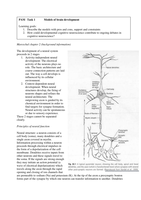
Neural structure: a neuron consists of a
cell body (soma), many dendrites and a
single axon covered in myelin.
Information processing within a neuron
proceeds through electrical impulses in
the form of a depolarization of the cell
membrane. Dendrites receive inputs from
other neurons and these signals travel to
the soma. If the signals are strong enough
they may initiate an action potential (a
wave of electrical depolarization) which
travels along the axon through the rapid
opening and closing of ion channels that
are permeable to sodium (Na) and potassium (K). At the tip of the axon a presynaptic bouton
forms part of the synapse by which one neuron can transfer information to another. Dendrites
Learning goals:
1. Describe the models with pros and cons, support and constraints
2. How could developmental cognitive neuroscience contribute to ongoing debates in
cognitive neuroscience?
Mareschal chapter 2 (background information)
The development of a neural system
proceeds in 2 stages
1. Activity-independent neural
development: The electrical
activity of the neurons plays no
role. The basic architecture and
coarse connection patterns are laid
out. The way a cell develops is
influenced by its cellular
environment.
2. Context-dependent neural
development: When neural
structures develop, the firing of
neurons shapes and refines the
neural architecture. The
outgrowing axon is guided by its
chemical environment in order to
find targets for synapse formation.
Neural activity can be spontaneous
or due to sensory experience.
These 2 stages cannot be separated
clearly.
Principles of neural function
Neural structure: a neuron consists of a
cell body (soma), many dendrites and a
single axon covered in myelin.
Information processing within a neuron
proceeds through electrical impulses in
the form of a depolarization of the cell
membrane. Dendrites receive inputs from
other neurons and these signals travel to
the soma. If the signals are strong enough
they may initiate an action potential (a
wave of electrical depolarization) which
travels along the axon through the rapid
opening and closing of ion channels that
are permeable to sodium (Na) and potassium (K). At the tip of the axon a presynaptic bouton
forms part of the synapse by which one neuron can transfer information to another. Dendrites