Infancy Task 4 Reflexes and intentional behaviour in infants
Learning goals:
1. Types of reflexes present at birth and their function
2. Theories on disappearance of reflexes
3. Outcomes/disorders based on reflexes
4. Development of goal directed/anticipatory behaviour
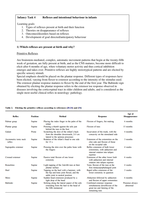
1) Which reflexes are present at birth and why?
Primitive Reflexes
Are brainstem-mediated, complex, automatic movement patterns that begin at the twenty-fifth
week of gestation, are fully present at birth, and as the CNS matures, become more difficult to
elicit after 6 months of age, when voluntary motor activity and thus cortical inhibition
emerges and takes over. Primitive reflexes are highly stereotypical patterns and are elicited by
specific sensory stimuli.
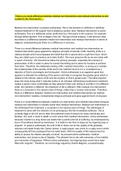
Special emphasis should be placed on the plantar response. Different types of responses have
been elicited, varying from flexor to extensor according to the intensity of the stimulus used.
The extensor plantar response matures to flexor by the end of the first year. The Babinski sign
obtained by eliciting the plantar response refers to the extensor toe response observed in
diseases involving the corticospinal tract in older children and adults, and is considered as the
single most useful clinical reflex in neurology: pathology.
Learning goals:
1. Types of reflexes present at birth and their function
2. Theories on disappearance of reflexes
3. Outcomes/disorders based on reflexes
4. Development of goal directed/anticipatory behaviour
1) Which reflexes are present at birth and why?
Primitive Reflexes
Are brainstem-mediated, complex, automatic movement patterns that begin at the twenty-fifth
week of gestation, are fully present at birth, and as the CNS matures, become more difficult to
elicit after 6 months of age, when voluntary motor activity and thus cortical inhibition
emerges and takes over. Primitive reflexes are highly stereotypical patterns and are elicited by
specific sensory stimuli.
Special emphasis should be placed on the plantar response. Different types of responses have
been elicited, varying from flexor to extensor according to the intensity of the stimulus used.
The extensor plantar response matures to flexor by the end of the first year. The Babinski sign
obtained by eliciting the plantar response refers to the extensor toe response observed in
diseases involving the corticospinal tract in older children and adults, and is considered as the
single most useful clinical reflex in neurology: pathology.