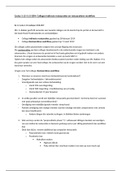
Basic Peace Officer Course (Endorsement/Final Exam) Pt. 4
151. According to the Family Code, the absence of a child on three or more days or parts of days within a four-week period from school is _____.(Sec.51.03) A. delinquent conduct B. conduct indicating a need for supervision C. habitual conduct D. truant conduct - Answer- B. conduct indicating a need for supervision * 152. Field notes give an officer the advantage of being able to _____. A. make repeated contact with witnesses and involved parties B. provide more details in reports and testimony C. rely on memory for most of the details of an event D. record personal observations that should not appear in reports - Answer- B. provide more details in reports and testimony * 153. Brief notations concerning specific events and circumstances that are recorded while fresh in the officer's mind and used to prepare a report are _____. A. statements of events B. interview tactics C. report writings D. field notes - Answer- D. field notes * 154. Chronological reports organize information by _____. A. when each thing happened B. where each thing happened C. who did each thing D. why each thing happened - Answer- A. when each thing happened * 155. According to the Penal Code, _____ is failing to return to custody following a temporary leave for a specific purpose. A. unauthorized departure B. escape C. evading arrest D. evasion - Answer- B. escape * 156. Peace officers are granted the authority to use force by the Texas _____. A. Occupations Code B. Constitution C. Code of Criminal Procedure D. Penal Code - Answer- D. Penal Code * 157. According to the Penal Code, deadly force is NOT justified to _____. A. prevent criminal mischief at night B. preserve someone's life in an emergency C. prevent the imminent commission of arson D. prevent someone from committing suicide - Answer- D. prevent someone from committing suicide * 158. According to the Penal Code, an amount of force that is intended or known by the actor to cause, or in any manner of its use or intended use is capable of causing, death or serious bodily injury is ____. A. reasonable force B. deadly force C. excessive force D. necessary force - Answer- B. deadly force * 159. According to the Penal Code, the threat of force is justified only when _____. A. the offender is an adult B. the traffic stop is a felony C. an arrest is being made D. the use of force is justified - Answer- D. the use of force is justified * 160. According to the Penal Code, a person who uses force against another may be _____ liable, if the force is justified. A. civilly but not criminally B. criminally but not civilly C. both criminally and civilly D. neither criminally nor civilly - Answer- A. civilly but not criminally * 161. According to the Penal Code, even though an actor is justified in using deadly force against another, if in doing so he recklessly kills an innocent third party, the justification is _____ in a prosecution for the reckless killing of the innocent third party. A. an affirmative defense B. unavailable C. a defense D. unnecessary - Answer- B. unavailable * 162. According to the Penal Code, the use of force, but not deadly force, against a child younger than _____ years of age is justified if the actor is the child's parent. A. 15 B. 16 C. 17 D. 18 - Answer- D. 18 * 163. According to the Penal Code, a person is justified in using deadly force against another _____. A. if a reasonable person in the actor's situation would not have retreated B. in order to prevent suicide C. to prevent unlawful restraint D. in response to verbal provocation - Answer- A. if a reasonable person in the actor's situation would not have retreated * 164. According to the Penal Code, the use of force against another when and to the degree they reasonably believe the force is immediately necessary to protect themselves against the other's use or attempted use of unlawful force, is justified as _____. A. self-defense B. necessity C. public duty D. protection - Answer- A. self-defense * 165. That degree of influence the officer must exert over the violator to take him or her safely into custody is known as ____. A. control B. force C. strength D. constraint - Answer- A. control * 166. _____ are obstacles to effective communication, and officers should try to eliminate them if possible. A. Personal appeals B. Constraints C. Perspectives D. Ethical appeals - Answer- A. Personal appeals * 167. Which of the following is one of the helpful tools used in verbal persuasion? A. Empty hand control B. Empathy C. Modeling D. Command - Answer- B. Empathy * 168. One of the tools an officer uses to maintain a psychological and physical edge is _____. A. demonstrated alertness B. logical necessity C. resistance D. aggression - Answer- A. demonstrated alertness * 169. The good faith defense for an officer is enhanced when following the _____ of the department. A. verbal standards B. implied policies C. fair labor standards D. written directives - Answer- D. written directives * 170. A police supervisor has a/an _____ duty to intervene to stop officers who are engaging in excessive force in their presence. A. affirmative B. required C. mandatory D. necessary - Answer- A. affirmative * 171. Which of the following is NOT a consideration used by the courts to determine if unreasonable force was used? A. motivation for force B. need for force C. area in which offense occurred D. reasonableness of force - Answer- C. area in which offense occurred * 172. One of the greatest assets to use in dealing with a violator is _____. A. crowd control B. self-control C. verbal judo D. compulsion - Answer- B. self-control * 173. Handcuffs are only a _____ restraining device. A. permanent B. temporary C. legal D. flexible - Answer- B. temporary * 174. When two officers are interviewing one subject, the second officer's position should be______. A. directly behind the subject B. directly behind the primary officer C. to the right or left of the subject D. to the right or left ahead of the primary officer - Answer- C. to the right or left of the subject * 175. Which of the following is a force option? A. Self-control B. Balance C. Awareness D. Professional presence - Answer- D. Professional presence * 176. Weaponless strategies include _____. A. verbal communication B. cultural awareness C. touching D. maintaining distance - Answer- C. touching * 177. Which of the following is considered a risk factor in the physical process of arrest? A. Officer's equipment B. Supportive spectators C. Weather conditions D. V formation - Answer- B. Supportive spectators *
Escuela, estudio y materia
- Institución
- Basic Peace Officer
- Grado
- Basic Peace Officer
Información del documento
- Subido en
- 6 de abril de 2023
- Número de páginas
- 9
- Escrito en
- 2022/2023
- Tipo
- Examen
- Contiene
- Preguntas y respuestas
Temas
-
basic peace officer
-
basic peace officer course endorsementfinal exam pt 4
-
151 according to the family code
-
the absence of a child on three or more days or parts of days within a four week period