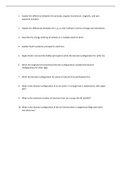
1. Explain the difference between the principle, angular momentum, magnetic, and spin
quantum numbers.
2. Explain the differences between the s, p, d, and f-orbitals in terms of shape and orientation.
3. Describe the energy ordering of orbitals in a multiple-electron atom.
4. Explain Pauli's exclusion principle for electrons.
5. Apply Hund's rule and the Aufbau principle to write the electron configuration for sulfur (S).
6. Write the longhand and shorthand electron configurations (condensed electron
configuration) for silver (Ag).
7. Write the electron configuration for atoms of calcium (Ca) and krypton (Kr).
8. What is the electron configuration of an ion with a +2 charge that is isoelectronic with argon
(Ar)?
9. What is the maximum number of electrons that can occupy the 4d subshell?
10. What is the electron configuration of the ion formed when a magnesium (Mg) atom loses
two electrons?
quantum numbers.
2. Explain the differences between the s, p, d, and f-orbitals in terms of shape and orientation.
3. Describe the energy ordering of orbitals in a multiple-electron atom.
4. Explain Pauli's exclusion principle for electrons.
5. Apply Hund's rule and the Aufbau principle to write the electron configuration for sulfur (S).
6. Write the longhand and shorthand electron configurations (condensed electron
configuration) for silver (Ag).
7. Write the electron configuration for atoms of calcium (Ca) and krypton (Kr).
8. What is the electron configuration of an ion with a +2 charge that is isoelectronic with argon
(Ar)?
9. What is the maximum number of electrons that can occupy the 4d subshell?
10. What is the electron configuration of the ion formed when a magnesium (Mg) atom loses
two electrons?