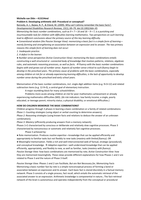
METHODS AND TECHNIQUES
PROBLEM 1
Reliability is something else than validity
Homeopathy: a system of complementary medicine in which ailments are treated by minute
doses of natural substances that in larger amounts would produce symptoms of the ailment.
One theory can have many hypothesis.
1.1 Lecture Persuasion
Study of mental processes and behaviour of people (describe, explain, predict, influence).
1. Make an observation and induction.
2. Form a hypothesis (testable prediction/deduction).
3. Perform the experiment, data collection.
4. Analyse the data, compare to predictions.
5. Interpret your results and report your findings.
6. Invite others to reproduce the results. Publish or perish. (Avoid fraud or pseudoscience).
Hypothesis:
o Connected with prior research and logical (consistent with known facts).
o Testable and falsifiable.
Variables should be observable and measurable.
o Should be written in a form so it can be rejected.
o Positive (entails the presence not the absence of a relation).
Absence of evidence is not evidence of absence.
o Parsimonious (Occam’s Razor: based on minimum number of assumptions).
Attribute a child’s school performance to his intelligence. If you have a certain
theory you can make a hypothesis from that (follows, comes from).
Ethics in research:
Responsibility to subjects and science
No harm to subjects
Privacy and confidentiality
Anonymity of the subjects
No high price which makes subjects want to do more, like painful things.
Debriefing/dehoaxing (in case of deception).
PROBLEM 1
Reliability is something else than validity
Homeopathy: a system of complementary medicine in which ailments are treated by minute
doses of natural substances that in larger amounts would produce symptoms of the ailment.
One theory can have many hypothesis.
1.1 Lecture Persuasion
Study of mental processes and behaviour of people (describe, explain, predict, influence).
1. Make an observation and induction.
2. Form a hypothesis (testable prediction/deduction).
3. Perform the experiment, data collection.
4. Analyse the data, compare to predictions.
5. Interpret your results and report your findings.
6. Invite others to reproduce the results. Publish or perish. (Avoid fraud or pseudoscience).
Hypothesis:
o Connected with prior research and logical (consistent with known facts).
o Testable and falsifiable.
Variables should be observable and measurable.
o Should be written in a form so it can be rejected.
o Positive (entails the presence not the absence of a relation).
Absence of evidence is not evidence of absence.
o Parsimonious (Occam’s Razor: based on minimum number of assumptions).
Attribute a child’s school performance to his intelligence. If you have a certain
theory you can make a hypothesis from that (follows, comes from).
Ethics in research:
Responsibility to subjects and science
No harm to subjects
Privacy and confidentiality
Anonymity of the subjects
No high price which makes subjects want to do more, like painful things.
Debriefing/dehoaxing (in case of deception).