Pesticide Applicator Right of Way Exam 2023
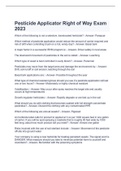
Which of the following is not a selective, translocated herbicide? - Answer- Paraquat Which method of pesticide application would reduce the amount of carrier required and risk of drift when controlling brush on a hot, windy day? - Answer- Basal bark A major factor in a successful IRVM program is: - Answer- Driver safety in rural areas The downward movement of pesticides in the soil is called: - Answer- Leaching Which type of weed is best controlled in early bloom? - Answer- Perennial Pesticides may move from the target area and damage the environment by: - Answer- Drift, soil runoff or soil erosion, leaching through the soil Basal bark applications are: - Answer- Possible throughout the year What type of chemical resistant gloves should you use if a pesticide application will last one or two hours? - Answer- Moderately or highly chemical resistant Volatilization: - Answer- May occur after spray reaches the target site and usually occurs at high temperatures Growth regulator herbicides: - Answer- Rapidly degrade or are tied up in the soil What should you do with clothing that becomes soaked with full strength concentrate pesticides? - Answer- Discard the clothing with any contaminated PPE Which of the following are annual weeds? - Answer- Pigweed An herbicide label calls for product to applied at 3 oz per 1000 square feet in one gallon of carrier. If you will be spot-spraying a roadside that is roughly 40 feet wide by 1000 feet long, about how much product will you need? - Answer- Almost one gallon Risks involved with the use of soil sterilant include: - Answer- Movement of the pesticide off-site into ground water Your company is using a new herbicide for treating persistent weeds. The signal word is DANGER. What measure should you take to minimize potential harm to yourself and coworkers? - Answer- Be familiar with the poisoning symptoms Most exposure to pesticide concentrates occurs to this part of the applicator's body: - Answer- Skin Growth regulator application is most effective when applied: - Answer- In early spring when sod has greened Which procedures will help reduce herbicide drift: - Answer- Reducing spray pressure and changing nozzles to a type which emits larger droplets Phenoxy herbicides are widely used along roadsides because: - Answer- They do not damage grasses Which of the following nonselective herbicides has the longest period of control when used at a given site? - Answer- Dichlobenil In order to avoid injury to nearby desirable trees, persistent, nonselective herbicides such as Hyvar should be applied _______: - Answer- Outside an area equal to twice the height of the desirable tree Krenite is different from most bush herbicides because: - Answer- Little effect is seen the year of application Herbicide spraying can be performed, as a general rule, until wind speed exceeds ____ mph. - Answer- 10 Which of the following formulations do not dissolve in water: - Answer- Wettable powders A major disadvantage of the phenoxy-herbicides is: - Answer- They can damage desirable plants at very low rates, making them susceptible to drift damage Basal bark treatment is not recommended for woody species larger than 6" in diameter: - Answer- The bark prevents penetration of the herbicide and reduces effectiveness The greatest risk involved with roadside spraying of phenoxy herbicides is: - Answer- Damage to non-target plants due to drift The best time to treat many perennials developing from an established root system is: - Answer- During early flowering The differences between drift and volatilization of an herbicide are: - Answer- Only herbicides with high vapor pressures are susceptible to volatilization AND drift can be controlled by adjusting spray pressure, whereas volatilization can not Name a plant type that lives for one year: - Answer- Annual Which form of plant has a single seed leaf at germination? - Answer- Grass Name five growth regulator active ingredients: - Answer- 1. 2,4-D 2. Dicamba 3. Picloram 4. Triclopyr 5. Aminopyralid Name three ALS-inhibitor active ingredients: - Answer- 1. Chlorsulfuron 2. Imazapic 3. Sulfometuron methyl In general, when should an herbicide be applied to control a weed? - Answer- During active growth Name five adjuvants for right-of-way: - Answer- 1. Surfactants 2. Drift retardants 3. Antifoaming agents 4. Basal oils 5. Nitrogen fertilizers Basal bark applications are most effective below what number of stems/acre? - Answer- 1500 stems/acre Define nonselective herbicide: - Answer- A pesticide that controls all plants. It is used where no plant growth is wanted. Name four nonselective herbicides: - Answer- 1. Glyphosate 2. Bromacil 3. Dichlobenil 4. Paraquat Which of the following is not a group 4 synthetic auxin: - Answer- Diuron What is the term associated with large areas of unsightly dying foliage after an herbicide application? - Answer- Brownout Which of the following is not considered a valid concern of right-of-way herbicide applications? - Answer- Inactivation of product from soil texture Which type of sprayer accessory uses light sensors to detect plants and spot treat them? - Answer- Weedseeker Which application system uses an emulsion formed from oil and water? - Answer- Thinvert Which boom sprayer nozzle has a suggested operating pressure between 8 and 25 psi? - Answer- Flooding flat fan A plant that releases chemicals into the soil to reduce competition from others plants is said to be: - Answer- Allelopathic
Escuela, estudio y materia
- Institución
- Pesticide Applicator Right of Way
- Grado
- Pesticide Applicator Right of Way
Información del documento
- Subido en
- 27 de marzo de 2023
- Número de páginas
- 4
- Escrito en
- 2022/2023
- Tipo
- Examen
- Contiene
- Desconocido
Temas
-
pesticide applicator right of way
-
pesticide applicator right of way exam 2023
-
which of the following is not a selective
-
translocated herbicide
-
which method of pesticide application would reduce the

Documento también disponible en un lote