Conformity
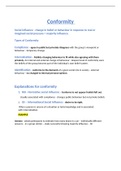
Social influence - change in belief or behaviour in response to real or
imagined social pressure = majority influence.
Types of Conformity
Compliance - agree in public but privately disagrees with the group’s viewpoint or
behaviour - temporary change.
Internalisation - Publicly changing behaviour to fit while also agreeing with them
privately. An internal and external change of behaviour - deepest level of conformity were
the beliefs of the group become part of the individual’s own belief system.
Identification - conforms to the demands of a given social role in society - external
behaviour - no changed to internal personal opinion.
Explanations for conformity
1. NSI - Normative social influence - Conforms to not appear foolish/left out.
Usually associated with compliance - changes public behaviour but not private beliefs.
2. ISI – Informational Social Influence - desire to be right.
When a person is unsure of a situation or lacks knowledge and is associated
with internalisation.
EXAMPLE
Jenness - asked participants to estimate how many beans in a jar – individually different
answers – in a group similar – study successful showing majority influence – ISI
, Variables Affecting Conformity
EXAMPLE
Asch’s Line Study
Aim: Investigate whether people would conform to the majority in situations where an answer was
obvious.
Procedure: 5-7 participants per group - presented with a standard line and three comparison lines -
Say aloud which comparison line matched the standard line in length.
One real participant and the rest confederates who gave incorrect answer on 12/18 trails.
Results: Conformed on 32% where confederates gave the wrong answers. Additionally, 75%
conformed at least once.
Positives
Provides support for Asch’s hypothesis that people conform to the majority
Some conformed to ‘fit in with the group’ – supports Normative influence – a theory behind
why
Negatives
Lacks eco valid – based on perception of lines not reflecting life’s complexities
Sampling issue – only men so gender biased – lacks pop validity
Ethical issue of deception and no informed consent – embarrassment cause harm
Factors Affecting Conformity
EXAMPLE
Asch – further trails - changed independent variables - which situational factors influenced the level
of conformity (dependent variable).
Group size - The bigger the majority group, the more people conformed, but only up to a certain
point. With one other confed in the group conformity was 3%, and with three or more it was 32% (or
1/3 – optimal size). However, conformity did not increase much after the group size was about 4/5.
Positives
Support - Brown and Byrne – suspect collusion if the majority rises beyond three or
four.
Group unanimity - more likely to conform when all members of the group agree and give the
same answer. Just one non-conformer reduce conformity as much as 80%.
Social influence - change in belief or behaviour in response to real or
imagined social pressure = majority influence.
Types of Conformity
Compliance - agree in public but privately disagrees with the group’s viewpoint or
behaviour - temporary change.
Internalisation - Publicly changing behaviour to fit while also agreeing with them
privately. An internal and external change of behaviour - deepest level of conformity were
the beliefs of the group become part of the individual’s own belief system.
Identification - conforms to the demands of a given social role in society - external
behaviour - no changed to internal personal opinion.
Explanations for conformity
1. NSI - Normative social influence - Conforms to not appear foolish/left out.
Usually associated with compliance - changes public behaviour but not private beliefs.
2. ISI – Informational Social Influence - desire to be right.
When a person is unsure of a situation or lacks knowledge and is associated
with internalisation.
EXAMPLE
Jenness - asked participants to estimate how many beans in a jar – individually different
answers – in a group similar – study successful showing majority influence – ISI
, Variables Affecting Conformity
EXAMPLE
Asch’s Line Study
Aim: Investigate whether people would conform to the majority in situations where an answer was
obvious.
Procedure: 5-7 participants per group - presented with a standard line and three comparison lines -
Say aloud which comparison line matched the standard line in length.
One real participant and the rest confederates who gave incorrect answer on 12/18 trails.
Results: Conformed on 32% where confederates gave the wrong answers. Additionally, 75%
conformed at least once.
Positives
Provides support for Asch’s hypothesis that people conform to the majority
Some conformed to ‘fit in with the group’ – supports Normative influence – a theory behind
why
Negatives
Lacks eco valid – based on perception of lines not reflecting life’s complexities
Sampling issue – only men so gender biased – lacks pop validity
Ethical issue of deception and no informed consent – embarrassment cause harm
Factors Affecting Conformity
EXAMPLE
Asch – further trails - changed independent variables - which situational factors influenced the level
of conformity (dependent variable).
Group size - The bigger the majority group, the more people conformed, but only up to a certain
point. With one other confed in the group conformity was 3%, and with three or more it was 32% (or
1/3 – optimal size). However, conformity did not increase much after the group size was about 4/5.
Positives
Support - Brown and Byrne – suspect collusion if the majority rises beyond three or
four.
Group unanimity - more likely to conform when all members of the group agree and give the
same answer. Just one non-conformer reduce conformity as much as 80%.