Lectures FSAV
Lecture week 1
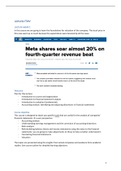
In this course we are going to learn the foundations for valuation of the company. The stock price in
this case went up so much because the expectations were boosted by all the news.
Welcome
Plan for this lecture:
- Introduction to course and organization
- Introduction to financial statement analysis
- Introduction to valuation fundamentals
- Accounting analysis: identifying and adjusting distortions in financial statements
Course objective
This course is designed to teach you specific tools that are useful for the analysis of companies’
financial statements → a user perspective
- Accounting analysis
- Understanding earnings management and the correction of accounting distortions
- Ratio analysis
- Reformulating balance sheets and income statements using the notes to the financial
statements: we are going to make adjustments to those to help us better understand it.
- Forecasting financial statements
- Valuation
The topics are presented using the insights from actual companies and evidence from academic
studies. See course outline for detailed learning objectives.
1
,Topics
Financial statement analysis
- Financial statements provide a lens on a company’s business
- Managers use financial statements to:
o Monitor and evaluate performance
o Communicate with external stakeholders
o Understand what changes to make in their operating, investment, and financing
policies
o To assess their own performance and subordinate performance
- Bankers use financial statements to decide on the terms of a loan
- Equity analysts use financial statements to forecast performance and value the company
- Credit rating agencies use financial statements to assess the likelihood (and magnitude) of
default
In this course, we take the perspective of an outside equity analyst who evaluates:
- The company’s current performance
- The quality of the financial statement numbers in reflecting the underlying business of the
company
- The sustainability of current performance as a basis for future performance forecasts
- The value of the company as a whole (“enterprise value”) and the value of equity
We therefore focus on the tools needed to extract information from financial statements, rather
than the application of a specific set of accounting standards such as IFRS
- We take the accounting standards as given, and then evaluate the company’s performance.
- Many of the companies we analyze use US GAAP instead of IFRS
- Differences in reporting are typically small; if not, we will identify and discuss them
2
, - Regardless of the standards applied, the toolbox we provide should be helpful in the analysis
of any company
The primary sources of information we will rely on are:
1) Income statements (“Statements of Operations”)
2) Balance sheets (“Statements of Financial Position”)
3) Statements of cash flows
4) Statements of changes in equity
5) Statements of comprehensive income
6) Notes
Additional useful information :
7) Company press releases / interim statements
8) Management discussion and analysis (MD&A) and performance expectations
The fundamentals of valuation
How do we determine the valuation of a company and a
share of its equity? In the long run, common shareholders
care about receiving a return on their investments.
- Either a constant periodic payoff (a cash dividend)
- And/or the ability to liquidate the investment at a
higher price
The expected/required payoff structure from buying an
equity share:
We have expectations of future dividends, and we have a
discount rate here, because we expect the value to increase by a certain amount. We are looking at
our expectations of what will happen in the future and then we are going to discount our
expectations.
Thus: we can view the value of an equity share as the present value of expected future dividends.
This includes a ‘liquidating’ dividend at the end of the investment horizon or end of the company’s
life.
The Discounted Dividends Model (DDM) formalizes this idea:
Hence, to determine the value of a share, we need to form expectations of the dividends to paid out
in future periods. The value of a company today is determined by things that will happen in the
future so that we have to make assessments of what will happen in the future and then we can
discount it to determine the value today.
In practice, a common way to express the value of a common share is to use a Discounted Cash Flow
(DCF) model:
3
, Instead of forecasting dividends, we are forecasting so-called free cash flows to the firm. We are
specifically going to focus on the value that a company is generating from its operating earnings. We
are going to take the financial statements and we are separating all the line items and splitting
between ‘core’ operating activities and everything else, and the basic idea is that these core
operating activities are going to generate the value to the firm.
Alternative models express value in terms of expected future net income or operating earnings. To
determine value, we need to make forecasts.
Important: value is not stock price! Stock price is based on market supply and demand. We will focus
on determining the ‘intrinsic’ or ‘fundamental’ value of a company.
Ex: Bitcoin, we don’t know what the underlying value will be, so just a stock price based on supply
and demand. The stock price of a company can be very different from the underlined value and the
focus of this course is the underlined value.
FSA and valuation
To create proper forecasts, we first need to understand current performance.
Accordingly, FSA consists of the following steps:
1) Understanding the business environment and accounting information (modules 1-2) [business
analysis] → what kind of company are we dealing with?
Q: What are the company’s primary business, key profit drivers, and risk areas?
2) Adjusting and assessing financial information using ratio and cash flow analysis (modules 1-
4)
Q: Do the financial statements accurately reflect the underlying business? [accounting
analysis]
Q: What factors drive current performance and how sustainable is this performance?
[financial analysis]
3) Forecasting financial information (module 11) [prospective analysis] → move from looking
backwards to looking forwards (step 3 & 4)
Q: How will the company’s business and past performance translate into performance in the
next years?
4) Using information for valuation (modules 12-15) [prospective analysis]
Q: What is the company worth, and should we make an investment?
4
Lecture week 1
In this course we are going to learn the foundations for valuation of the company. The stock price in
this case went up so much because the expectations were boosted by all the news.
Welcome
Plan for this lecture:
- Introduction to course and organization
- Introduction to financial statement analysis
- Introduction to valuation fundamentals
- Accounting analysis: identifying and adjusting distortions in financial statements
Course objective
This course is designed to teach you specific tools that are useful for the analysis of companies’
financial statements → a user perspective
- Accounting analysis
- Understanding earnings management and the correction of accounting distortions
- Ratio analysis
- Reformulating balance sheets and income statements using the notes to the financial
statements: we are going to make adjustments to those to help us better understand it.
- Forecasting financial statements
- Valuation
The topics are presented using the insights from actual companies and evidence from academic
studies. See course outline for detailed learning objectives.
1
,Topics
Financial statement analysis
- Financial statements provide a lens on a company’s business
- Managers use financial statements to:
o Monitor and evaluate performance
o Communicate with external stakeholders
o Understand what changes to make in their operating, investment, and financing
policies
o To assess their own performance and subordinate performance
- Bankers use financial statements to decide on the terms of a loan
- Equity analysts use financial statements to forecast performance and value the company
- Credit rating agencies use financial statements to assess the likelihood (and magnitude) of
default
In this course, we take the perspective of an outside equity analyst who evaluates:
- The company’s current performance
- The quality of the financial statement numbers in reflecting the underlying business of the
company
- The sustainability of current performance as a basis for future performance forecasts
- The value of the company as a whole (“enterprise value”) and the value of equity
We therefore focus on the tools needed to extract information from financial statements, rather
than the application of a specific set of accounting standards such as IFRS
- We take the accounting standards as given, and then evaluate the company’s performance.
- Many of the companies we analyze use US GAAP instead of IFRS
- Differences in reporting are typically small; if not, we will identify and discuss them
2
, - Regardless of the standards applied, the toolbox we provide should be helpful in the analysis
of any company
The primary sources of information we will rely on are:
1) Income statements (“Statements of Operations”)
2) Balance sheets (“Statements of Financial Position”)
3) Statements of cash flows
4) Statements of changes in equity
5) Statements of comprehensive income
6) Notes
Additional useful information :
7) Company press releases / interim statements
8) Management discussion and analysis (MD&A) and performance expectations
The fundamentals of valuation
How do we determine the valuation of a company and a
share of its equity? In the long run, common shareholders
care about receiving a return on their investments.
- Either a constant periodic payoff (a cash dividend)
- And/or the ability to liquidate the investment at a
higher price
The expected/required payoff structure from buying an
equity share:
We have expectations of future dividends, and we have a
discount rate here, because we expect the value to increase by a certain amount. We are looking at
our expectations of what will happen in the future and then we are going to discount our
expectations.
Thus: we can view the value of an equity share as the present value of expected future dividends.
This includes a ‘liquidating’ dividend at the end of the investment horizon or end of the company’s
life.
The Discounted Dividends Model (DDM) formalizes this idea:
Hence, to determine the value of a share, we need to form expectations of the dividends to paid out
in future periods. The value of a company today is determined by things that will happen in the
future so that we have to make assessments of what will happen in the future and then we can
discount it to determine the value today.
In practice, a common way to express the value of a common share is to use a Discounted Cash Flow
(DCF) model:
3
, Instead of forecasting dividends, we are forecasting so-called free cash flows to the firm. We are
specifically going to focus on the value that a company is generating from its operating earnings. We
are going to take the financial statements and we are separating all the line items and splitting
between ‘core’ operating activities and everything else, and the basic idea is that these core
operating activities are going to generate the value to the firm.
Alternative models express value in terms of expected future net income or operating earnings. To
determine value, we need to make forecasts.
Important: value is not stock price! Stock price is based on market supply and demand. We will focus
on determining the ‘intrinsic’ or ‘fundamental’ value of a company.
Ex: Bitcoin, we don’t know what the underlying value will be, so just a stock price based on supply
and demand. The stock price of a company can be very different from the underlined value and the
focus of this course is the underlined value.
FSA and valuation
To create proper forecasts, we first need to understand current performance.
Accordingly, FSA consists of the following steps:
1) Understanding the business environment and accounting information (modules 1-2) [business
analysis] → what kind of company are we dealing with?
Q: What are the company’s primary business, key profit drivers, and risk areas?
2) Adjusting and assessing financial information using ratio and cash flow analysis (modules 1-
4)
Q: Do the financial statements accurately reflect the underlying business? [accounting
analysis]
Q: What factors drive current performance and how sustainable is this performance?
[financial analysis]
3) Forecasting financial information (module 11) [prospective analysis] → move from looking
backwards to looking forwards (step 3 & 4)
Q: How will the company’s business and past performance translate into performance in the
next years?
4) Using information for valuation (modules 12-15) [prospective analysis]
Q: What is the company worth, and should we make an investment?
4