EQUITY AND TRUSTS LAW: FORMALITIES
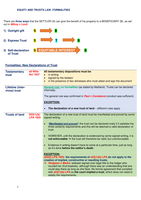
There are three ways that the SETTLOR (S) can give the benefit of his property to a BENEFICIARY (B), as set
out in Milroy v Lord:
1) Outright gift S B
2) Express Trust S T B
3) Self-declaration S EQUITABLE INTEREST B
of Trust
Formalities: New Declarations of Trust
Testamentary s9 Wills All testamentary dispositions must be:
trust Act 1837 in writing
signed by the testator
in the presence of two witnesses who must attest and sign the document
Lifetime (inter- General rule: no formalities (as stated by Maitland). Trusts can be declared
vivos) trust informally.
The general rule was confirmed in Paul v Constance (conduct was sufficient).
EXCEPTION:
The declaration of a new trust of land – different rules apply.
Trusts of land S53(1)(b) The declaration of a new trust of land must be manifested and proved by some
LPA 1925 signed writing.
‘Manifested and proved’: the trust can be declared orally if it satisfies the
three certainty requirements and this will be deemed a valid declaration of
trust.
HOWEVER, until the declaration is evidenced by some signed writing, it is
not enforceable the trust will therefore be valid, but unenforceable.
Evidence in writing doesn’t have to come at a particular time, just as long
as it’s done before the settlor’s death.
EXCEPTION:
s53(2) LPA 1925: the requirements of s53(1)(b) LPA do not apply to the
creation of implied, constructive or resulting trusts.
Hodgson v Marks: widower signed over legal title to the lodger who
courted her (fruit baskets), although there was an understanding that she
could stay there as long as she likes. No formal agreement that complied
with s53(1)(b) LPA so the court implied a trust, which does not need to
satisfy the requirements.
1
There are three ways that the SETTLOR (S) can give the benefit of his property to a BENEFICIARY (B), as set
out in Milroy v Lord:
1) Outright gift S B
2) Express Trust S T B
3) Self-declaration S EQUITABLE INTEREST B
of Trust
Formalities: New Declarations of Trust
Testamentary s9 Wills All testamentary dispositions must be:
trust Act 1837 in writing
signed by the testator
in the presence of two witnesses who must attest and sign the document
Lifetime (inter- General rule: no formalities (as stated by Maitland). Trusts can be declared
vivos) trust informally.
The general rule was confirmed in Paul v Constance (conduct was sufficient).
EXCEPTION:
The declaration of a new trust of land – different rules apply.
Trusts of land S53(1)(b) The declaration of a new trust of land must be manifested and proved by some
LPA 1925 signed writing.
‘Manifested and proved’: the trust can be declared orally if it satisfies the
three certainty requirements and this will be deemed a valid declaration of
trust.
HOWEVER, until the declaration is evidenced by some signed writing, it is
not enforceable the trust will therefore be valid, but unenforceable.
Evidence in writing doesn’t have to come at a particular time, just as long
as it’s done before the settlor’s death.
EXCEPTION:
s53(2) LPA 1925: the requirements of s53(1)(b) LPA do not apply to the
creation of implied, constructive or resulting trusts.
Hodgson v Marks: widower signed over legal title to the lodger who
courted her (fruit baskets), although there was an understanding that she
could stay there as long as she likes. No formal agreement that complied
with s53(1)(b) LPA so the court implied a trust, which does not need to
satisfy the requirements.
1