Superpowers
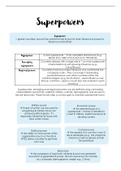
Superpower
= global countries; around the world that are known for their influence & power to
influence world affairs
Hyperpower A lone superpower – it has complete dominance (e.g.,
Britain from 1850-1910 & USA from 1990-2010)
Emerging Countries already with a large role in 1 or more superpower
characteristics & with growing influence (e.g.,
superpowers
China/Russia)
Regional powers Countries that have major influence at a continental but
not global scale – they can project dominating
power/influence over other countries within the
continent/region (e.g. South Africa – exert influence over
African continent, Japan in South East Asia & Brazil in South
America)
Superpowers, emerging and regional powers can be defined using contrasting
characteristics (economic, political, military, cultural, demographic and access to
natural resources). These factors help a country gain & maintain superpower status -
Military power Economic power
à threat of action can be used for à the essential base of a
bargaining & military force can superpower – money is needed to
achieve political goals – it’s invest in military, exploit resources &
especially influential for those with develop society
blue water navies
Political power Cultural power
à the ability to have power within à the appeal of a country’s way of
organisations (such as the UN & life & ideologies (e.g., the American
WTO) allows countries to get their Dream) as well as spread of their
own way films/art/food
Resources
à the possession of fossil fuels, minerals & land can generate
economic & geopolitical power. Human resources can include
no.s of people (demographic weight e.g., China)
,A country gains power through 7 factors
Physical size & geographical Economic power & influence
position
à they determine the à large GDP, high % of international trade, currency
area over which a country used as a reserve currency – it underpins the other
has potential influence – factors
larger countries usually
have greater resources & A large GDP creates influence as a potential market
influence & as the home of TNCs which create FDI
E.g., Russia – largest à countries with largest economies influence much
country, is in both Europe of the overall global economy because they
& Asia so controls
significant resources like ñ Earn 65% of global GDP
Arctic region & its natural ñ Control investment (most companies invest
resources – they’re mainly there as they’re more likely to gain a larger
under influence of Russia profit)
as its largest country ñ Have the world’s most powerful currencies –
bordering the region. e.g., US dollar & the euro produce over 40% of
global GDP
ñ They determine global economic policies &
therefore their strength determines what
happens to global trade or interest rates
ñ World’s largest economies give most to the
most poor – they choose who receives aid
E.g. USA, China
, Demographic factors Military strength Political factors
à pop size can à military size is one measure of a à the ability to influence
allow country to country’s power - use military the policies of other
gain/maintain status forces to protect themselves countries through the
against challenges (China has dominance of negotiations
Assists economic biggest military) (both bilaterally & through
power - e.g. china & international organisations
India use large pop Military power with a global reach
as source of cheap means they can be used to
labour in achieve geopolitical goals
manufacturing – few individual countries hold
they also provide a à military size isn’t as significant as more influence individually –
market, leading to national defence budgets & tech greater influence can be
economic growth – e.g., USA has highest military achieved by linking up with
as larger profit e.g., spending & USA’s military tech has like-minded countries e.g.,
EU greater global reach OECD (Aim is to promote
global development by
But it isn’t critical to Global influence through blue sharing common issues &
power – e.g., water navy & drone, missile & policies)
Singapore’s pop is satellite tech
smaller than London à role of international
but has major Measured – army size, defence organisations have become
influence on spending, nuclear weapons, size of more significant as
southeast Asia’s blue water navy economic problems now
economy assume a global dimension
Dependent on demographic
power & economic power
Cultural influence Access to natural resources
à the ability to influence the beliefs, values, à some resources are essential to
ideology & way of life in other countries economic development e.g., oils/metals
Achieved through dominance of media However possession of natural resources
(films/TV/radio), TNCs/migrants introducing doesn’t itself guarantee development –
cultural products (food/clothes/religion), many countries’ natural resources are
imposition of viewpoint in international actually managed by TNCs. E.g., shell
agreements
Australia has reserves of iron ore but
increased globalisation has led to a global exports most of it to China & gains little of
culture spread by TNCs – they dominate the value BUT possession does give some
global culture leverage over others e.g., influence of
OPEC countries in setting global oil prices –
e.g., News Corporation (American) has an they can export at high price, giving them
extensive interest including film production, economic power
newspapers, satellite TV & a strong influence
on global affairs
, USA as a superpower
Þ Economy is at $17.4 trillion
Þ Most powerful military globally – expenditure of $508bn annually, 800 military
bases globally
Þ Resources – has 320mil residents (to come up with inventions), largest coal
reserves, numerous minerals & metals, natural gas, land area of 9.834mil km2
Þ Cultural – American Dream, freedom of speech, free market economies,
consumerism
Þ Politically one of the most influential along with EU, Russia & China (as part of
NAFTA & NATO)
Mechanisms for maintaining power sit on a spectrum from ‘hard’ to ‘soft’ power,
which vary in their effectiveness.
Hard power
= where countries exert power through military force. Can measure through no. of bases
around the world, military size & nuclear capability. E.g., used by China, Russia & N. Korea.
Involves
ñ Military action/the threat of it
ñ The creation of economic & military alliances e.g., NAFTA/NATO – back each
other
ñ The use of economic sanctions to damage an economy e.g., Russia has had
many sanctions put on it
Soft power (term coined in 1990 by Joseph Nye)
= how countries can make themselves look attractive & appealing, therefore encouraging
others to follow them. E.g., American Dream, through films/TV – aligning people with their
values. E.g., used by westernised countries e.g. UK
Involves
ñ The cultural attractiveness of a nation
ñ Values & ideologies of some nations being seen as attractive
ñ The moral authority of a nation’s foreign policy
Hard power Economic power Soft power
Spectrum of power
Superpower
= global countries; around the world that are known for their influence & power to
influence world affairs
Hyperpower A lone superpower – it has complete dominance (e.g.,
Britain from 1850-1910 & USA from 1990-2010)
Emerging Countries already with a large role in 1 or more superpower
characteristics & with growing influence (e.g.,
superpowers
China/Russia)
Regional powers Countries that have major influence at a continental but
not global scale – they can project dominating
power/influence over other countries within the
continent/region (e.g. South Africa – exert influence over
African continent, Japan in South East Asia & Brazil in South
America)
Superpowers, emerging and regional powers can be defined using contrasting
characteristics (economic, political, military, cultural, demographic and access to
natural resources). These factors help a country gain & maintain superpower status -
Military power Economic power
à threat of action can be used for à the essential base of a
bargaining & military force can superpower – money is needed to
achieve political goals – it’s invest in military, exploit resources &
especially influential for those with develop society
blue water navies
Political power Cultural power
à the ability to have power within à the appeal of a country’s way of
organisations (such as the UN & life & ideologies (e.g., the American
WTO) allows countries to get their Dream) as well as spread of their
own way films/art/food
Resources
à the possession of fossil fuels, minerals & land can generate
economic & geopolitical power. Human resources can include
no.s of people (demographic weight e.g., China)
,A country gains power through 7 factors
Physical size & geographical Economic power & influence
position
à they determine the à large GDP, high % of international trade, currency
area over which a country used as a reserve currency – it underpins the other
has potential influence – factors
larger countries usually
have greater resources & A large GDP creates influence as a potential market
influence & as the home of TNCs which create FDI
E.g., Russia – largest à countries with largest economies influence much
country, is in both Europe of the overall global economy because they
& Asia so controls
significant resources like ñ Earn 65% of global GDP
Arctic region & its natural ñ Control investment (most companies invest
resources – they’re mainly there as they’re more likely to gain a larger
under influence of Russia profit)
as its largest country ñ Have the world’s most powerful currencies –
bordering the region. e.g., US dollar & the euro produce over 40% of
global GDP
ñ They determine global economic policies &
therefore their strength determines what
happens to global trade or interest rates
ñ World’s largest economies give most to the
most poor – they choose who receives aid
E.g. USA, China
, Demographic factors Military strength Political factors
à pop size can à military size is one measure of a à the ability to influence
allow country to country’s power - use military the policies of other
gain/maintain status forces to protect themselves countries through the
against challenges (China has dominance of negotiations
Assists economic biggest military) (both bilaterally & through
power - e.g. china & international organisations
India use large pop Military power with a global reach
as source of cheap means they can be used to
labour in achieve geopolitical goals
manufacturing – few individual countries hold
they also provide a à military size isn’t as significant as more influence individually –
market, leading to national defence budgets & tech greater influence can be
economic growth – e.g., USA has highest military achieved by linking up with
as larger profit e.g., spending & USA’s military tech has like-minded countries e.g.,
EU greater global reach OECD (Aim is to promote
global development by
But it isn’t critical to Global influence through blue sharing common issues &
power – e.g., water navy & drone, missile & policies)
Singapore’s pop is satellite tech
smaller than London à role of international
but has major Measured – army size, defence organisations have become
influence on spending, nuclear weapons, size of more significant as
southeast Asia’s blue water navy economic problems now
economy assume a global dimension
Dependent on demographic
power & economic power
Cultural influence Access to natural resources
à the ability to influence the beliefs, values, à some resources are essential to
ideology & way of life in other countries economic development e.g., oils/metals
Achieved through dominance of media However possession of natural resources
(films/TV/radio), TNCs/migrants introducing doesn’t itself guarantee development –
cultural products (food/clothes/religion), many countries’ natural resources are
imposition of viewpoint in international actually managed by TNCs. E.g., shell
agreements
Australia has reserves of iron ore but
increased globalisation has led to a global exports most of it to China & gains little of
culture spread by TNCs – they dominate the value BUT possession does give some
global culture leverage over others e.g., influence of
OPEC countries in setting global oil prices –
e.g., News Corporation (American) has an they can export at high price, giving them
extensive interest including film production, economic power
newspapers, satellite TV & a strong influence
on global affairs
, USA as a superpower
Þ Economy is at $17.4 trillion
Þ Most powerful military globally – expenditure of $508bn annually, 800 military
bases globally
Þ Resources – has 320mil residents (to come up with inventions), largest coal
reserves, numerous minerals & metals, natural gas, land area of 9.834mil km2
Þ Cultural – American Dream, freedom of speech, free market economies,
consumerism
Þ Politically one of the most influential along with EU, Russia & China (as part of
NAFTA & NATO)
Mechanisms for maintaining power sit on a spectrum from ‘hard’ to ‘soft’ power,
which vary in their effectiveness.
Hard power
= where countries exert power through military force. Can measure through no. of bases
around the world, military size & nuclear capability. E.g., used by China, Russia & N. Korea.
Involves
ñ Military action/the threat of it
ñ The creation of economic & military alliances e.g., NAFTA/NATO – back each
other
ñ The use of economic sanctions to damage an economy e.g., Russia has had
many sanctions put on it
Soft power (term coined in 1990 by Joseph Nye)
= how countries can make themselves look attractive & appealing, therefore encouraging
others to follow them. E.g., American Dream, through films/TV – aligning people with their
values. E.g., used by westernised countries e.g. UK
Involves
ñ The cultural attractiveness of a nation
ñ Values & ideologies of some nations being seen as attractive
ñ The moral authority of a nation’s foreign policy
Hard power Economic power Soft power
Spectrum of power