

Name: Lauren M. Hansen
Lab One: Fetal pig dissection “Endocrine System”.
Part A Assessments
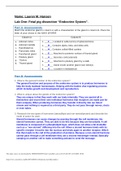
Match the endocrine gland in column A with a characteristic of the gland in column B. Place the
letter of your choice in the space provided.
Column A Column B
a. Adrenal cortex 1. ___F___ Located in sella turcica of sphenoid bone
b. Adrenal medulla 2. ___D__ Contains alpha, beta, and delta cells
c. Hypothalamus
3. ___H__ Contains colloid-filled cavities
d. Pancreatic islets
e. Parathyroid gland 4. ___E___ Attached to posterior surface of thyroid gland
f. Pituitary gland 5. ___A___ Secretes corticosteroids
g. Thymus 6. ___C___ Attached to pituitary gland by a stalk
h. Thyroid gland
7. ___B___ Gland inside another gland near kidneys
8. ___G___ Located in mediastinum
Part B Assessments
1. What is the general function of the endocrine system?
The general function and purpose of the endocrine system is to produce hormones to
help the body maintain homeostasis. Helping with the bodies vital regulating process
which includes growth and development and reproduction.
2. What is unique about the glands of the endocrine system?
They are unique in that they work with our body internally. They are special all in
themselves and secret their own individual hormones that receptors are made just for
them uniquely. When producing hormones they transfer it directly into our blood
stream and nothing is required as a third party. They do not pass through nerves, ducts
or even tubes.
3. Research the two types of hormones (steroid/lipid and non-steroid/protein) and describe the
mode of action for each.
Steroid hormones can cause changes by passing through the cell membrane. No-
steroid hormones cannot. They are able to do this because they are fat-soluble. A cell
membrane is composed of a phospholipid layer, which does not allow a fat insoluble
such as a “non-steroid” diffusing into the cell. When a steroid hormone binds with its
specific receptor it travels into the nucleus and binds again to another receptor. Which
this then leads to the call of the production of proteins. Because a non-steroid hormone
cannot pass through a cell membrane they use a second messenger instead. Basically
camping on another cell to make something activate to send the message.
This study source was downloaded by 100000852681095 from CourseHero.com on 03-07-2023 05:12:10 GMT -06:00
https://www.coursehero.com/file/28074280/Ch13-Endocrine-Lab-HansenLdoc/
Lab One: Fetal pig dissection “Endocrine System”.
Part A Assessments
Match the endocrine gland in column A with a characteristic of the gland in column B. Place the
letter of your choice in the space provided.
Column A Column B
a. Adrenal cortex 1. ___F___ Located in sella turcica of sphenoid bone
b. Adrenal medulla 2. ___D__ Contains alpha, beta, and delta cells
c. Hypothalamus
3. ___H__ Contains colloid-filled cavities
d. Pancreatic islets
e. Parathyroid gland 4. ___E___ Attached to posterior surface of thyroid gland
f. Pituitary gland 5. ___A___ Secretes corticosteroids
g. Thymus 6. ___C___ Attached to pituitary gland by a stalk
h. Thyroid gland
7. ___B___ Gland inside another gland near kidneys
8. ___G___ Located in mediastinum
Part B Assessments
1. What is the general function of the endocrine system?
The general function and purpose of the endocrine system is to produce hormones to
help the body maintain homeostasis. Helping with the bodies vital regulating process
which includes growth and development and reproduction.
2. What is unique about the glands of the endocrine system?
They are unique in that they work with our body internally. They are special all in
themselves and secret their own individual hormones that receptors are made just for
them uniquely. When producing hormones they transfer it directly into our blood
stream and nothing is required as a third party. They do not pass through nerves, ducts
or even tubes.
3. Research the two types of hormones (steroid/lipid and non-steroid/protein) and describe the
mode of action for each.
Steroid hormones can cause changes by passing through the cell membrane. No-
steroid hormones cannot. They are able to do this because they are fat-soluble. A cell
membrane is composed of a phospholipid layer, which does not allow a fat insoluble
such as a “non-steroid” diffusing into the cell. When a steroid hormone binds with its
specific receptor it travels into the nucleus and binds again to another receptor. Which
this then leads to the call of the production of proteins. Because a non-steroid hormone
cannot pass through a cell membrane they use a second messenger instead. Basically
camping on another cell to make something activate to send the message.
This study source was downloaded by 100000852681095 from CourseHero.com on 03-07-2023 05:12:10 GMT -06:00
https://www.coursehero.com/file/28074280/Ch13-Endocrine-Lab-HansenLdoc/

