C957 Unit 3 Module 3 Questions with detailed answers and graded A+
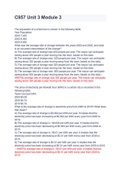
The population of a small town is shown in the following table: Year Population 2000 7,400 2002 8,300 2005 9,000 What was the average rate of change between the years 2000 and 2005, and what is an accurate interpretation of the change? A) The average rate of change was 450 people per year. The mayor can anticipate seeing about 450 people a year moving into the town, based on this data. B) The average rate of change was -320 people per year. The mayor can anticipate seeing about 320 people a year moving away from the town, based on this data. C) The average rate of change was 320 people per year. The mayor can anticipate seeing about 320 people a year moving into the town, based on this data. D) The average rate of change was -500 people per year. The mayor can anticipate seeing about 500 people a year moving away from the town, based on this data. - ANSThe average rate of change was 320 people per year. The mayor can anticipate seeing about 320 people a year moving into the town, based on this data. The price of electricity per kilowatt hour (kWh) in a certain city is recorded in the following table: Years Cost per kWh 2000 $0.08 2005 $0.15 2010 $0.10 What is the average rate of change in electricity price from 2005 to 2010? What does that mean? A) The average rate of change is $0.002 per kWh per year. It implies that the electricity price has been increasing at $0.002 per kWh every year from 2005 to 2010. B) The average rate of change is −$0.005 per kWh per year. It implies that the electricity price has been decreasing at $0.005 per kWh every year from 2000 to 2010. C) The average rate of change is −$0.01 per kWh per year. It implies that the electricity price has been decreasing at $0.01 per kWh every year from 2005 to 2010. D) The average rate of change is $0.01 per kWh per year. It implies that the electricity price has been increasing at $0.01 per kWh every year from 2005 to 2010. - ANSThe average rate of change is −$0.01 per kWh per year. It implies that the electricity price has been decreasing at $0.01 per kWh every year from 2005 to 2010. The function f(t) models the percent of population who use the Internet, where t is the number of years since 1995. During a certain year, the rate of internet usage grew to approximately one-third of the world population. Years Since 1995 Percent of Worldwide Population 0 0.8 5 6.8 10 15.8 15 28.9 20 43.2 In about what year did the rate of internet usage grow to approximately one-third of the world population, and what coordinate pair might represent that year? A) It appears that a third of the world's population was using the internet by 2020, represented by (25, 33.3). B) It appears that a third of the world's population was using the internet by 2007, represented by (12, 33.3). C) It appears that a third of the world's population was using the internet by 2012, represented by (12, 33.3). D) It appears that a third of the world's population was using the internet by 2012, represented by (17, 33.3). - ANSIt appears that a third of the world's population was using the internet by 2012, represented by (17, 33.3).
Escuela, estudio y materia
- Institución
- Wgu c957
- Grado
- Wgu c957
Información del documento
- Subido en
- 7 de marzo de 2023
- Número de páginas
- 6
- Escrito en
- 2022/2023
- Tipo
- Examen
- Contiene
- Preguntas y respuestas
Temas
-
wgu c957
-
400 2002 8
-
300 2005 9
-
000 what was th
-
c957 unit 3 module 3 questions with detailed answers and graded a
-
the population of a small town is shown in the following table year population 2000 7

Documento también disponible en un lote