

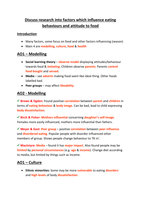
Discuss research into factors which influence eating
behaviours and attitude to food
Introduction
Many factors, some focus on food and other factors influencing (season)
Main 4 are modelling, culture, food & health
AO1 – Modelling
Social learning theory – observe model displaying attitudes/behaviour
towards food & imitating. Children observe parents. Parents control
food bought and served.
Media – see adverts making food seem like ideal thing. Other foods
labelled bad.
Peer groups – may affect likeability.
AO2 - Modelling
Brown & Ogden: Found positive correlation between parent and children in
terms of eating behaviour & body image. Can be bad, lead to child expressing
body dissatisfaction.
Birch & Fisher: Mothers influential concerning daughter’s self-image.
Females more easily influenced, mothers more influential than fathers.
Meyer & Gast: Peer group – positive correlation between peer influence
and disordered eating. Popular people with disorder influenced other
members of group. Shows people change behaviour to ‘fit in’.
MacIntyre: Media – found it has major impact. Also found people may be
limited by personal circumstances (e.g. age & income). Change diet according
to media, but limited by things such as income.
AO1 – Culture
Ethnic minorities: Some may be more vulnerable to eating disorders
and high levels of body dissatisfaction.
behaviours and attitude to food
Introduction
Many factors, some focus on food and other factors influencing (season)
Main 4 are modelling, culture, food & health
AO1 – Modelling
Social learning theory – observe model displaying attitudes/behaviour
towards food & imitating. Children observe parents. Parents control
food bought and served.
Media – see adverts making food seem like ideal thing. Other foods
labelled bad.
Peer groups – may affect likeability.
AO2 - Modelling
Brown & Ogden: Found positive correlation between parent and children in
terms of eating behaviour & body image. Can be bad, lead to child expressing
body dissatisfaction.
Birch & Fisher: Mothers influential concerning daughter’s self-image.
Females more easily influenced, mothers more influential than fathers.
Meyer & Gast: Peer group – positive correlation between peer influence
and disordered eating. Popular people with disorder influenced other
members of group. Shows people change behaviour to ‘fit in’.
MacIntyre: Media – found it has major impact. Also found people may be
limited by personal circumstances (e.g. age & income). Change diet according
to media, but limited by things such as income.
AO1 – Culture
Ethnic minorities: Some may be more vulnerable to eating disorders
and high levels of body dissatisfaction.

