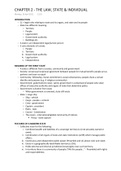
CHAPTER 2 - THE LAW, STATE & INDIVIDUAL
Monday, 26 April 2021 13:55
INTRODUCTION
- CL = legal rules relating to state and its organs, and state and its people
- State has different meaning
○ Territory
○ People
○ Legal system
○ Government authority
○ Buildings etc.
- A state is an independent legal/juristic person
- 5 core elements of a state:
i. People
ii. Territory
iii. Government authority
iv. Legal system
v. Independence
MEANING OF THE TERM 'STATE'
- A state is different from a society, community and government
- Society: consensual reciprocal agreement between people for mutual benefit; people act as
partners and seen as equal
- Community: fellowship, moral commitment, social cohesiveness; people share a certain
identity and purpose (e.g. A religious community)
- Government: gubernatio (to steer, Latin); government is comprised of people who steer;
offices of executive authority and organs of state that determine policy
- Government is distinct from state
○ When government is removed, state still exists
- State = cargo ship
○ Ship - vehicle
○ Cargo - people + content
○ Crew - government
○ Captain - president
○ Rules - laws
○ Course - Constitution
○ The ocean - international/global community of nations
Piracy - state capture
FEATURES OF A MODERN STATE
- Collective noun for the following:
i. Combined wealth and liabilities of a sovereign territory (s1) not privately owned or
owed;
ii. Combination of all organs of state and state institutions (s239) which manage public
affairs;
iii. Continuous and independent public power (Preamble and s1) above ruler and ruled;
iv. Exists in a geographically identifiable territory (s103);
v. Holds external and internal jurisdiction/sovereignty over such territory;
vi. In territory there is a community of people ("We the people..." - Preamble) with rights
and responsibilities;
, vii. Institutions of authority and power, both de facto and de jure (who governs and on
which authority);
viii. Has power to enforce rules and authority including use of legitimate force (rule of law);
ix. Power and authority restricted by international law (ss39,231-233);
x. Powers and functions are regulated into predetermined legal rules and principles, state
often also bound by such rules (s2 and rule of law)
HISTORICAL DEVELOPMENT OF STATE
- Concept of a state developed when centralisation of power occurred
- Centralisation occurred because of development of agriculture and writing
- History of state begins in classical antiquity/Greek city-states
- Today, more than 200 states in the world with few exceptions (Antarctica, the Amazon rain
forest...)
CONCEPT OF STATE - POLITICAL INFLUENCE
- In modern times, 3 traditions in political science that shaped the concept of statehood
i. Marxist - common affairs of society
ii. Pluralist - neutral arena for views
iii. Institutionalist - politics are influenced by certain institutions
- Political theory of state: try to explain the politics of the state in practice
- Various forms of state (pg. 24)
CONCEPT OF NATION-STATE
- Nation-state: sense of homogeneity and sovereignty
- State with aim of one culture and one ethnic unity
- One national identity/consciousness
- Problem: all states have minorities; constitution also protects minorities
- Nation-states claim absolute sovereignty
○ In modern world, unacceptable
ROLE OF CONSTITUTIONAL LAW
- CL = constitutional rules/legal rules/supreme rules
- Characteristics of legal rules:
a. Only apply within the specific territory of a state
b. Normally apply to all people present within the territory of that state
c. Rules of law apply to both natural and legal persons
- Legal persons: consists of a group of 'natural persons' who are regarded as a single
entity (e.g. Church organisation, a close corporation, or state itself)
- Government bodies: natural persons designated to act as organs of state on the
state's behalf (classified into legislative, executive and judicial bodies)
d. Law normally confers on all natural and legal persons in the capacity to either apply the
rules of law or to cause them to be enforced
- Government bodies with 3 sub-bodies are given specific government authority
(Separation of Powers)
1) Legislative authority = the power to enact, amend or repeal rules of law
2) Executive authority = the power to execute and enforce the law
3) Judicial authority = the power to determine the law and apply it in dispute
situations
- Government authority is further distributed between different levels of
government
1) National
Monday, 26 April 2021 13:55
INTRODUCTION
- CL = legal rules relating to state and its organs, and state and its people
- State has different meaning
○ Territory
○ People
○ Legal system
○ Government authority
○ Buildings etc.
- A state is an independent legal/juristic person
- 5 core elements of a state:
i. People
ii. Territory
iii. Government authority
iv. Legal system
v. Independence
MEANING OF THE TERM 'STATE'
- A state is different from a society, community and government
- Society: consensual reciprocal agreement between people for mutual benefit; people act as
partners and seen as equal
- Community: fellowship, moral commitment, social cohesiveness; people share a certain
identity and purpose (e.g. A religious community)
- Government: gubernatio (to steer, Latin); government is comprised of people who steer;
offices of executive authority and organs of state that determine policy
- Government is distinct from state
○ When government is removed, state still exists
- State = cargo ship
○ Ship - vehicle
○ Cargo - people + content
○ Crew - government
○ Captain - president
○ Rules - laws
○ Course - Constitution
○ The ocean - international/global community of nations
Piracy - state capture
FEATURES OF A MODERN STATE
- Collective noun for the following:
i. Combined wealth and liabilities of a sovereign territory (s1) not privately owned or
owed;
ii. Combination of all organs of state and state institutions (s239) which manage public
affairs;
iii. Continuous and independent public power (Preamble and s1) above ruler and ruled;
iv. Exists in a geographically identifiable territory (s103);
v. Holds external and internal jurisdiction/sovereignty over such territory;
vi. In territory there is a community of people ("We the people..." - Preamble) with rights
and responsibilities;
, vii. Institutions of authority and power, both de facto and de jure (who governs and on
which authority);
viii. Has power to enforce rules and authority including use of legitimate force (rule of law);
ix. Power and authority restricted by international law (ss39,231-233);
x. Powers and functions are regulated into predetermined legal rules and principles, state
often also bound by such rules (s2 and rule of law)
HISTORICAL DEVELOPMENT OF STATE
- Concept of a state developed when centralisation of power occurred
- Centralisation occurred because of development of agriculture and writing
- History of state begins in classical antiquity/Greek city-states
- Today, more than 200 states in the world with few exceptions (Antarctica, the Amazon rain
forest...)
CONCEPT OF STATE - POLITICAL INFLUENCE
- In modern times, 3 traditions in political science that shaped the concept of statehood
i. Marxist - common affairs of society
ii. Pluralist - neutral arena for views
iii. Institutionalist - politics are influenced by certain institutions
- Political theory of state: try to explain the politics of the state in practice
- Various forms of state (pg. 24)
CONCEPT OF NATION-STATE
- Nation-state: sense of homogeneity and sovereignty
- State with aim of one culture and one ethnic unity
- One national identity/consciousness
- Problem: all states have minorities; constitution also protects minorities
- Nation-states claim absolute sovereignty
○ In modern world, unacceptable
ROLE OF CONSTITUTIONAL LAW
- CL = constitutional rules/legal rules/supreme rules
- Characteristics of legal rules:
a. Only apply within the specific territory of a state
b. Normally apply to all people present within the territory of that state
c. Rules of law apply to both natural and legal persons
- Legal persons: consists of a group of 'natural persons' who are regarded as a single
entity (e.g. Church organisation, a close corporation, or state itself)
- Government bodies: natural persons designated to act as organs of state on the
state's behalf (classified into legislative, executive and judicial bodies)
d. Law normally confers on all natural and legal persons in the capacity to either apply the
rules of law or to cause them to be enforced
- Government bodies with 3 sub-bodies are given specific government authority
(Separation of Powers)
1) Legislative authority = the power to enact, amend or repeal rules of law
2) Executive authority = the power to execute and enforce the law
3) Judicial authority = the power to determine the law and apply it in dispute
situations
- Government authority is further distributed between different levels of
government
1) National