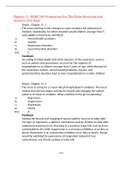
Chapter 8: NURS 340 Preparation For The Nclex Questions and
Answers Test Bank
Origin: Chapter 8, 1
1. The nurse is providing atraumatic care to children in a hospital
setting. What are principles of this philosophy of care? Select all
that apply.
A) Avoid or reduce painful procedures
B) Avoid or reduce physical distress
C) Minimize parent–child interactions
D) Provide child-centered care
E) Minimize child control
F) Use core primary nursing
Ans: A, B, F
Feedback:
When using atraumatic care, the nurse would avoid or reduce painful
procedures, avoid or reduce physical distress, use core primary nursing,
maximize parent–child interactions, provide family-centered care, and
provide opportunities for control, such as participating in care, attempting
to normalize daily schedule, and providing direct suggestions.
Origin: Chapter 8, 2
2. The nurse is consulting with a child life specialist (CLS) to help minimize
the stress of hospitalization for a child. Which services would the CLS
provide? Select all answers that apply.
A) Medical preparation for tests, surgeries, and other medical procedures
B) Support before and after, but not during, medical procedures
C) Activities to support normal growth and development
D) Grief and bereavement support
E) Emergency room interventions for children and families
F) Only inpatient consultations with families
Ans: C, D, E
Feedback:
The CLS would provide activities to support normal growth and
development, grief and bereavement support, and emergency room
interventions for children and families. The CLS would also provide
nonmedical preparation for tests, surgeries, and other medical procedures;
Page 1
, support during medical procedures; and outpatient consultation with
families.
Origin: Chapter 8, 3
3. The nurse is implementing interventions to prevent physical stressors
for a 9-year-old child receiving chemotherapy in the hospital. What is
an example of using atraumatic care for this child?
A) Use restraint or 'holding down' of the child during the procedure to
prevent injury.
B) Have the parent stand near and/or rub the child's feet during the
procedure.
C) Insert a saline lock if the child will require multiple doses of
parenteral medications.
D) Avoid using numbing techniques for multiple blood draws or IV
insertion.
Page 2
, Ans: C
Feedback:
The nurse should insert a saline lock if the child will require multiple doses
of parenteral medications. During painful or invasive procedures, the
nurse should avoid traditional restraint or "holding down" of the child and
use alternative positioning such as "therapeutic hugging." If therapeutic
hugging is not an option, the nurse could have the parent stand near the
child's head not his feet to provide visual and verbal comfort. The nurse
should also use numbing techniques for blood draws or IV insertion.
Origin: Chapter 8, 4
4. The nurse contacts a child life specialist (CLS) to work with children on a
pediatric ward. What is the primary goal of the CLS?
A) Decrease anxiety and fear during hospitalization and painful procedure.
B) Keep children who are hospitalized distracted from pain.
C) Perform medical procedures using atraumatic principles.
D) Act as a liaison between the nurse and
the child. Ans: A
Feedback:
The CLS is a specially trained individual who provides programs that
prepare children for hospitalization, surgery, and other procedures that
could be painful (Child Life Council, 2010a, 2010b). The goal of the CLS is to
decrease the anxiety and fear while improving and encouraging
understanding and cooperation of the child. The CLS may use distraction
techniques and act as a liaison, but that is not the primary goal of the CLS
role. The CLS does not perform medical procedures.
Origin: Chapter 8, 5
5. The nurse is preparing a child and his family for a lumbar puncture.
Which would be a primary intervention instituted to keep the child safe?
A) Distraction methods
B) Stimulation methods
C) Therapeutic hugging
D) Therapeutic touch
Ans: C
Page 3
Answers Test Bank
Origin: Chapter 8, 1
1. The nurse is providing atraumatic care to children in a hospital
setting. What are principles of this philosophy of care? Select all
that apply.
A) Avoid or reduce painful procedures
B) Avoid or reduce physical distress
C) Minimize parent–child interactions
D) Provide child-centered care
E) Minimize child control
F) Use core primary nursing
Ans: A, B, F
Feedback:
When using atraumatic care, the nurse would avoid or reduce painful
procedures, avoid or reduce physical distress, use core primary nursing,
maximize parent–child interactions, provide family-centered care, and
provide opportunities for control, such as participating in care, attempting
to normalize daily schedule, and providing direct suggestions.
Origin: Chapter 8, 2
2. The nurse is consulting with a child life specialist (CLS) to help minimize
the stress of hospitalization for a child. Which services would the CLS
provide? Select all answers that apply.
A) Medical preparation for tests, surgeries, and other medical procedures
B) Support before and after, but not during, medical procedures
C) Activities to support normal growth and development
D) Grief and bereavement support
E) Emergency room interventions for children and families
F) Only inpatient consultations with families
Ans: C, D, E
Feedback:
The CLS would provide activities to support normal growth and
development, grief and bereavement support, and emergency room
interventions for children and families. The CLS would also provide
nonmedical preparation for tests, surgeries, and other medical procedures;
Page 1
, support during medical procedures; and outpatient consultation with
families.
Origin: Chapter 8, 3
3. The nurse is implementing interventions to prevent physical stressors
for a 9-year-old child receiving chemotherapy in the hospital. What is
an example of using atraumatic care for this child?
A) Use restraint or 'holding down' of the child during the procedure to
prevent injury.
B) Have the parent stand near and/or rub the child's feet during the
procedure.
C) Insert a saline lock if the child will require multiple doses of
parenteral medications.
D) Avoid using numbing techniques for multiple blood draws or IV
insertion.
Page 2
, Ans: C
Feedback:
The nurse should insert a saline lock if the child will require multiple doses
of parenteral medications. During painful or invasive procedures, the
nurse should avoid traditional restraint or "holding down" of the child and
use alternative positioning such as "therapeutic hugging." If therapeutic
hugging is not an option, the nurse could have the parent stand near the
child's head not his feet to provide visual and verbal comfort. The nurse
should also use numbing techniques for blood draws or IV insertion.
Origin: Chapter 8, 4
4. The nurse contacts a child life specialist (CLS) to work with children on a
pediatric ward. What is the primary goal of the CLS?
A) Decrease anxiety and fear during hospitalization and painful procedure.
B) Keep children who are hospitalized distracted from pain.
C) Perform medical procedures using atraumatic principles.
D) Act as a liaison between the nurse and
the child. Ans: A
Feedback:
The CLS is a specially trained individual who provides programs that
prepare children for hospitalization, surgery, and other procedures that
could be painful (Child Life Council, 2010a, 2010b). The goal of the CLS is to
decrease the anxiety and fear while improving and encouraging
understanding and cooperation of the child. The CLS may use distraction
techniques and act as a liaison, but that is not the primary goal of the CLS
role. The CLS does not perform medical procedures.
Origin: Chapter 8, 5
5. The nurse is preparing a child and his family for a lumbar puncture.
Which would be a primary intervention instituted to keep the child safe?
A) Distraction methods
B) Stimulation methods
C) Therapeutic hugging
D) Therapeutic touch
Ans: C
Page 3