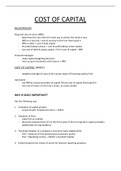
COST OF CAPITAL
BACKGROUND
Required rate of return (RRR):
- determine the min rates firm must pay to attract the funds it uses
- RRR on a security = cost of security to the firm that issued it
- RRR on debt = cost of debt capital
- On pref/ordinary shares = cost of pref/ordinary share capital
- Ave cost of debt & equity capital = firm’s cost of capital = RRR
Financial managers
- make capital budgeting decisions
- must accept investments with returns > RRR
COST OF CAPITAL (WACC)
- weighted average of costs of the various types of financing used by firm
represents:
- ave RRR by various providers of capital OR ave cost of capital financing firm
- min rate of return on the firm’s assets, to create wealth
WHY IS WACC IMPORTANT?
Has the following uses:
1. Evaluation of capital projects
- accept project if expected returns > WACC
2. Valuation of firms
- value firm as a whole
- discounts expected free CFs to the firm (value of firm to long-term capital providers
(debtholders & shareholders)
3. The determination of a company’s Economic Value Added (EVA)
- EVA = measure of firm performance (economic profit)
- EVA = Operating income – (WACC x Invested Capital)
4. Determining the fair values of assets for financial reporting purposes
, CALCULATING WACC
D P E
WACC = k d (1 − t) + k ps ( ) + k 𝑜𝑠 ( )
V V V
kd = before tax cost of debt.
k d (1 − t) = after tax cost of debt.
t = tax rate (28% or 0.28)
D = value of debt.
k ps = cost of preference shares.
P = The value of preference shares.
k 𝑜𝑠 = The cost of ordinary shares.
E = The value of ordinary shares.
V = Total value of the firm (i.e., value of D + P + E).
Lecture example 1:
Bauba Ltd has the following capital structure: 30% debt, 10% preference share capital, and
60% ordinary share capital. The company wishes to maintain this capital structure as it
raises new funds. It’s before tax cost of debt is 8%, the cost of preference shares is 10% and
its cost of ordinary shares is 15%. If the tax rate is 28%, calculate the weighted average cost
of capital for the firm.
Steps to calculate WACC:
1. Determine capital structure weights
- done in the following order: target capital structure; market value weights; book
value weights
2. Calculate the component cost of each source of capital
- use currents costs
- include effects of company tax
3. Calculate the weighted average cost of capital
BACKGROUND
Required rate of return (RRR):
- determine the min rates firm must pay to attract the funds it uses
- RRR on a security = cost of security to the firm that issued it
- RRR on debt = cost of debt capital
- On pref/ordinary shares = cost of pref/ordinary share capital
- Ave cost of debt & equity capital = firm’s cost of capital = RRR
Financial managers
- make capital budgeting decisions
- must accept investments with returns > RRR
COST OF CAPITAL (WACC)
- weighted average of costs of the various types of financing used by firm
represents:
- ave RRR by various providers of capital OR ave cost of capital financing firm
- min rate of return on the firm’s assets, to create wealth
WHY IS WACC IMPORTANT?
Has the following uses:
1. Evaluation of capital projects
- accept project if expected returns > WACC
2. Valuation of firms
- value firm as a whole
- discounts expected free CFs to the firm (value of firm to long-term capital providers
(debtholders & shareholders)
3. The determination of a company’s Economic Value Added (EVA)
- EVA = measure of firm performance (economic profit)
- EVA = Operating income – (WACC x Invested Capital)
4. Determining the fair values of assets for financial reporting purposes
, CALCULATING WACC
D P E
WACC = k d (1 − t) + k ps ( ) + k 𝑜𝑠 ( )
V V V
kd = before tax cost of debt.
k d (1 − t) = after tax cost of debt.
t = tax rate (28% or 0.28)
D = value of debt.
k ps = cost of preference shares.
P = The value of preference shares.
k 𝑜𝑠 = The cost of ordinary shares.
E = The value of ordinary shares.
V = Total value of the firm (i.e., value of D + P + E).
Lecture example 1:
Bauba Ltd has the following capital structure: 30% debt, 10% preference share capital, and
60% ordinary share capital. The company wishes to maintain this capital structure as it
raises new funds. It’s before tax cost of debt is 8%, the cost of preference shares is 10% and
its cost of ordinary shares is 15%. If the tax rate is 28%, calculate the weighted average cost
of capital for the firm.
Steps to calculate WACC:
1. Determine capital structure weights
- done in the following order: target capital structure; market value weights; book
value weights
2. Calculate the component cost of each source of capital
- use currents costs
- include effects of company tax
3. Calculate the weighted average cost of capital