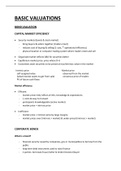
BASIC VALUATIONS
BOND VALUATION
CAPITAL MARKET EFFICIENCY
• Security markets (bonds & stock market)
- bring buyers & sellers together (traders meet)
- reduces cost of buying & selling ( cost, operational efficiency)
- physical location or computer trading system where traders meet and sell
• Organised market reflects D&S for securities better
• Equilibrium market price: price where D=S
• Economists want securities to be priced at true/intrinsic value in the market
Intrinsic price Market price
self-assigned value observed from the market
(what investor wants to get from sale) consensus price of traders
PV of future cash flows
Market efficiency
• Efficient
- market prices fully reflect all info, knowledge & expectations
- costs & easy to transact
- participants knowledgeable (active market)
- market price = intrinsic price
• Inefficient
- market price intrinsic price by large margins
- market prices over (intrinsic < market) & under-priced (intrinsic > market)
CORPORATE BONDS
What is a bond?
- financial security issued by companies, gov or municipalities to borrow from the
public
- long-term debt instrument used to raise finance
- 2 parties: borrower/issuer/seller & lender/investor/buyer
, borrower obligated to periodic int & principal # at a certain date
coupon payments
made to bondholder coupons
issuer obligated to pay bondholder fixed int amounts (annually/semi-annually) & the
principal sum on maturity
Advantage: less risky than shares (int & capital sum guaranteed)
Disadvantage: return less than that on shares
Bond transaction:
@ bond issue date
Bond SP Lender/investor
Borrower/issuer Bond certificate (have $, seek
(in need of finance) investment
@ during bond period
selling bond opportunities)
Coupon/int pmts buying bond
Principal # repaid at end of bond term
Types of corporate bonds:
• Plain Vanilla Bonds/Straight Bonds
- coupon pmts fixed
- entire original principal repaid at maturity
• Zero-coupon Bonds
- no coupon pmts
- single pmt at maturity (includes int earned)
- int = difference btw principal # paid for bond & # received at end
- longer term investment
• Convertible Bonds
- converted into shares at predetermined ratio at bondholder’s discretion
• Callable, Puttable & Perpetual Bonds
- company issuing bond includes special provision allowing issuer to redeem bond at
current price
• Bond in Perpetuity/Non-redeemable Bond
- no fixed life span (no redemption date)
- coupons paid indefinitely
, - principal not paid back
• Redeemable Bond
- fixed lifespan
- pays coupons up to maturity date
- pays principal at maturity
Bond features:
Face value:
- paid/received at maturity
- determines coupon pmt
- set by firm & fixed
Coupon rate/payment:
- determines coupon pmt
- coupon rate x face value
- set by firm & fixed
Time to maturity:
- bond’s lifespan
- set by firm & fixed
Yield to maturity:
- represents return required by investors on bond
- used as a discount rate
- fluctuates with market conditions
Price:
- pay for the bond
- function of CF & YTM
- fluctuates
Yield to maturity (YTM)
- derived from yields of similar instruments/other interest bearing instruments in
market
same family of int baring instruments, maturity time, risk profile
- int rate, YTM
- always fluctuate because int rates changing & drivers of int rates & repo rate change
(by central bank, inflation, eco conditions)
BOND VALUATION
CAPITAL MARKET EFFICIENCY
• Security markets (bonds & stock market)
- bring buyers & sellers together (traders meet)
- reduces cost of buying & selling ( cost, operational efficiency)
- physical location or computer trading system where traders meet and sell
• Organised market reflects D&S for securities better
• Equilibrium market price: price where D=S
• Economists want securities to be priced at true/intrinsic value in the market
Intrinsic price Market price
self-assigned value observed from the market
(what investor wants to get from sale) consensus price of traders
PV of future cash flows
Market efficiency
• Efficient
- market prices fully reflect all info, knowledge & expectations
- costs & easy to transact
- participants knowledgeable (active market)
- market price = intrinsic price
• Inefficient
- market price intrinsic price by large margins
- market prices over (intrinsic < market) & under-priced (intrinsic > market)
CORPORATE BONDS
What is a bond?
- financial security issued by companies, gov or municipalities to borrow from the
public
- long-term debt instrument used to raise finance
- 2 parties: borrower/issuer/seller & lender/investor/buyer
, borrower obligated to periodic int & principal # at a certain date
coupon payments
made to bondholder coupons
issuer obligated to pay bondholder fixed int amounts (annually/semi-annually) & the
principal sum on maturity
Advantage: less risky than shares (int & capital sum guaranteed)
Disadvantage: return less than that on shares
Bond transaction:
@ bond issue date
Bond SP Lender/investor
Borrower/issuer Bond certificate (have $, seek
(in need of finance) investment
@ during bond period
selling bond opportunities)
Coupon/int pmts buying bond
Principal # repaid at end of bond term
Types of corporate bonds:
• Plain Vanilla Bonds/Straight Bonds
- coupon pmts fixed
- entire original principal repaid at maturity
• Zero-coupon Bonds
- no coupon pmts
- single pmt at maturity (includes int earned)
- int = difference btw principal # paid for bond & # received at end
- longer term investment
• Convertible Bonds
- converted into shares at predetermined ratio at bondholder’s discretion
• Callable, Puttable & Perpetual Bonds
- company issuing bond includes special provision allowing issuer to redeem bond at
current price
• Bond in Perpetuity/Non-redeemable Bond
- no fixed life span (no redemption date)
- coupons paid indefinitely
, - principal not paid back
• Redeemable Bond
- fixed lifespan
- pays coupons up to maturity date
- pays principal at maturity
Bond features:
Face value:
- paid/received at maturity
- determines coupon pmt
- set by firm & fixed
Coupon rate/payment:
- determines coupon pmt
- coupon rate x face value
- set by firm & fixed
Time to maturity:
- bond’s lifespan
- set by firm & fixed
Yield to maturity:
- represents return required by investors on bond
- used as a discount rate
- fluctuates with market conditions
Price:
- pay for the bond
- function of CF & YTM
- fluctuates
Yield to maturity (YTM)
- derived from yields of similar instruments/other interest bearing instruments in
market
same family of int baring instruments, maturity time, risk profile
- int rate, YTM
- always fluctuate because int rates changing & drivers of int rates & repo rate change
(by central bank, inflation, eco conditions)