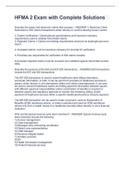
HFMA 2 Exam with Complete Solutions
Describe the paper and electronic claims flow process. - ANSWER-1. Electronic Claim Submission= EDI claims forwarded to either directly or via EDI clearing house/ vendor. 2. Claims Verification= Clearinghouse specifications and insurance company requirements used to validate transmitted claims. 3. Rejected Claims = Claims not meeting requirements returned via clearinghouse error report. 4. Accepted claims= sent to insurance company for provider ID verification. 5. Providers are responsible for verification of EDI claims receipts. 6.Accepted /rejected claims must be reviewed and validated against transmittal records daily. Describe the purpose of the 835 and 837 EDI transactions. - ANSWER-EDI transactions include the 837 and 835 transactions. The 837 EDI transaction is used to submit healthcare claim billing information, encounter information, or both. It can be sent from providers of healthcare services to payers, either directly or via intermediary billers and claims clearinghouses. It can also be used to transmit healthcare claims and billing payment information between payers with different payment responsibilities where coordination of benefits is required or between payers and regulatory agencies to monitor the rendering, billing, and/or payment of healthcare services within a specific healthcare/insurance industry segment. The 835 EDI transaction can be used to make a payment, send an Explanation of Benefits (EOB) remittance advice, or make a payment and send an EOB remittance advice only from a health insurer to a healthcare provider either directly or via a financial institution. Who are the typical revenue cycle team members? - ANSWER-Typical revenue cycle team members include the following: 1) Access management 2) Case management 3) Managed care contracting coordinator 4) Patient care representatives 5) CDM manager 6) Revenue integrity leader 7) Ancillary services 8) ED 9) Health information management 10) Patient financial services 11) Decision support 12) Finance and accounting (CFO) 13) Compliance 14) Information technology What are the 9 thing included in the team charter? - ANSWER-The team charter includes the following: 1. Ensuring revenue is captured in a timely fashion 2. Collecting entitled reimbursement 3. Reengineering workflow processes 4. Analyzing hurdles, snags 5. Monitoring improvements 6. Establishing metrics 7. Creating policies and procedures 8. Educating others 9. Prioritizing projects that will yield maximum benefit for the patient and the organization When may claims be denied? (relates to timing of denial) - ANSWER-Claims may be denied: 1) Prior to payment for a variety of reasons. 2) Retrospectively, that is, after they have been paid by a payer, based on an audit of claims processing methods and/or review of a copy of the patient record. 3) By the payer or an agent other than the original payer. List 8 reasons that claims may be denied prior to payment? - ANSWER-Claims may be denied prior to payment for a variety of reasons, such as: 1) Whether services provided or proposed are reasonable and medically necessary. 2) Whether services furnished or proposed to be furnished on an inpatient basis could be effectively furnished on an outpatient basis. 3) The medical necessity, reasonableness, and appropriateness of inpatient care for which additional payment is sought under the outlier provision of PPS. 4) Whether the hospital has misrepresented admission or discharge information or taken an action that results in unnecessary admission, or other inappropriate practices. 5) The validity of the diagnostic and procedural information given by the provider to the payer for payment. 6) The completeness and adequacy of the hospital care provided. 7) Whether the quality of service meets professionally recognized standards of care. 8) Duplicate bills, usually caused by rebills or late charges, without the proper bill type code. Claims denied by payer or agent? - ANSWER-Claims may be denied by payer or by agent: 1) For non-governmental payers, the payer typically performs the review and issues the denial; however, some third party payers engage external firms to review a sample of claims as well as assess whether credit balances have been properly refunded to the patient or the payer. 2) For governmental payers, there are a number of contractors that have been engaged by the federal and state governments to review claims both prospectively (prior to payment) and retrospectively (after payment). These reviews may be conducted on claims that are 10 years old. What are retrospectively denied claims? - ANSWER-Restrospectively Denied Claims-----Claims may be denied retrospectively, that is, after they have been paid by a payer, based on an audit of claims processing methods and/or review of a copy of the patient record for any of, but not limited to, the aforementioned reasons. Medicare Administrative Contractors (MACs) - ANSWER-Medicare Administrative Contractors (MACs) a. MACs process provider claims for Medicare. During the processing stage, the MAC may deny a claim for any of the reasons noted earlier or if there is an unusual trend noted. The MAC's goal is to avoid paying a claim improperly at the onset rather than review and take back a payment retrospectively. Claims Reviewer----Quality Improvement Organization (QIOs) - ANSWER-Quality Improvement Organization (QIOs) a. Determines whether healthcare services provided under Medicare are reasonable and medically necessary. Their reviews may be prospective or retrospective Recovery Audit Contractors (RACs) - ANSWER-Recovery Audit Contractors (RACs) a. Federal entities that payments made to providers in error by Medicare. When they conduct their reviews, if they find a trend dating back further than three years, they refer the finding to another governmental contractor. Their reviews are retrospective in nature. Medicaid Integrity Contractors (MICs) - ANSWER-Medicaid Integrity Contractors (MICs) a. State employees who recover payments made to providers in error by Medicaid. The look-back period varies from state to state. MICs may also engage RACs to conduct the reviews for the state. Comprehensive Error Rate Testing Program (CERT) - ANSWER-Comprehensive Error Rate Testing Program (CERT) a. The CERT monitors payer performance and providers. Their focus in 2010 has been on physician providers. They review the history of provider claims and compare it to other comparable providers. Variations in practices are shared with the provider as an initial educational approach to raise awareness for the provider. Should unexpected variations continue, the CERT may conduct an audit or refer to another agency to do so. Zone Program Integrity Contractors (ZPICs) - ANSWER-Zone Program Integrity Contractors (ZPICs) a. Their focus is fraud identification and the investigations referred to them by other agencies when variant trends are identified. They will request records, may come on-site, and have no limitations as to whom they can investigate. They also identify program vulnerabilities. Their findings are referred to the OIG for any civil or criminal prosecutions. Office of the Inspector General (OIG) - ANSWER-Office of the Inspector General (OIG) a. The OIG may conduct an investigation of any of the governmental payers to assess their performance as well as providers should an unexpected trend surface in claim activity for that provider. The OIG may also refer the investigation component to another agency or contractor of the government. The look-back period for the OIG is 10 years Health Care Fraud Prevention and Enforcement Action Team (HEAT) - ANSWER-Health Care Fraud Prevention and Enforcement Action Team (HEAT) HEAT is a partnership of OIG and Department of Justice and the States to target fraudulent providers. Findings and prosecution results are posted on a public website. Process of managing denied claims? - ANSWER-Managing Denied Claims 1) To effectively manage denials, generate reports regarding the type, source, and frequency of the denials to address each denial reason. Frequently, significant process changes may need to occur to effectively address the reason for the denial. And if that process change is not achieved, one can expect those specific denials to continue. 2) The Revenue Cycle Team should review the reports and identify and implement process changes to reduce or eliminate denials.---May involve re-education of staff 3) In addition, it is important to have sufficient reporting capabilities such that the provider cannot only track and report denials, they can also track and report appeals and appeal overturns, along with eventual collections. a. This denial and payment information can and should also subsequently be used during contract negotiations with the payer to promote more efficient contracting and payment mechanisms for both the payer and the provider. What is Medicare Fraud? - ANSWER-Fraud in Medicare usually takes the form of false claims submitted to carriers and intermediaries for payment for medical or health services that were in fact not rendered. Another form of fraud is the representation on a Medicare claim form of more complicated and hence more costly procedures than those actually rendered. Still another form of Medicare fraud results from "kickback" arrangements between providers of services and their suppliers. To be classified as fraud, there must have been intentional misrepresentation or deception for the purpose of obtaining payment or other benefits not otherwise due. 4 Examples of Medicare Fraud - ANSWER-Examples of Medicare fraud include: 1) Claiming costs for non-covered items and services disguised as covered items. 2) Incorrect reporting of diagnosis and procedures to maximize reimbursement. 3) Intentionally double billing for the same services. 4) Billing for services that were not rendered. 4 Examples of Medicare abuse - ANSWER-Examples of abuse include: 1) Excessive charges. 2) Billing Medicare as primary instead of other third-party payers that are primary. 3) Increasing charges for Medicare beneficiaries but not to other patients. 4) Billing Medicare for services deemed medically unnecessary. 5 areas where reports cards for revenue cycle can be made? - ANSWER-If the team has access to decision support or performance improvement staff, report cards can be developed for those areas that feed the revenue cycle: 1. Access/Registration 2. Patient Care Services 3. Case Management 4. HIM 5. PFS 3 Disbursement functions of HCO? - ANSWER-The disbursement functions of a healthcare organization include: 1) Materials management 2) Payroll 3) Accounts Payable How are Funds disbursed? - ANSWER-Funds may be disbursed through a treasury management function that directs funds to be invested in various stocks, bonds, and other financial market instruments. What is Materials Management? - ANSWER-Materials management is also known as inventory or supply chain management, purchasing, or procurement. It involves the planning and control of the functions supporting the complete cycle (flow) of materials and the associated flow of information.* Function of Materials Management? - ANSWER-... Claims may be sent in two ways: - ANSWER-Claims may be sent in two ways: Paper Claims are sent via CMS-1500 or UB-04 forms Electronic claims are sent in ANSI/NSF format. It is one of the two standardized electronic formats that are currently accepted by Medicare. Claims Transmission to Insurance Companies Directly - ANSWER-Claims Transmission to Insurance Companies Directly Files containing the claims in electronic format forwarded to the insurance companies directly from billing are called Direct Transmission. Claims are transmitted directly to major carriers like Medicare, Medicaid, and Blue Cross Blue Shield. Each of the insurance companies has an EDI (electronic data interchange) department, which is responsible for receiving claims and forwarding them to the appropriate departments. Claims Transmission to the Clearinghouse - ANSWER-Claims Transmission to the Clearinghouse Files containing the claims in electronic format are forwarded to the clearinghouses, which in turn forwards the claims to the insurance companies' EDI department. After this process, the billing office would receive the following reports. Confirmation Report: This report ensures the claims sent from the billing office have reached the insurance companies.� Rejection Report: Rejection reports provide a list of claims that are not successfully transmitted for various reasons. What is the difference between basic demographic scrubber and a coding & diagnosis scrubber? - ANSWER-Basic Demographic Scrubber----ensures the basic elements of claims are in place (digits, and etc) Coding & Diagnostic Scubber---looks for ICD-9 & CPT mismatches according to Medicare and CCI rules to find claims denials Role of Knowledge Management Scrubbers? - ANSWER-Knowledge Management Scrubbers allow the medical billing operation to continually reevaluate the adjudication rules of each payer and update the rules accordingly. The proper implementation of the scrubber requires a clear feedback loop from the follow-up department to the scrubber so that the lessons learned from denied claims can be quickly incorporated in to the scrubber. Any top notch medical billing service utilizes a scrubber like this. Role of Claims Clearinghouse? - ANSWER-Claims Clearinghouse An office that receives the claims from a billing office, doctor's office, or hospital in ASCII (American Standard Code for Information Interchange) text format and transmits them directly to the respective insurance company via tapes, discs, or modem after validation using EBCDIC (Extended Binary Code Digital Interchange Code) format is called a clearinghouse.
Escuela, estudio y materia
- Institución
- HFMA
- Grado
- HFMA
Información del documento
- Subido en
- 16 de febrero de 2023
- Número de páginas
- 21
- Escrito en
- 2022/2023
- Tipo
- Examen
- Contiene
- Preguntas y respuestas
Temas
-
hfma
-
hfma 2 exam
-
hfma 2 exam with complete solutions
-
describe the paper and electronic claims flow process
-
describe the purpose of the 835 and 837 edi transactions
-
who are the typical revenue cycle

Documento también disponible en un lote