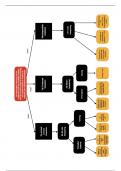
Overview of every lecture
Lecture 1
1. Refresh Micro 1:
a. Perfect competition
i. Many sellers, many pbuyers
ii. Complete and perfect information
iii. Homogeneous product
iv. Free and easy entry and exit
v. P = m c= ac (long run)
vi. LI = 0
b. Monopoly
c.
i. Markup = percentage of a firm’s price is greater than its
marginal cost
2. Competition policy
a. Differences between US and EU competition law
i. Criminal law
ii. Importance of common market in EU
iii. Treble damages
iv. EU competition law uses concept of market dominance
b. Main areas
i. Price fixing
1. Explicit collusion is illegal
2. Implicit collusion is not illegal
3. Implicit collusion is frequently more effective
4. Per se vs rule of reason
5. Leniency programs
ii. Merger policy
1. US guidelines, EU regulation
2. Efficiency vs market power
3. Market definition
4. HHI thresholds
iii. Abuse of dominant position
3. Measures of Market power = the ability to set prices above (marginal) cost
a. Lerner Index (measure of firm’s markup
indicates market power)
, b. CR4 =
c. Herfindahl Index
4. Price discrimination = a seller sells the same product to different buyers
at different prices
a. First degree (Perfect/ personalized pricing): the firm charges each
consumer highest amount she would be willing to pay =
reservation price
i. CS = 0
ii. PS = all profits
b. Second degree (self-selection):
i. the firm cannot distinguish between different types of
consumers
ii. but designs products in such a way that consumers choose to
reveal themselves by their choices.
iii. Steps:
1. Make sure the lesser-valued customers are willing to
pay
2. Make sure the higher-valued customers are willing to
pay
3. Make sure the higher-valued customers will prefer the
higher-valued product incentive compatibility
constraint
4. Solve the three constraints
5. Set p2 = price lesser-valued product
6. Substitute get p1
iv. PS =
v. CS = information rent = WTP – P
c. Third degree (indicators):
i. the firm can distinguish between different groups
ii. can charge different prices & avoid arbitrage
iii. Steps:
1. Maximize π1 by setting ∂π1/∂Q1 = 0
2. Maximize π2 by setting ∂π2/∂Q2 = 0
3. You get different values for P1, Q1, P2, Q2 π more
than without price discrimination
iv. Calculate without price discrimination:
1. Q = Q1 + Q2 (gives total demand, use demand curves
not inverse demand curves!)
2. Maximize profits on joint demand curve ∂π/∂Q = 0
3. Gives P and π
4. Check whether this P is feasible in both markets
Lecture 1
1. Refresh Micro 1:
a. Perfect competition
i. Many sellers, many pbuyers
ii. Complete and perfect information
iii. Homogeneous product
iv. Free and easy entry and exit
v. P = m c= ac (long run)
vi. LI = 0
b. Monopoly
c.
i. Markup = percentage of a firm’s price is greater than its
marginal cost
2. Competition policy
a. Differences between US and EU competition law
i. Criminal law
ii. Importance of common market in EU
iii. Treble damages
iv. EU competition law uses concept of market dominance
b. Main areas
i. Price fixing
1. Explicit collusion is illegal
2. Implicit collusion is not illegal
3. Implicit collusion is frequently more effective
4. Per se vs rule of reason
5. Leniency programs
ii. Merger policy
1. US guidelines, EU regulation
2. Efficiency vs market power
3. Market definition
4. HHI thresholds
iii. Abuse of dominant position
3. Measures of Market power = the ability to set prices above (marginal) cost
a. Lerner Index (measure of firm’s markup
indicates market power)
, b. CR4 =
c. Herfindahl Index
4. Price discrimination = a seller sells the same product to different buyers
at different prices
a. First degree (Perfect/ personalized pricing): the firm charges each
consumer highest amount she would be willing to pay =
reservation price
i. CS = 0
ii. PS = all profits
b. Second degree (self-selection):
i. the firm cannot distinguish between different types of
consumers
ii. but designs products in such a way that consumers choose to
reveal themselves by their choices.
iii. Steps:
1. Make sure the lesser-valued customers are willing to
pay
2. Make sure the higher-valued customers are willing to
pay
3. Make sure the higher-valued customers will prefer the
higher-valued product incentive compatibility
constraint
4. Solve the three constraints
5. Set p2 = price lesser-valued product
6. Substitute get p1
iv. PS =
v. CS = information rent = WTP – P
c. Third degree (indicators):
i. the firm can distinguish between different groups
ii. can charge different prices & avoid arbitrage
iii. Steps:
1. Maximize π1 by setting ∂π1/∂Q1 = 0
2. Maximize π2 by setting ∂π2/∂Q2 = 0
3. You get different values for P1, Q1, P2, Q2 π more
than without price discrimination
iv. Calculate without price discrimination:
1. Q = Q1 + Q2 (gives total demand, use demand curves
not inverse demand curves!)
2. Maximize profits on joint demand curve ∂π/∂Q = 0
3. Gives P and π
4. Check whether this P is feasible in both markets