Chapter 3
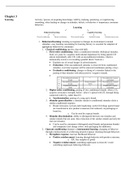
Learning Activity / process of acquiring knowledge / skill by studying, practicing, or experiencing
something, often leading to changes in attitudes, beliefs, or behavior (= importance consumer
behavior).
Learning
↙ ↘
Behavioral learning Cognitive learning
↙ ↘ ↙ ↓ ↘
Classical conditioning Operant conditioning Observational learning Incidental learning Information processing
1. Behavioral learning: learning as response to changes in environment (external
stimulus), easy learning (accounting for learning history) is essential for adaption of
appropriate behavior by consumers
1. Classical conditioning (pavlov, dog with bell).
1. First-order conditioning: when a conditioned stimulus (biological stimulus,
food, sex, pain etc.) acquires motivational importance by being paired (US
almost immediately after CS) with an unconditioned stimulus, which is
intrinsically aversive or rewarding (painful shock / food etc.)
• Explains use of sexual images in advertisements.
• Extinction: if the unconditioned stimulus is removed from conditioned
stimulus, over time response will be removed (continuous pairing = key).
• Evaluative conditioning: changes in liking of a stimulus linked to the
pairing of that stimulus with other positive / negative stimuli.
•
↑ Unconditioned stimulus → Unconditioned response
T (food) (salvation)
I Unconditioned stimulus + Neutral stimulus → Unconditioned response
M (food) (bell) (salvation)
E Conditioned stimulus → Conditioned response
↓ (bell) (salvation)
2. Higher-order conditioning: pairing of two conditioned stimuli: when a 𝐶𝑆1
acquires associative strength, before / after it’s paired with 𝑈𝑆, through being
connected with 𝐶𝑆2 , rather than 𝑈𝑆.
• Synchronization: pairing of a song and a brand.
3. Stimulus generalization: a stimulus similar to conditioned stimulus elicits a
similar conditioned response.
• Brand extensions / private-label marketing: useful if feelings parent brand
are transferred to new product extension (risk reduced) via packaging or
brand etc.
a. Can be used by copycat brands.
4. Stimulus discrimination: ability to distinguish between one stimulus and
similar stimuli (but not same, thus extinction of the similar stimuli and only the
real one remains).
• Can be used by consumers (distinguish retail-brands and premium brands)
and companies (not change colors, only packaging for additions).
2. Operant conditioning (skinner) = instrumental learning: changing of behavior
through reinforcement of a following desired response (learning through behavior).
1. Strengthen response: increase likelihood behavior:
• Positive reinforcement: learning through behavior with positive outcome.
a. EX: free samples (if good)
• Negative reinforcement: something unpleasant is removed / avoid
something unpleasant following behavior.
Learning Activity / process of acquiring knowledge / skill by studying, practicing, or experiencing
something, often leading to changes in attitudes, beliefs, or behavior (= importance consumer
behavior).
Learning
↙ ↘
Behavioral learning Cognitive learning
↙ ↘ ↙ ↓ ↘
Classical conditioning Operant conditioning Observational learning Incidental learning Information processing
1. Behavioral learning: learning as response to changes in environment (external
stimulus), easy learning (accounting for learning history) is essential for adaption of
appropriate behavior by consumers
1. Classical conditioning (pavlov, dog with bell).
1. First-order conditioning: when a conditioned stimulus (biological stimulus,
food, sex, pain etc.) acquires motivational importance by being paired (US
almost immediately after CS) with an unconditioned stimulus, which is
intrinsically aversive or rewarding (painful shock / food etc.)
• Explains use of sexual images in advertisements.
• Extinction: if the unconditioned stimulus is removed from conditioned
stimulus, over time response will be removed (continuous pairing = key).
• Evaluative conditioning: changes in liking of a stimulus linked to the
pairing of that stimulus with other positive / negative stimuli.
•
↑ Unconditioned stimulus → Unconditioned response
T (food) (salvation)
I Unconditioned stimulus + Neutral stimulus → Unconditioned response
M (food) (bell) (salvation)
E Conditioned stimulus → Conditioned response
↓ (bell) (salvation)
2. Higher-order conditioning: pairing of two conditioned stimuli: when a 𝐶𝑆1
acquires associative strength, before / after it’s paired with 𝑈𝑆, through being
connected with 𝐶𝑆2 , rather than 𝑈𝑆.
• Synchronization: pairing of a song and a brand.
3. Stimulus generalization: a stimulus similar to conditioned stimulus elicits a
similar conditioned response.
• Brand extensions / private-label marketing: useful if feelings parent brand
are transferred to new product extension (risk reduced) via packaging or
brand etc.
a. Can be used by copycat brands.
4. Stimulus discrimination: ability to distinguish between one stimulus and
similar stimuli (but not same, thus extinction of the similar stimuli and only the
real one remains).
• Can be used by consumers (distinguish retail-brands and premium brands)
and companies (not change colors, only packaging for additions).
2. Operant conditioning (skinner) = instrumental learning: changing of behavior
through reinforcement of a following desired response (learning through behavior).
1. Strengthen response: increase likelihood behavior:
• Positive reinforcement: learning through behavior with positive outcome.
a. EX: free samples (if good)
• Negative reinforcement: something unpleasant is removed / avoid
something unpleasant following behavior.