100% de satisfacción garantizada Inmediatamente disponible después del pago Tanto en línea como en PDF No estas atado a nada 4.2 TrustPilot
logo-home
Examen

CALT Alliance Exam Questions and Answers 2019,100% CORRECT

Puntuación
-
Vendido
-
Páginas
6
Grado
A+
Subido en
13-02-2023
Escrito en
2019/2020

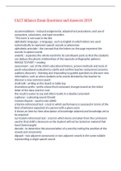
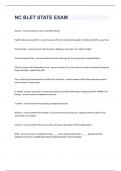
CALT Alliance Exam Questions and Answers 2019 accommodations - reduced assignments; adapted test procedures; and use of computers, calculators, and tape recorders *This term is not used in the IDA alphabetic language - a language , such as English in which letters are used systematically to represent speech sounds or phonemes alphabetic principle - the concept that the letters on the page represent the sounds in spoken words analytic - separates the whole word into its constituent parts so that the students can deduce the phonic relationships of the separate orthographic patterns WHOLE TO PART = reading assessment - use of the child's educational history, proven methods and tools of psych-educational evaluation to clarify and confirm teacher and parent concerns. auditory discovery - listening and responding to guided questions to discover new information, such as when students echo words dictated by the teacher to discover a new common sound chalk talk - writing on the board or table top chameleon prefix - prefix whose final consonant changes based on the initial letter of the base word or root the result is easier to say and often results in a double consonant euphony - a pleasing sound (Greek) Conners Report - used to rate ADHD criterion-referenced test - a test in which performance is assessed in terms of the kind of behavior expected of a person with a given score it shows an item-by-item description of knowledge attained and knowledge yet to be acquired curriculum-referenced test - a test in which items are taken from the curriculum used in that child's classroom so the student will not be tested on material that hasn't been taught decode - to determine the pronunciation of a word by noting the position of the vowels and consonants digraph - two adjacent consonants or two adjacent vowels in the same syllable representing a single speech sound diphthong - two adjacent vowels in the same syllable whose sounds blend together with a slide or shift during the production of the syllable directionality - the direction used in language for reading and writing English is governed by left to right directionality discovery learning - also called Socratic Method, is learning through guided questioning dyscalculia - math related disorder dysgraphia - trouble with small motor writing skills dyslexia - a specific language-based disorder of constitutional origin involving atypical phonological processing ability and correlated weaknesses; which are not the result of inadequate intellectual potential, instructional or environmental opportunity, motivation, sensory anomalies or other unrelated cause, and are manifested by variable difficulty with expressive and receptive language, often including a conspicuous problem with acquiring proficiency in reading, writing, and spelling echolalia - repeating sounds over and over, 6 to 12 months of age encoding - Spelling explicit, direct instruction - instruction that is systematic (structured), sequential, and cumulative instruction is organized and presented in a way that follows a logical sequential plan, fits the nature of language (alphabetic principle) with no assumption of prior skills of language knowledge, and maximizes student engagement expository writing - writing that explains or informs, including persuasive, descriptive, and compare/contrast compositions expressive language - spelling/writing FAPE (Free Appropriate Public Education) - ensures that students with disabilities receive necessary education and services without cost to the family Fernald Method - technique for learning words that involves the visual, auditory, kinesthetic, and tactile (VAKT) modalities the student looks at a word while saying and tracing it. fluency - the ability to read with speed, accuracy, and proper expression it is one of several critical factors necessary for reading comprehension grapheme - a written letter or letter cluster representing a single speech sound graphophonemic knowledge - an understanding of the letter-sound plan in which words that carry meaning are made of sounds, and sounds are written with letters in the right order students with this understanding can blend sounds associated with letters into words and can separate words into component sounds for spelling and writing guided discovery teaching - the manner presenting new material or concepts so they can be deduced or discovered by students hyperlexia - disability characterized by early precocious reading ability or a fascination with letters, words or numbers this is accompanied by limited comprehension, difficulty with verbal language, difficulties with social interaction and other autistic traits they are visual learners - understand what they see much better than what they hear IDEA (Individuals with Disabilities Education Act) - passed in 1975; requires public schools to provide special education and other services to qualified children from birth to age 21 IEP (Individualized Education Plan) - individual goals short-term objectives, and benchmarks for measuring each year individualized instruction - instruction that meets the specific learning needs of an individual student irregular word - a word that has a unexpected spelling either because its orthographic representation does not match it's pronunciation (colonel, Wednesday) or because it contains an infrequent orthographic representation of a sound (soap) linkages - the associations developed in language training between students' visual, auditory and kinesthetic and tactile perceptions by seeing the letter, naming it, saying its sound, and writing it in the air and on paper metacognitive strategies - strategies that students may use to think about what they are reading and the factors that influence their thinking morhpeme - the smallest unit of meaning (child in childhood) morphology - the study of word formation and patterns norm-referenced test - test that produces scores that permit comparisons between a student and other children the same age orthographic memory - memory of letter patterns and word spellings orthography - the writing system of language/refers to letter patterns in words Orton-Gillingham approach - instruction that is explicit, systematic, cumulative, direct, and sequential phoneme - the smallest unit of sound phonetics - the system of speech sounds in any specific language phonological awareness - the knowledge of and sensitivity to the phonological structure of words in language which involves the ability to notice, think about, or manipulate sound segments in words phonology - the science of speech sounds pragmatics - practical application of language conversation prosody - features of spoken language, such as intonation as tress that fluent readers use for appropriate phrasing of test into meaningful units rapid automatic naming - a speed naming task, most often administered to pre-readers, in which the individual is asked to name quickly a series of printed letters, numbers, objects, etc. retrieval from long-term memory receptive language - understanding language rime - the written or spoken vowel and the final consonant(s) in a syllable as (at) in cat schwa - an unaccented vowel whose pronunciation approximates the short /u/ semantics - the meaning of word and the relationships among words as they are used to represent knowledge of the world sibilant - a speech sound that is uttered with a hissing sound, /z/, /ch/, /j/, /sh/, /zh/ SOS (Simultaneous Oral Spelling) - a structured sequence of procedures to teach how to think about the process of spelling aka Save Our Spelling standardized test - a test with carefully selected sample of people representative of the larger group of people for whom the test was created; procedures and scoring are prescribed in the manual accompanying the test syntax - the way in which words may be ordered in phrases and sentences sentence structure; grammar synthetic - instruction or process that begins with the parts that build to whole (individual letter sounds that are blended together to form a word) spelling WOW (Watch Our Writing) - procedures to help students write accurately, comfortably, and legibly 4 Components of Language - 1. Phonology (sound units) 2. Semantics (meaning) 3. Syntax (sentence structure) 4. Pragmatics (rules for usage) expressive language disorder - difficulty with verbal expression, syntax, morphology, and semantics (uses gestures and sign language) syllable division - process that combines synthetic and analytic phonics metacognition - conscious choice of and evaluation of the strategies used to accomplish a task occipital-temporal region - area of the brain used for skilled reading vowel team syllable - a syllable with two adjacent vowels in initial, medial, or finial position coarticulation - the overlapping, changing, or modifying of adjacent speech sounds parito-temporal region - area of the brain used for step-by-step word analysis alexia - loss of ability to read because of a brain injury aphasia - language disorder that results from the damage to portions of the brain that are responsible for language impairs expression, understanding, reading, and writing invented spelling - the initial stage of spelling to which novice writers understand that a symbol stands for a unit or units of sound and attempts to represent the sound with the symbol in an unconventional manner auditory memory - the ability to listen and remember sounds, words, and sentences in sequence phonics - instruction that connects sound and letter, application of phonetics in an approach to teach reading and spelling; stressing symbol/sound relationship take off final consonant - is the best way to teach going from short vowel sounds to long vowel sounds bound morpheme - a morpheme which may not stand alone as an independent word as -ing synthetic phonics (inductive) - student learns sounds represented by letters, and blends; those sounds pronounce words-part to whole phonics, generalizations for symbol/sound correspondences, part to whole, bottom-up 1066 - the year the Norman Conquest (battle of Hastings) caused the French influence on the English language receptive language disorder - difficulty in the ability to attend to, process, comprehend, retain, or integrate spoken language lexicon - body of word knowledge double deficit - deficit in phonological awareness and rapid automatized naming blend - two or more letters that flow smoothly together left inferior frontal region - area of the brain used for articulation and slower word analysis short-term memory - the active part of the memory system with a distinctly limited time element of retention allophone - a variation of speech sound that is not a separate phoneme etymology - the study of word origins and historical development of words cognate - two consonant sounds having the same origin in the mouth but offering qualities such as voicedness analytic phonics (deductive) - whole to part phonics approach, key sight words, relevant phonic generalizations, symbol/sound correspondence, top-down modality - a specific sensory pathway dysphasia - partial or complete impairment of the ability to communicate resulting from a brain injury (speech disorder) equivocal - a letter may represent more than one sound or a sound may be spelled in more than one way (k, c, ck, ch) angular gyrus - area of the brain used for visual verbal associations visual memory - the ability to retain the visual image of a two dimensional symbol especially the sequence of symbols in who words, or the sequence of words in phrases or in sentences auditory processing - the mental activity of receiving, understanding, weighing, ordering, remembering, and examining sounds, especially speech sounds, and considering their meanings in relationship to past experience and their future use auditory discrimination - the ability to hear the likenesses and differences in the sounds of phonemes and words heterogeneous practice - including more than one level or focus of practice

Mostrar más Leer menos
Institución
Grado


Ups! No podemos cargar tu documento ahora. Inténtalo de nuevo o contacta con soporte.

Escuela, estudio y materia

Grado

Información del documento

Subido en
13 de febrero de 2023
Número de páginas
6
Escrito en
2019/2020
Tipo
Examen
Contiene
Preguntas y respuestas

Temas

Vista previa del contenido

CALT Alliance Exam Questions and Answers 2019

accommodations - reduced assignments; adapted test procedures; and use of
computers, calculators, and tape recorders
*This term is not used in the IDA
alphabetic language - a language , such as English in which letters are used
systematically to represent speech sounds or phonemes
alphabetic principle - the concept that the letters on the page represent the
sounds in spoken words
analytic - separates the whole word into its constituent parts so that the students
can deduce the phonic relationships of the separate orthographic patterns
WHOLE TO PART = reading
assessment - use of the child's educational history, proven methods and tools of
psych-educational evaluation to clarify and confirm teacher and parent concerns.
auditory discovery - listening and responding to guided questions to discover new
information, such as when students echo words dictated by the teacher to
discover a new common sound
chalk talk - writing on the board or table top
chameleon prefix - prefix whose final consonant changes based on the initial
letter of the base word or root
the result is easier to say and often results in a double consonant
euphony - a pleasing sound (Greek)
Conners Report - used to rate ADHD
criterion-referenced test - a test in which performance is assessed in terms of the
kind of behavior expected of a person with a given score
it shows an item-by-item description of knowledge attained and knowledge yet to
be acquired
curriculum-referenced test - a test in which items are taken from the curriculum
used in that child's classroom so the student will not be tested on material that
hasn't been taught
decode - to determine the pronunciation of a word by noting the position of the
vowels and consonants
digraph - two adjacent consonants or two adjacent vowels in the same syllable
representing a single speech sound

, diphthong - two adjacent vowels in the same syllable whose sounds blend
together with a slide or shift during the production of the syllable
directionality - the direction used in language for reading and writing
English is governed by left to right directionality
discovery learning - also called Socratic Method, is learning through guided
questioning
dyscalculia - math related disorder
dysgraphia - trouble with small motor writing skills
dyslexia - a specific language-based disorder of constitutional origin involving
atypical phonological processing ability and correlated weaknesses; which are not
the result of inadequate intellectual potential, instructional or environmental
opportunity, motivation, sensory anomalies or other unrelated cause, and are
manifested by variable difficulty with expressive and receptive language, often
including a conspicuous problem with acquiring proficiency in reading, writing,
and spelling
echolalia - repeating sounds over and over, 6 to 12 months of age
encoding - Spelling
explicit, direct instruction - instruction that is systematic (structured), sequential,
and cumulative
instruction is organized and presented in a way that follows a logical sequential
plan, fits the nature of language (alphabetic principle) with no assumption of prior
skills of language knowledge, and maximizes student engagement
expository writing - writing that explains or informs, including persuasive,
descriptive, and compare/contrast compositions
expressive language - spelling/writing
FAPE (Free Appropriate Public Education) - ensures that students with disabilities
receive necessary education and services without cost to the family
Fernald Method - technique for learning words that involves the visual, auditory,
kinesthetic, and tactile (VAKT) modalities
the student looks at a word while saying and tracing it.
fluency - the ability to read with speed, accuracy, and proper expression
it is one of several critical factors necessary for reading comprehension
grapheme - a written letter or letter cluster representing a single speech sound
graphophonemic knowledge - an understanding of the letter-sound plan in which
words that carry meaning are made of sounds, and sounds are written with letters
in the right order

$7.99
Accede al documento completo:

100% de satisfacción garantizada
Inmediatamente disponible después del pago
Tanto en línea como en PDF
No estas atado a nada


Documento también disponible en un lote

Conoce al vendedor

Seller avatar
Los indicadores de reputación están sujetos a la cantidad de artículos vendidos por una tarifa y las reseñas que ha recibido por esos documentos. Hay tres niveles: Bronce, Plata y Oro. Cuanto mayor reputación, más podrás confiar en la calidad del trabajo del vendedor.
ElonMusk Yale School Of Medicine
Seguir Necesitas iniciar sesión para seguir a otros usuarios o asignaturas
Vendido
186
Miembro desde
3 año
Número de seguidores
163
Documentos
1345
Última venta
4 semanas hace
chemistry

FOR THE BEST ASSIGNMENTS AND HOMEWORKS ,TO HELP AND TUTORING ALL KIND OF EXAMS I have done papers of various topics and complexities. I am punctual and always submit work on-deadline. I write engaging and informative content on all subjects. Send me your research papers, case studies, psychology papers, etc, and I’ll do them to the best of my abilities. Writing is my passion when it comes to academic work. I’ve got a good sense of structure and enjoy finding interesting ways to deliver information in any given paper. I love impressing clients with my work, and I am very punctual about deadlines. Send me your assignment and I’ll take it to the next level. I strive for my content to be of the highest quality. Your wishes come first— send me your requirements and I’ll make a piece of work with fresh ideas, consistent structure, and following the academic formatting rules. I'm an expert on major courses especially; All AQA, OCR, A & AS LEVELS AND GCSE, Chemistry, Psychology, Nursing, Mathematics. Human Resource Management. Quality work is my priority. I ensure scholarly standards in my documents. Use my work for GOOD GRADES. In requirement of case studies, test banks, exams and many other studies document our site helps in acquiring them all. If in need of any revision document you can go to the inbox and you will be attended to right away. SUCCESS and BEST OF LUCK.

Lee mas Leer menos
4.2

42 reseñas

5
27
4
7
3
3
2
1
1
4

Recientemente visto por ti

Por qué los estudiantes eligen Stuvia

Creado por compañeros estudiantes, verificado por reseñas

Calidad en la que puedes confiar: escrito por estudiantes que aprobaron y evaluado por otros que han usado estos resúmenes.

¿No estás satisfecho? Elige otro documento

¡No te preocupes! Puedes elegir directamente otro documento que se ajuste mejor a lo que buscas.

Paga como quieras, empieza a estudiar al instante

Sin suscripción, sin compromisos. Paga como estés acostumbrado con tarjeta de crédito y descarga tu documento PDF inmediatamente.

Student with book image

“Comprado, descargado y aprobado. Así de fácil puede ser.”

Alisha Student

Preguntas frecuentes