Unit 4
The fluid mosaic model
● The cell surface membrane creates an enclosed space separating the internal cell
environment from the external
● They also control the exchange of material across them
● They are partially permeable; and substances cross them by diffusion, osmosis and active
transport
● This model helps to explain the passive and active movements between cells and their
environment, cell-to-cell interactions and cell signalling
Phospholipids
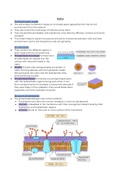
● They contain two different regions: a
polar head and two non-polar tails
● Phospholipid monolayer: formed when
phospholipids are spread over the
surface with the polar heads in the
water
● Micelle: formed when phospholipids are shaken in
water, forming spheres with the hydrophilic heads
falling towards the water and the hydrophobic fatty
acid tails facing inwards
● Phospholipid bilayer: formed by two phospholipid layers,
with the hydrophobic regions facing each other. It can
form compartments, for example, in lysosomes, because if
they were freely in the cytoplasm, they would break down
organelles with their hydrolytic enzymes
Structure of membranes
● The phospholipid bilayers also contain proteins
● The proteins can either be intrinsic (integral), or extrinsic (peripheral)
● Intrinsic: embedded in the membrane with their arrangement determined by their
hydrophilic and hydrophobic regions
● Extrinsic: found on the outer or inner surface of the membrane
, Components
● Phospholipids: form a bilayer, with the hydrophilic
regions pointing out. Individual phospholipid
molecules can move around within their own
monolayers by diffusion
● Cholesterol: also have hydrophilic heads, and fit
between phospholipid molecules
● Glycolipids: these are lipids with carbohydrate
chains, with these chains projecting into the fluid
surrounding the cell
● Glycoproteins: these are proteins with carbohydrate
chains attached, whose chains also project out into
the fluid surrounding the cell
● Proteins:
● When they are found embedded within the membrane, they are known as integral
● They span the entire membrane - transmembrane proteins
● They can also be found on the inner or outer surface - extrinsic/peripheral proteins
The cell surface membrane
1. Phospholipids
● Form the basic structure of the membrane (phospholipid bilayer)
● The tails form a hydrophobic core
● They act as a barrier to most water-soluble substances, and prevent polar molecules or
ions from passing across the membrane
● This ensures water-soluble molecules such as sugars, amino acids and proteins cannot
leak out of the cell, and unwanted water-soluble molecules cannot get in
● Can be chemically modified to act as signalling molecules by:
● Moving within the bilayer to activate other molecules (eg: enzymes)
● Being hydrolysed which releases smaller water-soluble molecules that bind to specific
receptors in the cytoplasm
2. Cholesterol
● Regulates the fluidity of the membrane
● They sit between the phospholipids, preventing them from packing too closely together
when temperatures are low; this prevents membranes from freezing and fracturing
● Interaction between cholesterol and phospholipid tails also stabilises the cell membrane
at higher temperatures by stopping the membrane from becoming too fluid
● Cholesterol molecules bind to the hydrophobic tails of phospholipids, stabilising them and
causing the phospholipids to pack more closely together
● Cholesterol also contributes to the impermeability of the membrane to ions and increases
mechanical strength of membranes; without it membranes would break down and cells
burst
The fluid mosaic model
● The cell surface membrane creates an enclosed space separating the internal cell
environment from the external
● They also control the exchange of material across them
● They are partially permeable; and substances cross them by diffusion, osmosis and active
transport
● This model helps to explain the passive and active movements between cells and their
environment, cell-to-cell interactions and cell signalling
Phospholipids
● They contain two different regions: a
polar head and two non-polar tails
● Phospholipid monolayer: formed when
phospholipids are spread over the
surface with the polar heads in the
water
● Micelle: formed when phospholipids are shaken in
water, forming spheres with the hydrophilic heads
falling towards the water and the hydrophobic fatty
acid tails facing inwards
● Phospholipid bilayer: formed by two phospholipid layers,
with the hydrophobic regions facing each other. It can
form compartments, for example, in lysosomes, because if
they were freely in the cytoplasm, they would break down
organelles with their hydrolytic enzymes
Structure of membranes
● The phospholipid bilayers also contain proteins
● The proteins can either be intrinsic (integral), or extrinsic (peripheral)
● Intrinsic: embedded in the membrane with their arrangement determined by their
hydrophilic and hydrophobic regions
● Extrinsic: found on the outer or inner surface of the membrane
, Components
● Phospholipids: form a bilayer, with the hydrophilic
regions pointing out. Individual phospholipid
molecules can move around within their own
monolayers by diffusion
● Cholesterol: also have hydrophilic heads, and fit
between phospholipid molecules
● Glycolipids: these are lipids with carbohydrate
chains, with these chains projecting into the fluid
surrounding the cell
● Glycoproteins: these are proteins with carbohydrate
chains attached, whose chains also project out into
the fluid surrounding the cell
● Proteins:
● When they are found embedded within the membrane, they are known as integral
● They span the entire membrane - transmembrane proteins
● They can also be found on the inner or outer surface - extrinsic/peripheral proteins
The cell surface membrane
1. Phospholipids
● Form the basic structure of the membrane (phospholipid bilayer)
● The tails form a hydrophobic core
● They act as a barrier to most water-soluble substances, and prevent polar molecules or
ions from passing across the membrane
● This ensures water-soluble molecules such as sugars, amino acids and proteins cannot
leak out of the cell, and unwanted water-soluble molecules cannot get in
● Can be chemically modified to act as signalling molecules by:
● Moving within the bilayer to activate other molecules (eg: enzymes)
● Being hydrolysed which releases smaller water-soluble molecules that bind to specific
receptors in the cytoplasm
2. Cholesterol
● Regulates the fluidity of the membrane
● They sit between the phospholipids, preventing them from packing too closely together
when temperatures are low; this prevents membranes from freezing and fracturing
● Interaction between cholesterol and phospholipid tails also stabilises the cell membrane
at higher temperatures by stopping the membrane from becoming too fluid
● Cholesterol molecules bind to the hydrophobic tails of phospholipids, stabilising them and
causing the phospholipids to pack more closely together
● Cholesterol also contributes to the impermeability of the membrane to ions and increases
mechanical strength of membranes; without it membranes would break down and cells
burst