Unit 2
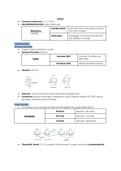
● Common elements: C, O , N & H
● MACROMOLECULES: large molecules
Condensation Joining of two molecules with the
Reactions removal of water
Cx(H2O)y
Hydrolysis Breakage of chemical bonds with
the addition of water
Carbohydrates
Monosaccharides
● Sugars that are soluble in water
● General formula: (CH2O)n
Hexoses (6C) Glucose, fructose and
Types galactose
Pentoses (5C) Ribose and deoxyribose
● Hexose: C6H12O6
● Isomers: two forms of the same chemical (α & β glucose)
● Functions: source of energy in respiration; and is used to make ATP, ADP, starch,
glycogen, cellulose, RNA and DNA
Disaccharides
● Formed by two monosaccharides joined together by a glycosidic bond
Maltose glucose + glucose
Examples Sucrose glucose + sucrose
Lactose glucose + galactose
● Glycosidic bond: C-O-C covalent link between 2 sugar molecules (condensation)
, Polysaccharides
● Polymers made by the joining of many monosaccharides by condensation and
glycosidic bonds
1. Glycogen: storage polysaccharide in animals and fungi
● Highly branched, uncoiled (similar to amylopectin but more branched to be
able to store more of it)
● Liver & muscles: granules; respiration due to mobility
● Branching: more free ends for glucose to condense & hydrolyse faster to
suit demand
● Less dense & + soluble than starch: broken down faster
2. Cellulose: most abundant organic molecule (usually in plants)
● Β- glucose joined by 1-4 β-glycosidic bonds
● Strengthening material in cell walls
● Mechanically strong; unlike starch and glycogen
Its strength is due to the arrangement of the β-glucose, as it results in a strong molecule
because the H atoms of -OH groups are weakly attracted to O atoms in the same
cellulose ring; and also to the O atoms in the neighbouring molecules
These H bonds are individually weak but because there are so many, they create huge
strength; becoming tightly cross-linked by H bonds to form bundles called microfibrils,
which are held together by H bundles called fibrils.
3. Starch: storage polysaccharide in plants (granules in plastids)
Amylose (10-30%) Amylopectin (70-90%)
Unbranched helix Branched
α-glucose α-glucose
1-4 glycosidic bonds 1-4 & 1-6 glycosidic bonds
More compact & resistant to digestion Branches: many terminal glucose that
can be hydrolysed for: storage &
respiration
Starch
Feature Amylose Amylopectin Glycogen
Monomer α-glucose α-glucose α-glucose
Branched? No Yes; (every 20) Yes; (every 10)
Helical? Yes No No
Glycosidic bond 1-4 1-4 & 1-6 1-4 & 1-6
Source Plants Plants Animals
● Common elements: C, O , N & H
● MACROMOLECULES: large molecules
Condensation Joining of two molecules with the
Reactions removal of water
Cx(H2O)y
Hydrolysis Breakage of chemical bonds with
the addition of water
Carbohydrates
Monosaccharides
● Sugars that are soluble in water
● General formula: (CH2O)n
Hexoses (6C) Glucose, fructose and
Types galactose
Pentoses (5C) Ribose and deoxyribose
● Hexose: C6H12O6
● Isomers: two forms of the same chemical (α & β glucose)
● Functions: source of energy in respiration; and is used to make ATP, ADP, starch,
glycogen, cellulose, RNA and DNA
Disaccharides
● Formed by two monosaccharides joined together by a glycosidic bond
Maltose glucose + glucose
Examples Sucrose glucose + sucrose
Lactose glucose + galactose
● Glycosidic bond: C-O-C covalent link between 2 sugar molecules (condensation)
, Polysaccharides
● Polymers made by the joining of many monosaccharides by condensation and
glycosidic bonds
1. Glycogen: storage polysaccharide in animals and fungi
● Highly branched, uncoiled (similar to amylopectin but more branched to be
able to store more of it)
● Liver & muscles: granules; respiration due to mobility
● Branching: more free ends for glucose to condense & hydrolyse faster to
suit demand
● Less dense & + soluble than starch: broken down faster
2. Cellulose: most abundant organic molecule (usually in plants)
● Β- glucose joined by 1-4 β-glycosidic bonds
● Strengthening material in cell walls
● Mechanically strong; unlike starch and glycogen
Its strength is due to the arrangement of the β-glucose, as it results in a strong molecule
because the H atoms of -OH groups are weakly attracted to O atoms in the same
cellulose ring; and also to the O atoms in the neighbouring molecules
These H bonds are individually weak but because there are so many, they create huge
strength; becoming tightly cross-linked by H bonds to form bundles called microfibrils,
which are held together by H bundles called fibrils.
3. Starch: storage polysaccharide in plants (granules in plastids)
Amylose (10-30%) Amylopectin (70-90%)
Unbranched helix Branched
α-glucose α-glucose
1-4 glycosidic bonds 1-4 & 1-6 glycosidic bonds
More compact & resistant to digestion Branches: many terminal glucose that
can be hydrolysed for: storage &
respiration
Starch
Feature Amylose Amylopectin Glycogen
Monomer α-glucose α-glucose α-glucose
Branched? No Yes; (every 20) Yes; (every 10)
Helical? Yes No No
Glycosidic bond 1-4 1-4 & 1-6 1-4 & 1-6
Source Plants Plants Animals